Lords and peasants — history review game (French curriculum, 5e)

5e — French national curriculum (ages 12–13)

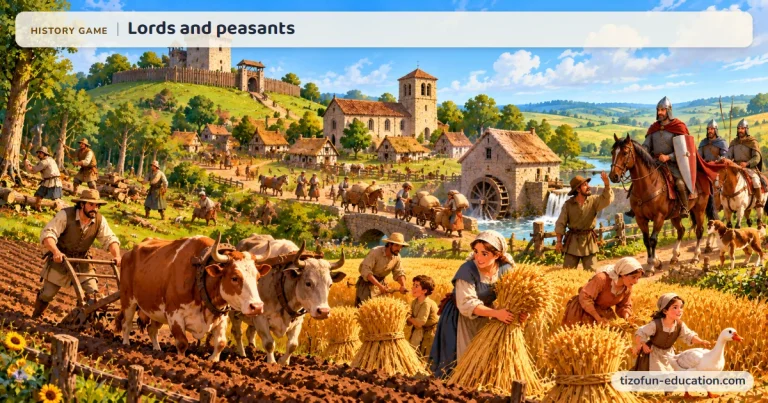
History game “Lords and peasants”: A stone castle overlooks a village where peasants plow, harvest, and carry their grain to the lord’s mill.

History review game on the lesson “Lords and peasants” from the French curriculum for 5e (ages 12–13). Every answer is checked and explained.

Loading the game…

Teaching documentation of the game “History, French curriculum 5e — Lords and peasants”

About this game

Review the lesson “Lords and peasants” from the French history curriculum for 5e (ages 12–13). Its questions are about the lordship and the lord’s power (castle, ban, banalities, cens, labor service, taille), free peasants and serfs, the growth of the countryside (land clearing, the plow, the water mill, a population that doubles), and the ties between lords: vassal, suzerain, fief, homage, and knight.

Review the lesson “Lords and peasants”

This review game covers a single lesson of the French history curriculum for 5e: “Lords and peasants”, from the unit “Society, the Church, and political power in the feudal West (11th-15th centuries).” Its questions are about the lordship and the lord’s power (castle, ban, banalities, cens, labor service, taille), free peasants and serfs, the growth of the countryside (land clearing, the plow, the water mill, a population that doubles), and the ties between lords: vassal, suzerain, fief, homage, and knight.

Each round has 10 questions drawn at random from the lesson: multiple choice, true or false, fill in the blanks and matching. After each answer, an explanation recalls what to remember. Hints are free, and you can go back.

The game follows the French national curriculum: 5e is the second year of middle school in France, for students aged 12 to 13. Elsewhere, it works as general knowledge for curious learners of that age. Play it again and you get other questions: it is good practice right after the lesson or before a test.
Tip for a successful review

Always ask yourself which bond the question is about: the one that links the master of an estate to the people who live there, or the one that links a noble to a more powerful noble. A serf is not free, but he is not a slave. And the countryside does not stand still: its improvements add up. If you get it wrong, read the explanation carefully: it tells you what to remember.