Europe discovers the world — history review game (French curriculum, 5e)

5e — French national curriculum (ages 12–13)

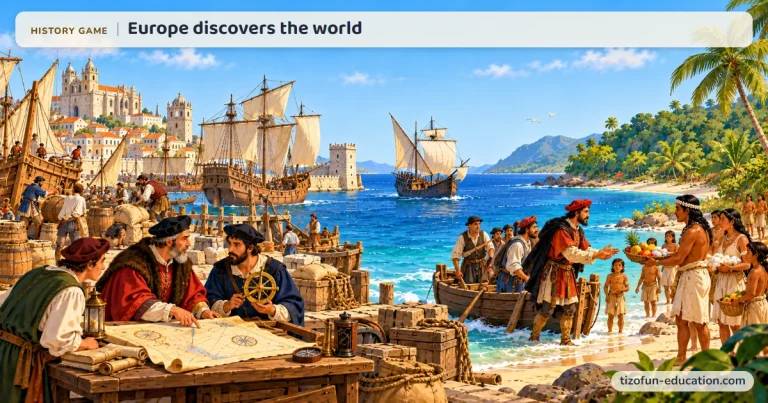
History game “Europe discovers the world”: On a Caribbean beach, European sailors landing from caravels meet Taíno people who offer them fruit; on the quay of a European port, scholars study a map.

History review game on the lesson “Europe discovers the world” from the French curriculum for 5e (ages 12–13). Every answer is checked and explained.

Loading the game…

Teaching documentation of the game “History, French curriculum 5e — Europe discovers the world”

About this game

Review the lesson “Europe discovers the world” from the French history curriculum for 5e (ages 12–13). Its questions are about the great voyages of discovery: the spice route, Henry the Navigator and the coast of Africa, the caravel, the compass, and the astrolabe, Christopher Columbus and his first voyage, the Treaty of Tordesillas, Vasco da Gama and India, Jacques Cartier, the first voyage around the world by Magellan’s expedition, the Native American peoples, the conquest of the Aztec and Inca empires, the exploitation of the conquered lands, and the first globalization.

Review the lesson “Europe discovers the world”

This review game covers a single lesson of the French history curriculum for 5e: “Europe discovers the world”, from the unit “Transformations of Europe and opening to the world in the 16th and 17th centuries.” Its questions are about the great voyages of discovery: the spice route, Henry the Navigator and the coast of Africa, the caravel, the compass, and the astrolabe, Christopher Columbus and his first voyage, the Treaty of Tordesillas, Vasco da Gama and India, Jacques Cartier, the first voyage around the world by Magellan’s expedition, the Native American peoples, the conquest of the Aztec and Inca empires, the exploitation of the conquered lands, and the first globalization.

Each round has 10 questions drawn at random from the lesson: multiple choice, true or false, fill in the blanks, matching and timelines. After each answer, an explanation recalls what to remember. Hints are free, and you can go back.

The game follows the French national curriculum: 5e is the second year of middle school in France, for students aged 12 to 13. Elsewhere, it works as general knowledge for curious learners of that age. Play it again and you get other questions: it is good practice right after the lesson or before a test.
Tip for a successful review

Put the voyages in order: Columbus sails west, the world is divided at Tordesillas, Vasco da Gama sails east, and the first voyage around the world returns. Do not mix up exploring and conquering, or Cortés (the Aztecs) and Pizarro (the Incas). And remember that America was not empty: it was new only to Europeans. If you get it wrong, read the explanation carefully: it tells you what to remember.