Humanism and the Renaissance — history review game (French curriculum, 5e)

5e — French national curriculum (ages 12–13)

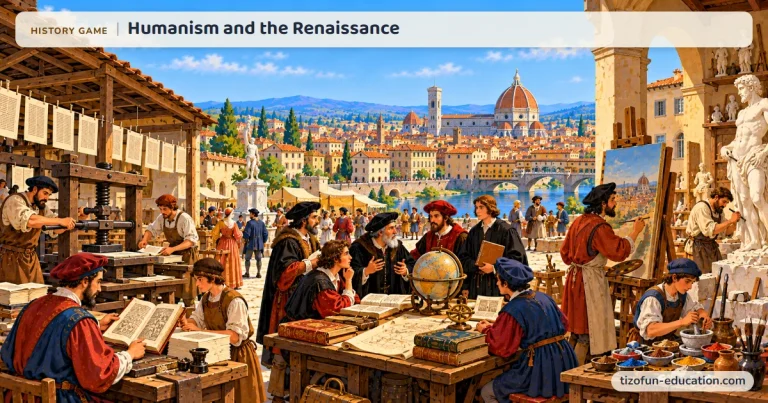
History game “Humanism and the Renaissance”: In Florence, printers work a screw press, humanists talk around a globe and books, and a painter works at his canvas, below the dome of the cathedral.

History review game on the lesson “Humanism and the Renaissance” from the French curriculum for 5e (ages 12–13). Every answer is checked and explained.

Loading the game…

Teaching documentation of the game “History, French curriculum 5e — Humanism and the Renaissance”

About this game

Review the lesson “Humanism and the Renaissance” from the French history curriculum for 5e (ages 12–13). Its questions are about humanism and the Renaissance: the humanists and the texts of Antiquity, the return to the sources, the Republic of Letters, Thomas More, Rabelais, and Montaigne, Gutenberg and printing with movable type around 1450, the printer’s workshop, the manuscript and the printed book, Copernicus, the “middle time,” Florence and the cities of Italy, the Medici and patrons of the arts, Michelangelo, Raphael, and Dürer, perspective, and the spread of the Renaissance across Europe.

Review the lesson “Humanism and the Renaissance”

This review game covers a single lesson of the French history curriculum for 5e: “Humanism and the Renaissance”, from the unit “Transformations of Europe and opening to the world in the 16th and 17th centuries.” Its questions are about humanism and the Renaissance: the humanists and the texts of Antiquity, the return to the sources, the Republic of Letters, Thomas More, Rabelais, and Montaigne, Gutenberg and printing with movable type around 1450, the printer’s workshop, the manuscript and the printed book, Copernicus, the “middle time,” Florence and the cities of Italy, the Medici and patrons of the arts, Michelangelo, Raphael, and Dürer, perspective, and the spread of the Renaissance across Europe.

Each round has 10 questions drawn at random from the lesson: multiple choice, true or false, fill in the blanks and matching. After each answer, an explanation recalls what to remember. Hints are free, and you can go back.

The game follows the French national curriculum: 5e is the second year of middle school in France, for students aged 12 to 13. Elsewhere, it works as general knowledge for curious learners of that age. Play it again and you get other questions: it is good practice right after the lesson or before a test.
Tip for a successful review

Do not mix up the three: humanism is a movement of ideas, printing is a technique, and the Renaissance is a renewal of the arts, but all three are linked. Gutenberg develops printing in Europe, he does not invent it for the whole world; Copernicus puts forward an idea, he does not prove it. And the Renaissance begins in Italy. If you get it wrong, read the explanation carefully: it tells you what to remember.