Soldiers and Civilians in the Great War — history review game (French curriculum, 3e)

3e — French national curriculum (ages 14–15)

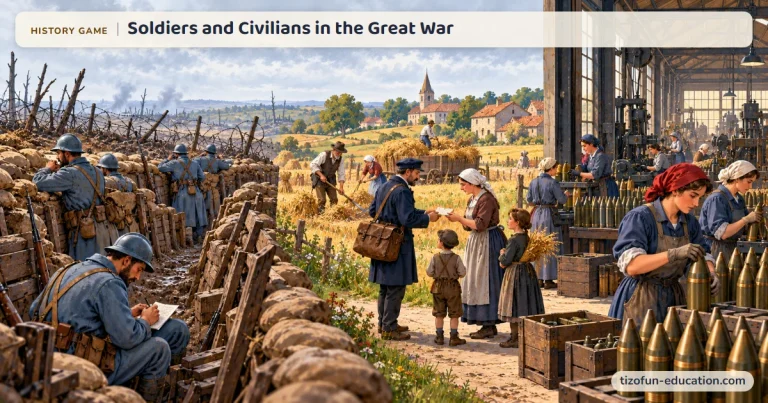
History game “Soldiers and Civilians in the Great War”: On one side, French soldiers in horizon-blue uniforms wait in a trench; on the other, women make shells in a factory and bring in the harvest, while a mail carrier delivers a letter.

History review game on the lesson “Soldiers and Civilians in the Great War” from the French curriculum for 3e (ages 14–15). Every answer is checked and explained.

Loading the game…

Teaching documentation of the game “History, French curriculum 3e — Soldiers and Civilians in the Great War”

About this game

Review the lesson “Soldiers and Civilians in the Great War” from the French history curriculum for 3e (ages 14–15). Its questions are about the First World War: a Western Front and an Eastern Front; a war that spreads to the colonies, the Middle East, and as far as the United States; Verdun, a battle of attrition; the life of the soldiers in the trenches, a war of position; the home front mobilized through arms factories, war loans, censorship, and propaganda; women replacing men in the fields and factories; and a war that gradually throws all of a country’s strength into the fight, soldiers and civilians alike.

Review the lesson “Soldiers and Civilians in the Great War”

This review game covers a single lesson of the French history curriculum for 3e: “Soldiers and Civilians in the Great War”, from the unit “Europe, a major theater of total wars (1914-1945).” Its questions are about the First World War: a Western Front and an Eastern Front; a war that spreads to the colonies, the Middle East, and as far as the United States; Verdun, a battle of attrition; the life of the soldiers in the trenches, a war of position; the home front mobilized through arms factories, war loans, censorship, and propaganda; women replacing men in the fields and factories; and a war that gradually throws all of a country’s strength into the fight, soldiers and civilians alike.

Each round has 10 questions drawn at random from the lesson: multiple choice, matching and short answers. After each answer, an explanation recalls what to remember. Hints are free, and you can go back.

The game follows the French national curriculum: 3e is the fourth and last year of middle school in France, for students aged 14 to 15. Elsewhere, it works as general knowledge for curious learners of that age. Play it again and you get other questions: it is good practice right after the lesson or before a test.

Tip for a successful review

To put events in order, ask yourself, for each one, what had to have happened already to make it possible. When two words look alike, ask yourself what each one is for and whom it concerns: the soldiers at the front, or the civilians on the home front. In front of a poster or a newspaper from the time, ask yourself who had it published and what it expects from the French. If you get it wrong, read the explanation carefully: it tells you what to remember.