1st Grade Adding 3 Worksheet: Three More in Fifteen Vertical Sums
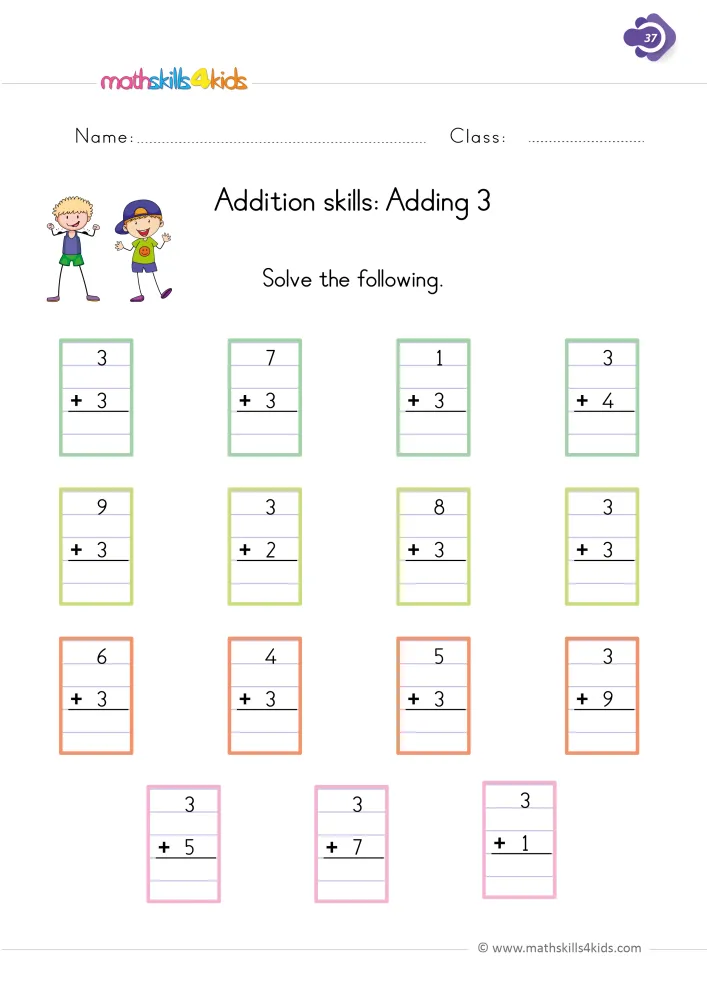
Watch a six-year-old add 3, and you often see three fingers pop up, one at a time, while the lips count quietly. This 1st grade adding 3 worksheet gives that habit fifteen chances to grow steady. Each colored box holds one sum of vertical addition with a 3 in it, sometimes on top, as in 3 + 9, and sometimes below, as in 8 + 3. The totals run from 4 to 12. So a few sums stay small, while others cross ten. Between them sits 7 + 3, a sum that lands exactly on ten and helps with the harder ones. A second page gives the answer key.
Why three is a turning point
Adding 1 or 2 can be done almost by feel. With 3, most children need a way to keep track, and three fingers do the job: one finger per number said after the start.
This page also hides a strategy. In the top row, 7 + 3 makes exactly 10. Once your child knows that, 8 + 3 becomes one more than ten, and 9 + 3 is two more. That idea, using ten as a stepping stone, is called "make ten." It carries a lot of later arithmetic.
Finally, 3 + 3 shows up as a double. Many children already know it as "three and three." It is a fact worth keeping. Short facts like this one free the mind for the next step.
At the table: crossing ten with 9 + 3
Start with 1 + 3 in the top row. Ask your child to say the bigger number, then lift three fingers while counting on.
The likely slip comes at 9 + 3, at the start of the second row. Ten feels like an end point, so a child may stop there and write 10. Instead of correcting, ask, "How many fingers did you lift?"
If only two fingers are up, your child will see it. Let them try again, slowly. A second trap waits at 3 + 9 in the third row, where counting on nine from three is long. Tap the 9 together. Then ask your child to start from it.
Also, once 7 + 3 is finished, point back to it whenever 8 + 3 feels hard: "What did 7 + 3 make?"
Three grapes more, three squares ahead
At snack time, put a few grapes on a plate, add three more, and ask for the total before anyone counts the whole plate. While you wait for the bus or at a red light, choose a number and add three out loud together.
Board games help as well. In Chutes and Ladders, the spinner says how many squares to move, so a spin of three from square 8 is exactly 8 + 3. Let your child count the jumps with a finger on the board.
Once you finish the page, check it with the answer key together. Then name the effort, not the score: "You kept counting past ten without stopping."
About this 1st grade adding 3 worksheet, its 15 sums and answer key
Download the worksheet: 1st Grade Adding 3 Worksheet: Three More in Fifteen Vertical Sums
 Worksheet3rd Grade Addition and Subtraction Problems: 3 Stories
 Worksheet3rd Grade Addition Properties Worksheet: Commutative, Associative, Identity
 Worksheet3rd Grade Count Coins and Bills Worksheet: 8 Money Totals
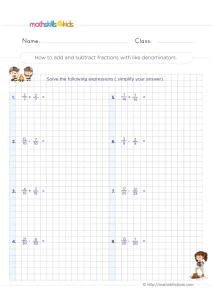 Worksheet3rd Grade Adding and Subtracting Like Fractions Worksheet: Eight Sums
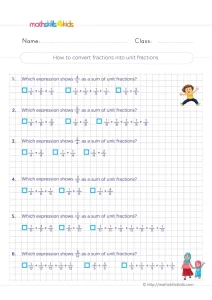 Worksheet3rd Grade Writing Fractions as Unit Fraction Sums Worksheet: Tick One
A few related activities
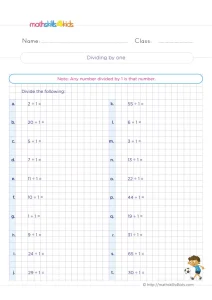 Twenty division facts by 1, from 1 ÷ 1 to 65 ÷ 1. One rule solves them all:…See the activity3rd Grade Area with Length and Width Worksheet
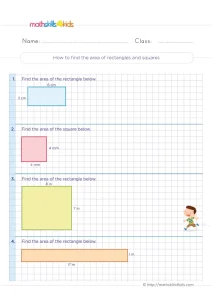 Three rectangles and one square, each with its side lengths. Your child multiplies length by width to find…See the activity3rd Grade Multiplication Worksheet: Find Products Using Properties
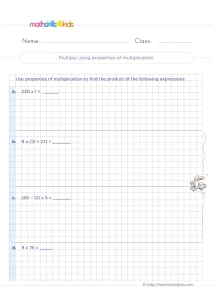 Work out four products, from 230 x 1 to 9 x 75, with the identity, distributive and commutative…See the activity
