2nd Grade Missing Number Subtraction Worksheet: Fill the Box up to 3 Digits
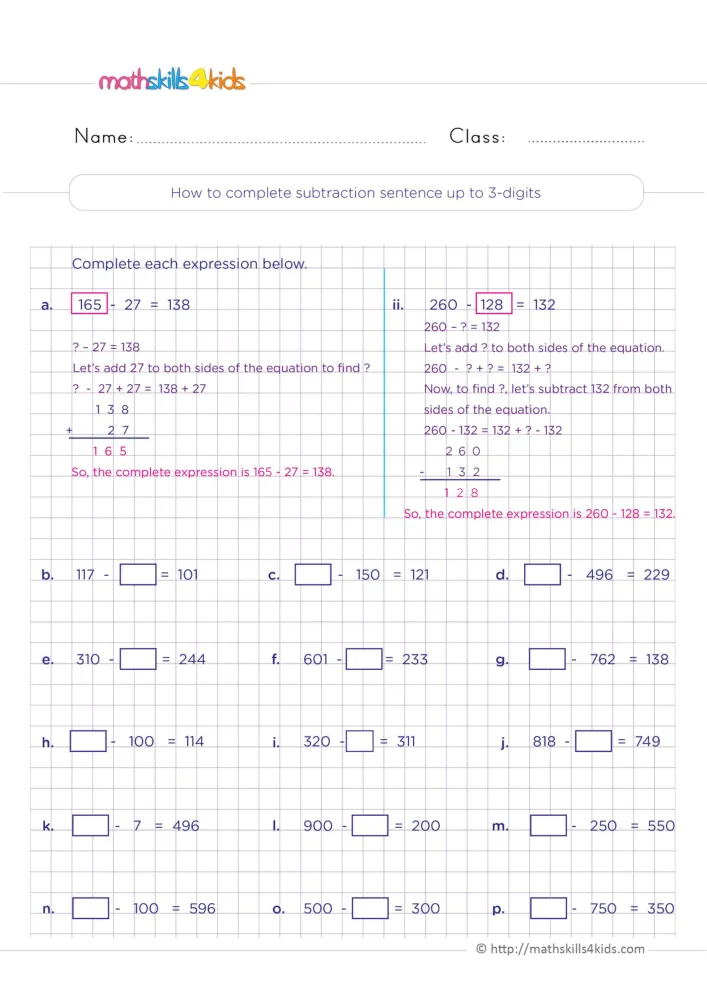
Show a seven-year-old a box in the middle of a subtraction, like 310 − □ = 244, and you may get a long silence. The box looks like a mistake on the page, not a question. This 2nd grade missing number subtraction worksheet turns that box into a puzzle with a method. At the top, two worked examples walk through 165 − 27 = 138 and 260 − 128 = 132, showing how adding helps undo a subtraction. Below, fifteen sentences from b to p hide one number each, sometimes at the start and sometimes in the middle. Most are 3-digit numbers, with friendly ones like 900 − □ = 200 mixed in. A second page gives the answer key.
Why the box moves around
Most early practice puts the answer at the end of a subtraction sentence. Here the empty box can sit in front, as in □ − 762 = 138, or after the minus sign, as in 601 − □ = 233. However, each position asks for a different kind of thinking.
When the first number is missing, your child is really asking, "What did I start with?" The two smaller numbers add up to it. When the middle number is missing, the question becomes, "How much was taken away?"
This link between adding and subtracting has a name: inverse operations. It is one of the most useful ideas in second grade, because every subtraction can then be checked with an addition. The worked examples at the top model exactly that.
At the table: start with the friendly ones
Let your child warm up on item l, 900 − □ = 200, or item o, 500 − □ = 300. As a result, your child can solve them in the head with hundreds only.
Then move to item k, □ − 7 = 496. A common slip is to subtract again and write 489. Instead of correcting, ask, "If you take 7 away from your number, do you get 496?" Let them try it.
For item i, 320 − □ = 311, some children subtract 311 from 320 in a column when a quick count up works. Ask, "How far is it from 311 to 320?" Then counting on with fingers is fine.
Finally, once a box holds a number, read the whole sentence aloud. That habit catches most errors.
After the page: hide a number at home
Hidden numbers turn up in everyday moments. Count the crackers in a bowl, let your child eat some, then count what remains and ask how many they ate. Also, hide a few coins under your hand and say, "I had 50 cents, now you see 35. How many are hiding?"
Moreover, a card game makes it stick. Play Memory with pairs of cards: one card shows a subtraction with a box, the other shows the missing number. Your child flips two cards and checks whether they match.
When you look at the answer key together, praise the checking: "You read every sentence back to make sure." That is the real skill here.
About this 2nd grade missing number subtraction worksheet and its key
Download the worksheet: 2nd Grade Missing Number Subtraction Worksheet: Fill the Box up to 3 Digits
 Worksheet3rd Grade Addition and Subtraction Problems: 3 Stories
 Worksheet3rd Grade Addition Properties Worksheet: Commutative, Associative, Identity
 Worksheet3rd Grade Count Coins and Bills Worksheet: 8 Money Totals
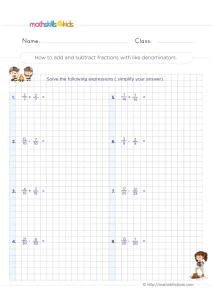 Worksheet3rd Grade Adding and Subtracting Like Fractions Worksheet: Eight Sums
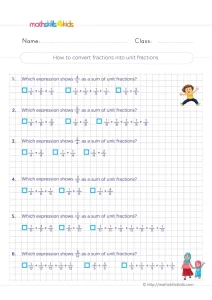 Worksheet3rd Grade Writing Fractions as Unit Fraction Sums Worksheet: Tick One
A few related activities
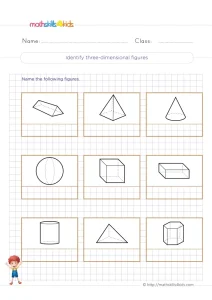 Nine drawn solids to name, from a cube and a cone to a hexagonal prism and a triangular…See the activity3rd Grade Count Edges of 3D Shapes Worksheet: Faces and Vertices Too
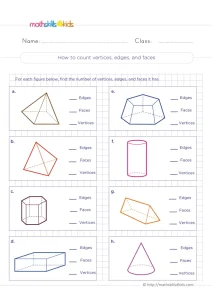 Eight drawn solids, from a square pyramid to a hexagonal prism and a cone. Count the edges, faces…See the activity3rd Grade Multiplication Worksheet: Find Products Using Properties
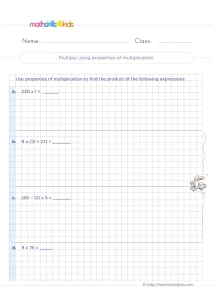 Work out four products, from 230 x 1 to 9 x 75, with the identity, distributive and commutative…See the activity
