2nd Grade Count Square Units Worksheet: Which Shapes Have This Area?
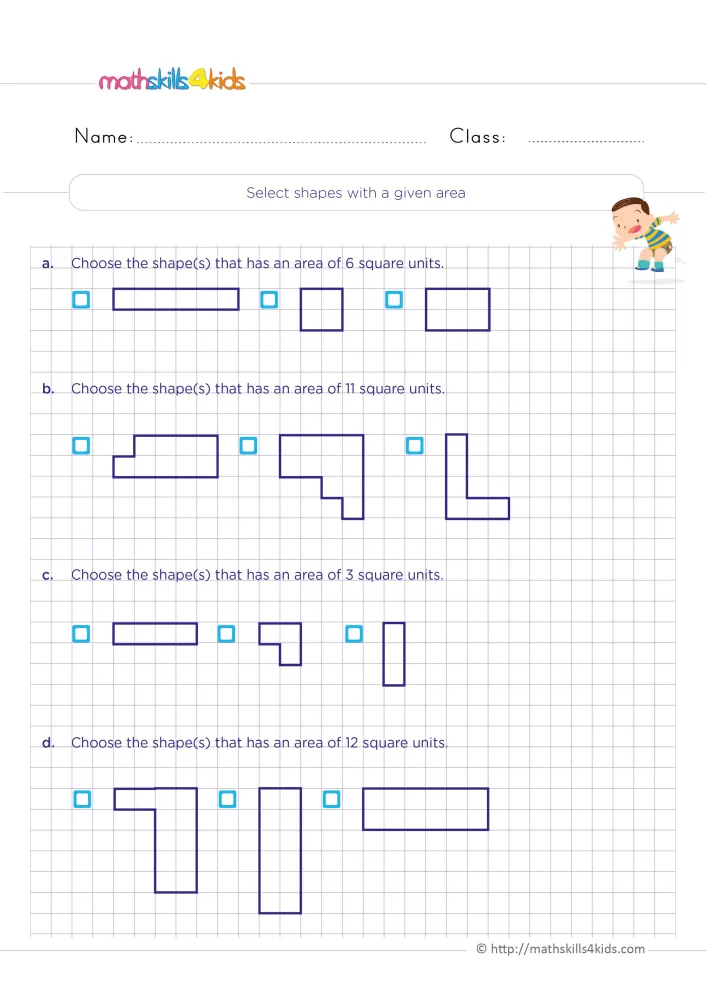
Cover a tabletop with sticky notes and ask a seven-year-old how many it took, and they have just measured an area. This 2nd grade count square units worksheet uses that same idea on a grid. Four rows each ask one question, such as "Choose the shape(s) that have an area of 11 square units." Then, below it, sit three shapes outlined on the grid paper: long strips, small squares, rectangles and L shapes. Your child counts the squares inside each one and ticks every shape that matches. Some rows have one answer, others two or even three. A second page gives the answer key, with every square numbered.
Why area starts with counting squares
Area is how much surface a shape covers. Before any formula, children need to see it as a number of equal squares. Counting those squares is the most honest way to start, and the grid on this page does the cutting for them.
Also, the rows are cleverly built. For example, in the row asking for 6, the long strip and the small rectangle both cover six squares, while the square covers only four. So two very different looks share the same area. In the last row, all three shapes have 12 squares.
That surprise is the lesson: shape and area are not the same thing. Counting square units reveals it.
At the table: the L shapes in row b
Start with row a. Ask your child to count the squares inside the long strip, touching each one. Most will reach six without trouble.
However, row b is harder. The shapes have steps and corners, so squares get counted twice or skipped. Instead of correcting, suggest a pencil dot in each square as it is counted. Then ask, "Did every square get exactly one dot?"
In row c, the long strip looks small, yet it holds four squares, not three. A child may tick it on looks alone. Ask, "Count it again, slowly."
Finally, the last row tempts children to stop after one tick. Remind them that the question allows more than one shape.
Covering surfaces at home
Area becomes real when you cover something, so start at the table. Lay square crackers on a plate, sticky notes on a book or tiles of a puzzle on a tray, and count how many fit. Also, draw shapes on a grid of graph paper and ask your child to make two different shapes with the same count.
The picture book "Spaghetti and Meatballs for All!" by Marilyn Burns follows a family dinner where square tables keep getting pushed around. While you read it, line up square napkins or coasters on the floor to copy each table plan.
When you check the page, praise the method: "You dotted every square before you counted." That careful counting is the base of every later area lesson.
About this 2nd grade count square units worksheet and its answer key
Download the worksheet: 2nd Grade Count Square Units Worksheet: Which Shapes Have This Area?
 Worksheet3rd Grade Area with Length and Width Worksheet
 Worksheet3rd Grade Area of Rectangles in Real Life Worksheet: 3 Word Problems
 Worksheet3rd Grade Area of Shaded Parts Worksheet: Subtract the Gaps
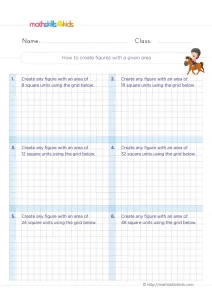 Worksheet3rd Grade Draw Shapes with a Given Area Worksheet: Six Grids
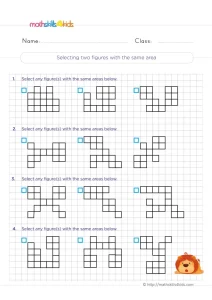 Worksheet3rd Grade Figures with the Same Area Worksheet: Count the Squares
A few related activities
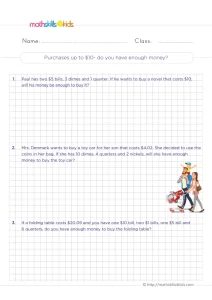 Three shopping stories with bills and coins. Children count the money, compare it with the price and decide…See the activity3rd Grade Count Coins and Bills Worksheet: 8 Money Totals
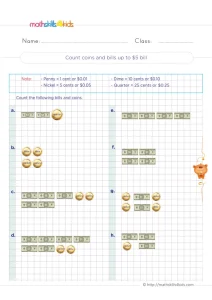 Eight sets of $1 and $5 bills with pennies, nickels, dimes and quarters. Children find each total in…See the activity3rd Grade Change and Total Cost Worksheet: Money Word Problems
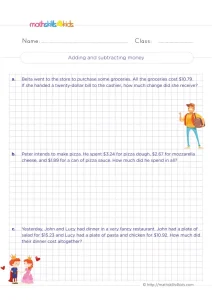 Three money word problems about groceries, a pizza and a dinner out. Children find the change from a…See the activity
