French democracy in the 1930s — history review game (French curriculum, 3e)

3e — French national curriculum (ages 14–15)

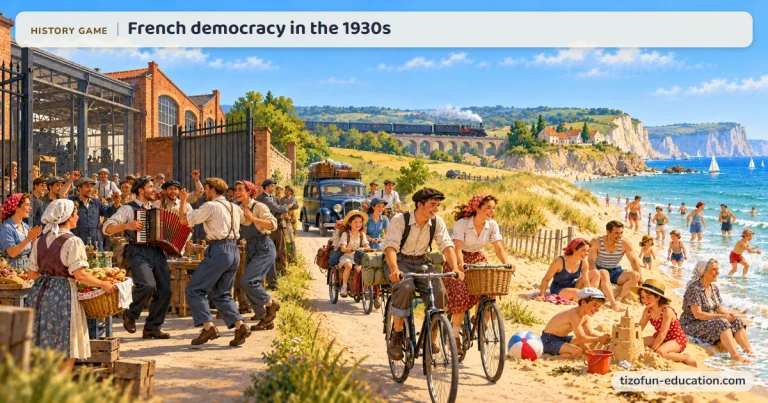
History game “French democracy in the 1930s”: In the summer of 1936, workers celebrate in front of their occupied factory, then head to the beach by bicycle and train for their first paid vacation.

History review game on the lesson “French democracy in the 1930s” from the French curriculum for 3e (ages 14–15). Every answer is checked and explained.

Loading the game…

Teaching documentation of the game “History, French curriculum 3e — French democracy in the 1930s”

About this game

Review the lesson “French democracy in the 1930s” from the French history curriculum for 3e (ages 14–15). Its questions are about French democracy facing the crisis between the two world wars: the crisis that comes from the United States brings unemployment, and the deflation policy makes people angrier; a demonstration by far-right leagues and veterans turns into a riot, and the left sees it as a threat to the Republic; the Socialists, the Radicals, and the Communists unite in the Popular Front, which wins the legislative elections; the Socialist Léon Blum becomes President of the Council; the great strikes with factory occupations; the agreements signed by the employers and the CGT, then the laws passed by Parliament: two weeks of paid vacation, the 40-hour week, collective agreements; and a democracy that holds, facing Hitler’s Germany and Stalin’s USSR.

Review the lesson “French democracy in the 1930s”

This review game covers a single lesson of the French history curriculum for 3e: “French democracy in the 1930s”, from the unit “Europe, a major theater of total wars (1914-1945).” Its questions are about French democracy facing the crisis between the two world wars: the crisis that comes from the United States brings unemployment, and the deflation policy makes people angrier; a demonstration by far-right leagues and veterans turns into a riot, and the left sees it as a threat to the Republic; the Socialists, the Radicals, and the Communists unite in the Popular Front, which wins the legislative elections; the Socialist Léon Blum becomes President of the Council; the great strikes with factory occupations; the agreements signed by the employers and the CGT, then the laws passed by Parliament: two weeks of paid vacation, the 40-hour week, collective agreements; and a democracy that holds, facing Hitler’s Germany and Stalin’s USSR.

Each round has 10 questions drawn at random from the lesson: multiple choice, matching and short answers. After each answer, an explanation recalls what to remember. Hints are free, and you can go back.

The game follows the French national curriculum: 3e is the fourth and last year of middle school in France, for students aged 14 to 15. Elsewhere, it works as general knowledge for curious learners of that age. Play it again and you get other questions: it is good practice right after the lesson or before a test.

Tip for a successful review

To put events in order, ask yourself, for each one, what had to have happened already to make it possible. To tell apart two texts that change workers’ lives, ask yourself what each one is for and who decides on it. And to find out whether a country is still a democracy, ask yourself how its leaders came to power. If you get it wrong, read the explanation carefully: it tells you what to remember.