Mass Violence and the End of the War — history review game (French curriculum, 3e)

3e — French national curriculum (ages 14–15)

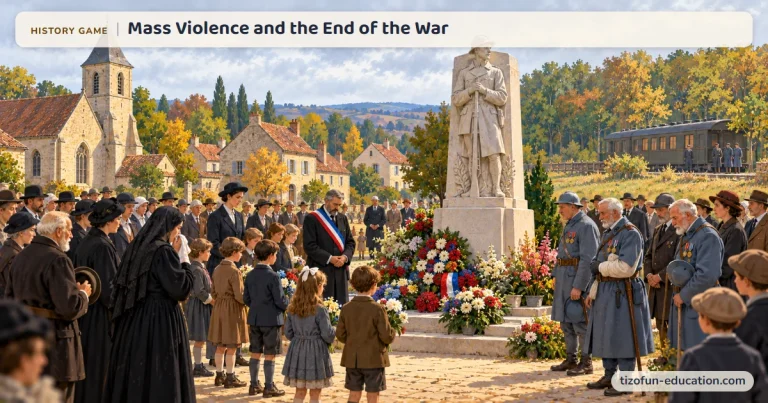
History game “Mass Violence and the End of the War”: In a French village, widows in black, children, and veterans pay their respects at the flower-covered war memorial, around the mayor wearing his tricolor sash.

History review game on the lesson “Mass Violence and the End of the War” from the French curriculum for 3e (ages 14–15). Every answer is checked and explained.

Loading the game…

Teaching documentation of the game “History, French curriculum 3e — Mass Violence and the End of the War”

About this game

Review the lesson “Mass Violence and the End of the War” from the French history curriculum for 3e (ages 14–15). Its questions are about the Armenians, victims of the Ottoman state in the middle of the war: the arrests in Constantinople, the massacres and the deportations to the deserts of Syria and Mesopotamia, and what sets this crime apart from just another massacre; then the end of the war: the armistice signed at Rethondes, the Treaty of Versailles, which holds Germany responsible for the war, imposes reparations on it, disarms it, and takes territory from it, and the League of Nations, created to keep the peace.

Review the lesson “Mass Violence and the End of the War”

This review game covers a single lesson of the French history curriculum for 3e: “Mass Violence and the End of the War”, from the unit “Europe, a major theater of total wars (1914-1945).” Its questions are about the Armenians, victims of the Ottoman state in the middle of the war: the arrests in Constantinople, the massacres and the deportations to the deserts of Syria and Mesopotamia, and what sets this crime apart from just another massacre; then the end of the war: the armistice signed at Rethondes, the Treaty of Versailles, which holds Germany responsible for the war, imposes reparations on it, disarms it, and takes territory from it, and the League of Nations, created to keep the peace.

Each round has 10 questions drawn at random from the lesson: multiple choice, matching, short answers and timelines. After each answer, an explanation recalls what to remember. Hints are free, and you can go back.

The game follows the French national curriculum: 3e is the fourth and last year of middle school in France, for students aged 14 to 15. Elsewhere, it works as general knowledge for curious learners of that age. Play it again and you get other questions: it is good practice right after the lesson or before a test.

Tip for a successful review

Do not mix up the two parts of the lesson: what the Armenians suffer happens during the war; the end of the war comes afterward. To tell apart two texts that end a war, ask yourself what each one is for and which one has to come first. And to name a crime, ask yourself who decided on it and whom it targets. If you get it wrong, read the explanation carefully: it tells you what to remember.