The genocides of the Jews and the Roma — history review game (French curriculum, 3e)

3e — French national curriculum (ages 14–15)

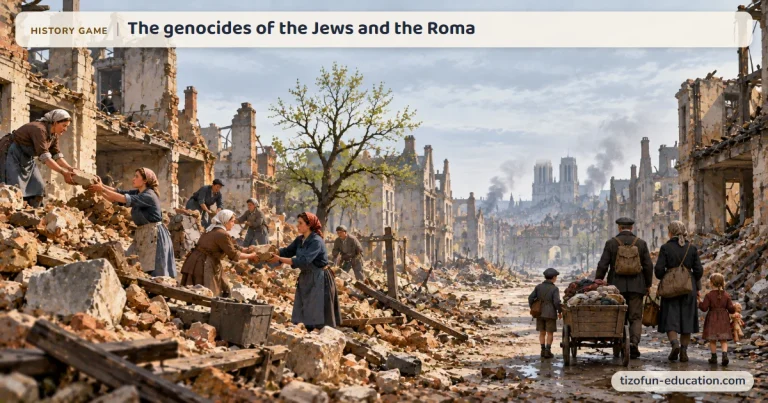
History game “The genocides of the Jews and the Roma”: A European city in ruins after the Second World War: women clear the rubble and families pass by with a cart.

History review game on the lesson “The genocides of the Jews and the Roma” from the French curriculum for 3e (ages 14–15). Every answer is checked and explained.

Loading the game…

Teaching documentation of the game “History, French curriculum 3e — The genocides of the Jews and the Roma”

About this game

Review the lesson “The genocides of the Jews and the Roma” from the French history curriculum for 3e (ages 14–15). Its questions are about the genocides of the Jews and the Roma, committed by Nazi Germany and its collaborators during the Second World War: what sets a genocide apart from other mass crimes; persecution and the antisemitic laws; the ghettos; after the invasion of the USSR, the mass shootings behind the Eastern Front; the Wannsee Conference; the killing centers, not to be confused with concentration camps; the deportations by train; the other groups the Nazis persecute; what sources such as diaries, convoy lists, or Nazi documents tell us; and what makes this genocide a state project.

Review the lesson “The genocides of the Jews and the Roma”

This review game covers a single lesson of the French history curriculum for 3e: “The genocides of the Jews and the Roma”, from the unit “Europe, a major theater of total wars (1914-1945).” Its questions are about the genocides of the Jews and the Roma, committed by Nazi Germany and its collaborators during the Second World War: what sets a genocide apart from other mass crimes; persecution and the antisemitic laws; the ghettos; after the invasion of the USSR, the mass shootings behind the Eastern Front; the Wannsee Conference; the killing centers, not to be confused with concentration camps; the deportations by train; the other groups the Nazis persecute; what sources such as diaries, convoy lists, or Nazi documents tell us; and what makes this genocide a state project.

Each round has 10 questions drawn at random from the lesson: multiple choice, matching, short answers and timelines. After each answer, an explanation recalls what to remember. Hints are free, and you can go back.

The game follows the French national curriculum: 3e is the fourth and last year of middle school in France, for students aged 14 to 15. Elsewhere, it works as general knowledge for curious learners of that age. Play it again and you get other questions: it is good practice right after the lesson or before a test.

Tip for a successful review

To put the stages in order, ask yourself, for each one, what had to exist already for it to be possible. Careful: a meeting that organizes a crime is not always where it begins; ask yourself what was already happening before it. And do not mix up a concentration camp and a killing center: for each place, ask yourself what the Nazis built it for. If you get it wrong, read the explanation carefully: it tells you what to remember.