Baghdad and learning in the Muslim world — history review game (French curriculum, 5e)

5e — French national curriculum (ages 12–13)

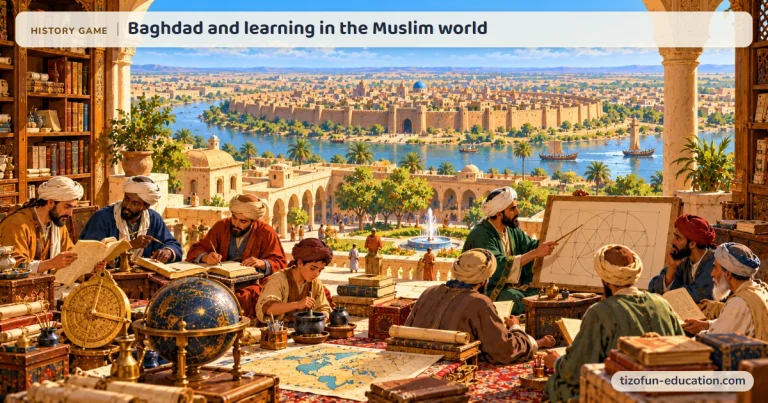
History game “Baghdad and learning in the Muslim world”: On the terrace of a library in Baghdad, above the Tigris River, scholars translate books among an astrolabe, a celestial globe, and a map.

History review game on the lesson “Baghdad and learning in the Muslim world” from the French curriculum for 5e (ages 12–13). Every answer is checked and explained.

Loading the game…

Teaching documentation of the game “History, French curriculum 5e — Baghdad and learning in the Muslim world”

About this game

Review the lesson “Baghdad and learning in the Muslim world” from the French history curriculum for 5e (ages 12–13). Its questions are about Baghdad, the capital of the Abbasid caliphs, its founding, its scholars who translate and add to Greek, Persian, and Indian knowledge, and its capture by invaders from Asia.

Review the lesson “Baghdad and learning in the Muslim world”

This review game covers a single lesson of the French history curriculum for 5e: “Baghdad and learning in the Muslim world”, from the unit “Christendom and Islam (6th-13th centuries): worlds in contact.” Its questions are about Baghdad, the capital of the Abbasid caliphs, its founding, its scholars who translate and add to Greek, Persian, and Indian knowledge, and its capture by invaders from Asia.

Each round has 10 questions drawn at random from the lesson: multiple choice, true or false, fill in the blanks and matching. After each answer, an explanation recalls what to remember. Hints are free, and you can go back.

The game follows the French national curriculum: 5e is the second year of middle school in France, for students aged 12 to 13. Elsewhere, it works as general knowledge for curious learners of that age. Play it again and you get other questions: it is good practice right after the lesson or before a test.
Tip for a successful review

Think of the city’s history in three stages: its founding, its golden age around the translators, and its fall. For each scholar, ask yourself what knowledge he passes on or invents. If you get it wrong, read the explanation carefully: it tells you what to remember.