Christendom and Islam: contacts and conflicts — history review game (French curriculum, 5e)

5e — French national curriculum (ages 12–13)

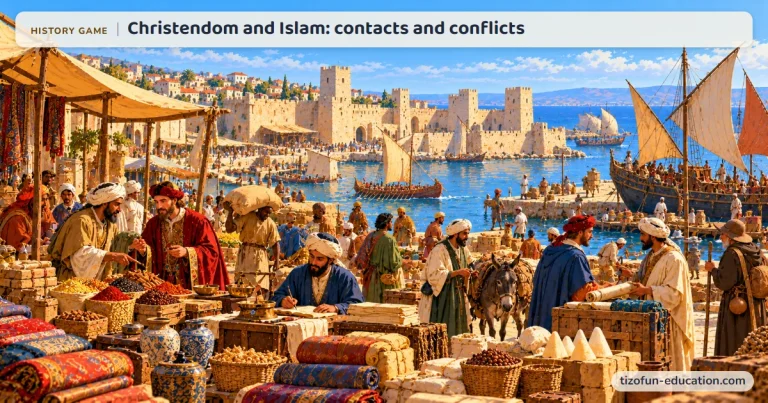
History game “Christendom and Islam: contacts and conflicts”: In the port of Acre, Venetian and Arab merchants trade spices, silk, sugar loaves, and paper in front of the harbor walls and galleys.

History review game on the lesson “Christendom and Islam: contacts and conflicts” from the French curriculum for 5e (ages 12–13). Every answer is checked and explained.

Loading the game…

Teaching documentation of the game “History, French curriculum 5e — Christendom and Islam: contacts and conflicts”

About this game

Review the lesson “Christendom and Islam: contacts and conflicts” from the French history curriculum for 5e (ages 12–13). Its questions are about the contacts between the Christian West, the Christian East, and the Muslim worlds: the crusades and the Holy City, taken and then retaken, the sack of a great Christian capital by crusaders, but also truces and treaties, trade in the Mediterranean, and translations from Arabic into Latin.

Review the lesson “Christendom and Islam: contacts and conflicts”

This review game covers a single lesson of the French history curriculum for 5e: “Christendom and Islam: contacts and conflicts”, from the unit “Christendom and Islam (6th-13th centuries): worlds in contact.” Its questions are about the contacts between the Christian West, the Christian East, and the Muslim worlds: the crusades and the Holy City, taken and then retaken, the sack of a great Christian capital by crusaders, but also truces and treaties, trade in the Mediterranean, and translations from Arabic into Latin.

Each round has 10 questions drawn at random from the lesson: multiple choice, true or false, fill in the blanks, matching and timelines. After each answer, an explanation recalls what to remember. Hints are free, and you can go back.

The game follows the French national curriculum: 5e is the second year of middle school in France, for students aged 12 to 13. Elsewhere, it works as general knowledge for curious learners of that age. Play it again and you get other questions: it is good practice right after the lesson or before a test.
Tip for a successful review

Place the great moments on a timeline, from the call to crusade to the looting of a Christian capital by crusaders. Do not mix up a break between Church leaders and a war between armies. And for each question, ask yourself whether it is about a war or an exchange: both happen at the same time. If you get it wrong, read the explanation carefully: it tells you what to remember.