The Church at the heart of medieval society — history review game (French curriculum, 5e)

5e — French national curriculum (ages 12–13)

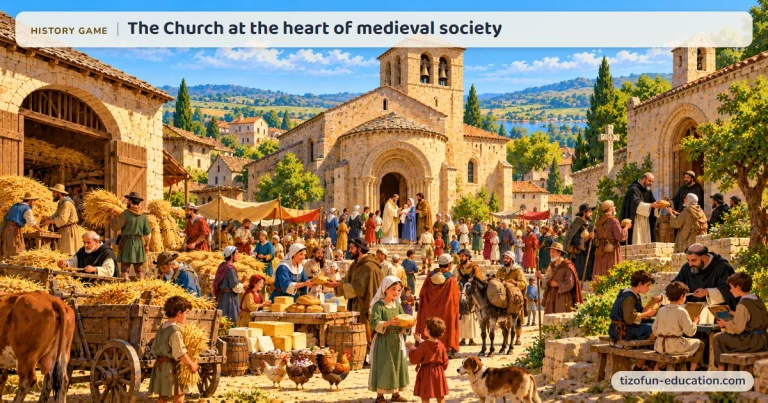
History game “The Church at the heart of medieval society”: In front of a Romanesque church, a family brings a baby to be baptized; peasants bring the tithe and monks give bread to the poor.

History review game on the lesson “The Church at the heart of medieval society” from the French curriculum for 5e (ages 12–13). Every answer is checked and explained.

Loading the game…

Teaching documentation of the game “History, French curriculum 5e — The Church at the heart of medieval society”

About this game

Review the lesson “The Church at the heart of medieval society” from the French history curriculum for 5e (ages 12–13). Its questions are about the clergy (priests, bishops, monks), the parish and the sacraments, the tithe, the Church as a great landowner and lord, monasteries that reform themselves (Cluny, Cîteaux, the mendicant orders), the Peace of God, manuscripts copied by monks, and the three orders: those who pray, those who fight, and those who work.

Review the lesson “The Church at the heart of medieval society”

This review game covers a single lesson of the French history curriculum for 5e: “The Church at the heart of medieval society”, from the unit “Society, the Church, and political power in the feudal West (11th-15th centuries).” Its questions are about the clergy (priests, bishops, monks), the parish and the sacraments, the tithe, the Church as a great landowner and lord, monasteries that reform themselves (Cluny, Cîteaux, the mendicant orders), the Peace of God, manuscripts copied by monks, and the three orders: those who pray, those who fight, and those who work.

Each round has 10 questions drawn at random from the lesson: multiple choice, true or false, fill in the blanks and matching. After each answer, an explanation recalls what to remember. Hints are free, and you can go back.

The game follows the French national curriculum: 5e is the second year of middle school in France, for students aged 12 to 13. Elsewhere, it works as general knowledge for curious learners of that age. Play it again and you get other questions: it is good practice right after the lesson or before a test.
Tip for a successful review

First ask yourself who the question is about: the priest lives among the people of his parish, the monk follows a rule in his monastery, and a higher-ranking churchman leads a whole diocese. The tithe goes to the Church, not to the lord. And the three orders are an ideal society seen by clerics, not an exact description. If you get it wrong, read the explanation carefully: it tells you what to remember.