The growth of towns — history review game (French curriculum, 5e)

5e — French national curriculum (ages 12–13)

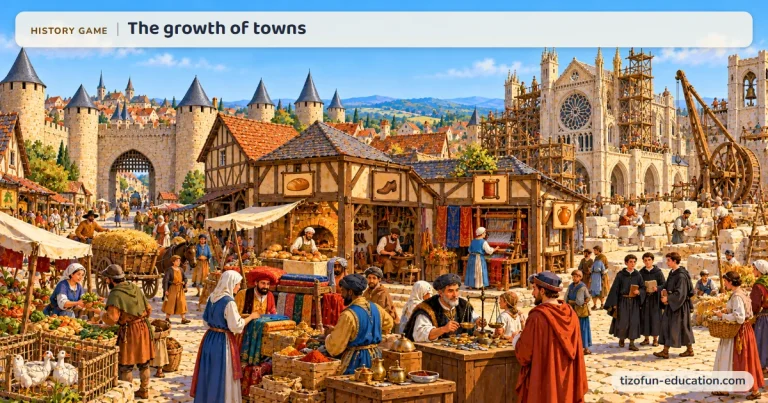
History game “The growth of towns”: In the square of a walled medieval town, craftsmen and merchants run their shops with painted signs at the foot of a Gothic cathedral under construction, with its treadwheel crane.

History review game on the lesson “The growth of towns” from the French curriculum for 5e (ages 12–13). Every answer is checked and explained.

Loading the game…

Teaching documentation of the game “History, French curriculum 5e — The growth of towns”

About this game

Review the lesson “The growth of towns” from the French history curriculum for 5e (ages 12–13). Its questions are about towns that grow in the 12th and 13th centuries, their walls and suburbs, merchants, craftsmen and their guilds, markets and the Champagne fairs, charters of liberties, communes and burghers, Gothic cathedrals such as Notre-Dame de Paris, and the first universities.

Review the lesson “The growth of towns”

This review game covers a single lesson of the French history curriculum for 5e: “The growth of towns”, from the unit “Society, the Church, and political power in the feudal West (11th-15th centuries).” Its questions are about towns that grow in the 12th and 13th centuries, their walls and suburbs, merchants, craftsmen and their guilds, markets and the Champagne fairs, charters of liberties, communes and burghers, Gothic cathedrals such as Notre-Dame de Paris, and the first universities.

Each round has 10 questions drawn at random from the lesson: multiple choice, fill in the blanks and matching. After each answer, an explanation recalls what to remember. Hints are free, and you can go back.

The game follows the French national curriculum: 5e is the second year of middle school in France, for students aged 12 to 13. Elsewhere, it works as general knowledge for curious learners of that age. Play it again and you get other questions: it is good practice right after the lesson or before a test.
Tip for a successful review

Ask yourself who does what in the town: the merchant buys and resells, the craftsman makes things, and the burgher has rights that not everyone has. Do not mix up the weekly market with a fair, which draws traders from far away. And these rights of the cities are most often negotiated with the lord. If you get it wrong, read the explanation carefully: it tells you what to remember.