The Reformations and the Wars of Religion — history review game (French curriculum, 5e)

5e — French national curriculum (ages 12–13)

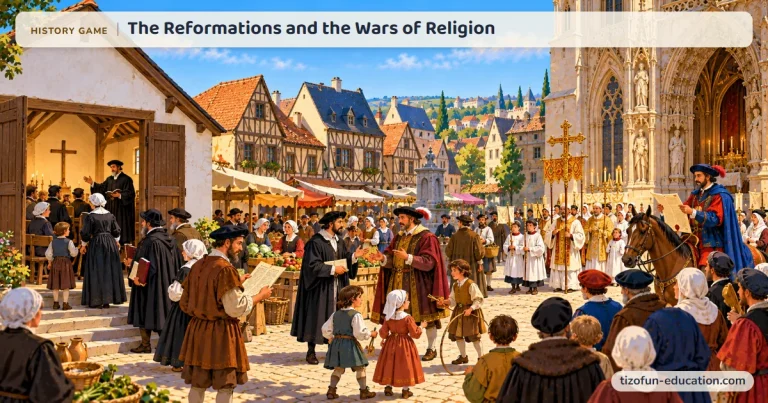
History game “The Reformations and the Wars of Religion”: In the square of a 16th-century town, Protestants leave a plain church and Catholics walk in procession before a richly decorated church, while a herald on horseback reads out a peace edict.

History review game on the lesson “The Reformations and the Wars of Religion” from the French curriculum for 5e (ages 12–13). Every answer is checked and explained.

Loading the game…

Teaching documentation of the game “History, French curriculum 5e — The Reformations and the Wars of Religion”

About this game

Review the lesson “The Reformations and the Wars of Religion” from the French history curriculum for 5e (ages 12–13). Its questions are about the reformations and the Wars of Religion: Luther and his 95 theses, the sale of indulgences, the Diet of Worms, printing that quickly spreads his writings, Calvin, Geneva, and the French Protestants, the Lutheran, Reformed, and Anglican Churches, the breaking of the unity of Western Christendom, Erasmus and reform without a break, the Council of Trent and the Jesuits, the Wassy massacre, the great noble families, the Saint Bartholomew’s Day Massacre, violence on both sides, Henry IV, and the Edict of Nantes.

Review the lesson “The Reformations and the Wars of Religion”

This review game covers a single lesson of the French history curriculum for 5e: “The Reformations and the Wars of Religion”, from the unit “Transformations of Europe and opening to the world in the 16th and 17th centuries.” Its questions are about the reformations and the Wars of Religion: Luther and his 95 theses, the sale of indulgences, the Diet of Worms, printing that quickly spreads his writings, Calvin, Geneva, and the French Protestants, the Lutheran, Reformed, and Anglican Churches, the breaking of the unity of Western Christendom, Erasmus and reform without a break, the Council of Trent and the Jesuits, the Wassy massacre, the great noble families, the Saint Bartholomew’s Day Massacre, violence on both sides, Henry IV, and the Edict of Nantes.

Each round has 10 questions drawn at random from the lesson: multiple choice, true or false, fill in the blanks, matching and timelines. After each answer, an explanation recalls what to remember. Hints are free, and you can go back.

The game follows the French national curriculum: 5e is the second year of middle school in France, for students aged 12 to 13. Elsewhere, it works as general knowledge for curious learners of that age. Play it again and you get other questions: it is good practice right after the lesson or before a test.

Tip for a successful review

Place the great moments on a timeline: Luther’s theses, the opening of the Council of Trent, the start of the wars, the Saint Bartholomew’s Day Massacre, and the Edict of Nantes. Do not mix up the Protestant Reformation, which breaks with the pope, and the Catholic Reformation, which changes without breaking away. And remember that the Edict of Nantes is not the religious freedom of today: Catholicism remains the religion of the kingdom. If you get it wrong, read the explanation carefully: it tells you what to remember.