French curriculum 6e history — review game: the Roman Empire in the ancient world

6e — French national curriculum (ages 11–12)

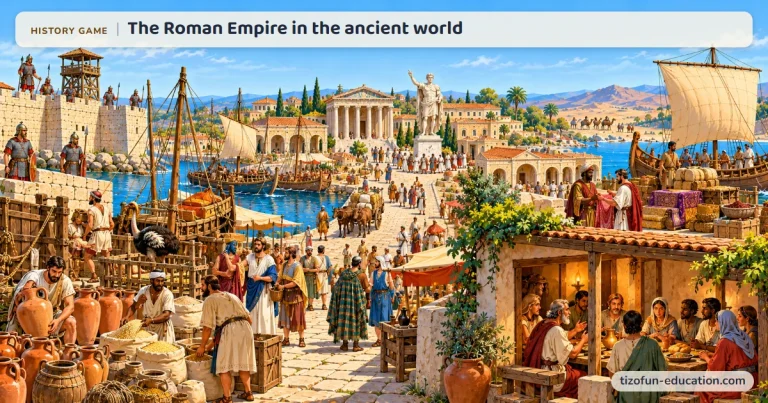
History game “The Roman Empire in the ancient world”: In the port of Ostia, legionaries in chain mail guard a fort, merchants from across the Empire unload amphorae and grain, the emperor’s statue towers over the forum, Christians share bread in a house, and a Parthian merchant hands silk to a Roman.

History review game, French curriculum 6e: the Roman Empire in the ancient world. Every answer is checked and explained.

Loading the game…

Teaching documentation of the game “History, French curriculum 6e — The Roman Empire in the ancient world”

About this game

Review the unit of the French history curriculum for 6e (ages 11–12), “The Roman Empire in the ancient world,” with the questions from its lessons: “The Roman conquests”, “The Roman Empire and the Roman peace”, “Romanization”, “Christians in the Roman Empire” and “Rome and the other ancient worlds”.

Review a unit of the French 6e history curriculum

This review game covers a unit of the French history curriculum for 6e: “The Roman Empire in the ancient world.” Its questions come from the 5 lessons of the unit already online: “The Roman conquests”, “The Roman Empire and the Roman peace”, “Romanization”, “Christians in the Roman Empire” and “Rome and the other ancient worlds”.

Each round has 10 questions drawn at random: multiple choice, true or false, fill in the blanks, matching and timelines. After each answer, an explanation recalls what to remember. Hints are free, and you can go back.

The game follows the French national curriculum: 6e is the first year of middle school in France, for students aged 11 to 12. Elsewhere, it works as general knowledge for curious learners of that age. Play it again and you get other questions: it is good practice before a test.
Tip for a successful review

Before you answer, first spot what the question is about: war and conquest, the emperor’s power, the life of the peoples who became Roman, the place of Christians, or the Empire’s ties with faraway lands. For a timeline, remember that “BC” years count backward: the bigger the number, the older the event; after the birth of Jesus, it is the reverse. In front of a monument or an object, ask yourself what it was used for and who used it. When a question quotes an ancient writer, ask yourself which side that writer was on. And for a “True or false,” read every word: a single wrong detail is enough to make the sentence false. If you get it wrong, read the explanation carefully: it tells you what to remember.