Romanization — history review game (French curriculum, 6e)

6e — French national curriculum (ages 11–12)

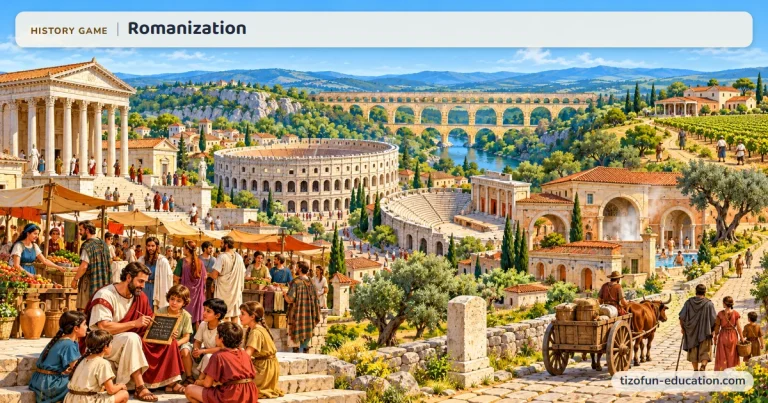
History game “Romanization”: In a Roman town in Gaul, a teacher shows a tablet to children near the forum and its temple, where Gauls in checked cloaks and Romans in togas mingle; in the distance, an oval amphitheater, a semicircular theater, an arched aqueduct, and public baths.

History review game on the lesson “Romanization” from the French curriculum for 6e (ages 11–12). Every answer is checked and explained.

Loading the game…

Teaching documentation of the game “History, French curriculum 6e — Romanization”

About this game

Review the lesson “Romanization” from the French history curriculum for 6e (ages 11–12). Its questions are about the Romanization of Gaul: how the Gallic peoples gradually adopt the Roman way of life without losing all of their own, what statuses the inhabitants of the Empire have and how one becomes a Roman citizen, what a Roman city of Gaul such as Lyon or Autun looks like, and what the Romans build to bring water and link the cities.

Review the lesson “Romanization”

This review game covers a single lesson of the French history curriculum for 6e: “Romanization”, from the unit “The Roman Empire in the ancient world.” Its questions are about the Romanization of Gaul: how the Gallic peoples gradually adopt the Roman way of life without losing all of their own, what statuses the inhabitants of the Empire have and how one becomes a Roman citizen, what a Roman city of Gaul such as Lyon or Autun looks like, and what the Romans build to bring water and link the cities.

Each round has 10 questions drawn at random from the lesson: multiple choice, true or false, fill in the blanks and matching. After each answer, an explanation recalls what to remember. Hints are free, and you can go back.

The game follows the French national curriculum: 6e is the first year of middle school in France, for students aged 11 to 12. Elsewhere, it works as general knowledge for curious learners of that age. Play it again and you get other questions: it is good practice right after the lesson or before a test.
Tip for a successful review

For each question, first ask yourself what it is about: a person and their rights, a building in the city, or something built to bring water or to travel. In front of a building, do not trust the name it is given today: look for what it was used for and what people did there. When it is about a person, spot the words that say what they were at birth and what they became later. And for a “True or false” question, read every word: a single wrong detail is enough to make the sentence false. If you get it wrong, read the explanation carefully: it tells you what to remember.