Rome and the other ancient worlds — history review game (French curriculum, 6e)

6e — French national curriculum (ages 11–12)

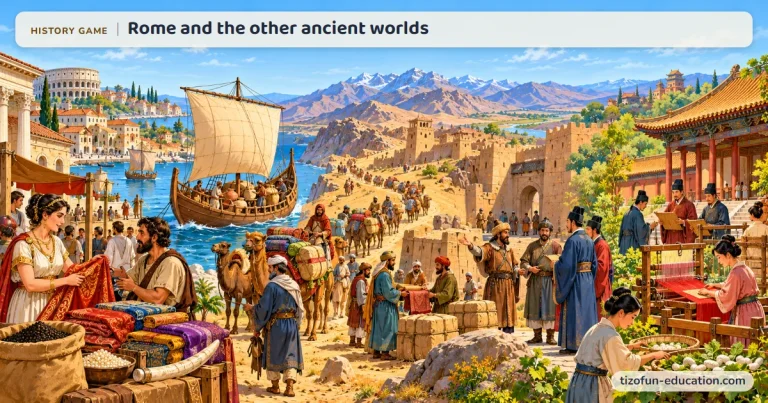
History game “Rome and the other ancient worlds”: From Rome to Han China: a Roman woman chooses silk near a ship bound for India, a camel caravan passes the silk from hand to hand, Chinese envoys stop among the Parthians, and Han officials read bamboo strips near a loom.

History review game on the lesson “Rome and the other ancient worlds” from the French curriculum for 6e (ages 11–12). Every answer is checked and explained.

Loading the game…

Teaching documentation of the game “History, French curriculum 6e — Rome and the other ancient worlds”

About this game

Review the lesson “Rome and the other ancient worlds” from the French history curriculum for 6e (ages 11–12). Its questions are about Rome and the other ancient worlds: by which land and sea paths the goods of the East reach the Roman Empire, what the Romans and the Chinese know about each other, and how Han China, a great empire at the other end of the known world, is governed.

Review the lesson “Rome and the other ancient worlds”

This review game covers a single lesson of the French history curriculum for 6e: “Rome and the other ancient worlds”, from the unit “The Roman Empire in the ancient world.” Its questions are about Rome and the other ancient worlds: by which land and sea paths the goods of the East reach the Roman Empire, what the Romans and the Chinese know about each other, and how Han China, a great empire at the other end of the known world, is governed.

Each round has 10 questions drawn at random from the lesson: multiple choice, true or false and matching. After each answer, an explanation recalls what to remember. Hints are free, and you can go back.

The game follows the French national curriculum: 6e is the first year of middle school in France, for students aged 11 to 12. Elsewhere, it works as general knowledge for curious learners of that age. Play it again and you get other questions: it is good practice right after the lesson or before a test.
Tip for a successful review

For each question, first spot what it is about: a journey, an old name, or the way an empire is governed. For a journey, follow it on the map in your head: where the product starts, which lands or seas it crosses, where it ends up. In front of an old name, do not take it for a name of today: ask yourself who gave it, and to whom. When a question quotes an old text, ask yourself who wrote it, and whether the other people tells the same story. To compare two empires, look for what they share and what sets them apart. And for a “True or false” question, read every word: a single wrong detail is enough to make the sentence false. If you get it wrong, read the explanation carefully: it tells you what to remember.