The birth of Jewish monotheism — history review game (French curriculum, 6e)

6e — French national curriculum (ages 11–12)

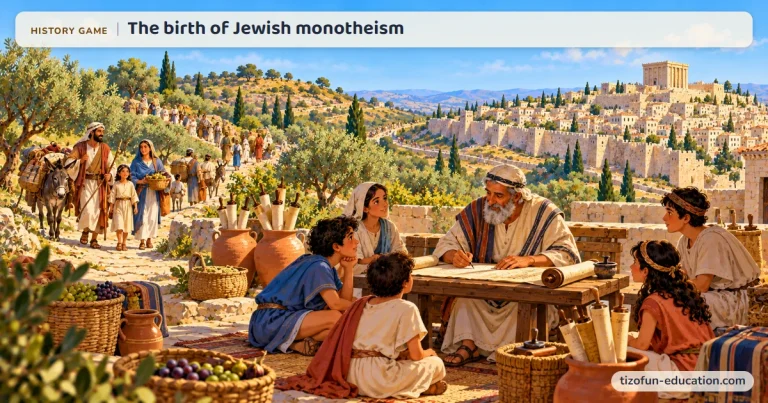
History game “The birth of Jewish monotheism”: On a hill of olive trees, a scribe copies a scroll in front of children, while families and their donkeys walk up toward a walled city.

History review game on the lesson “The birth of Jewish monotheism” from the French curriculum for 6e (ages 11–12). Every answer is checked and explained.

Loading the game…

Teaching documentation of the game “History, French curriculum 6e — The birth of Jewish monotheism”

About this game

Review the lesson “The birth of Jewish monotheism” from the French history curriculum for 6e (ages 11–12). Its questions are about the Hebrews and their belief in one single god: what the Bible tells, how this story was written and gathered over the centuries, the exile in Babylon, and what historians can check thanks to other sources.

Review the lesson “The birth of Jewish monotheism”

This review game covers a single lesson of the French history curriculum for 6e: “The birth of Jewish monotheism”, from the unit “Founding stories, beliefs, and citizenship in the ancient Mediterranean in the 1st millennium BCE.” Its questions are about the Hebrews and their belief in one single god: what the Bible tells, how this story was written and gathered over the centuries, the exile in Babylon, and what historians can check thanks to other sources.

Each round has 10 questions drawn at random from the lesson: multiple choice, true or false, fill in the blanks and matching. After each answer, an explanation recalls what to remember. Hints are free, and you can go back.

The game follows the French national curriculum: 6e is the first year of middle school in France, for students aged 11 to 12. Elsewhere, it works as general knowledge for curious learners of that age. Play it again and you get other questions: it is good practice right after the lesson or before a test.
Tip for a successful review

For each question, ask yourself whether it is about what the Bible tells or about what historians have been able to check. Believing is not proving: we say “according to the Bible…” or “according to historians…”, and we compare the sources. If you get it wrong, read the explanation carefully: it tells you what to remember.