The Roman conquests — history review game (French curriculum, 6e)

6e — French national curriculum (ages 11–12)

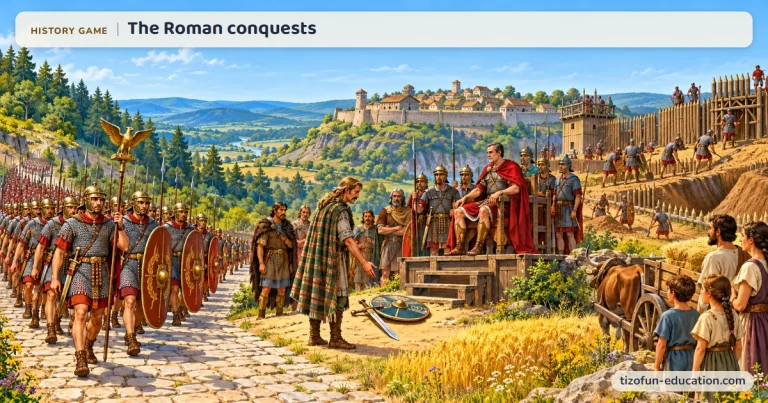
History game “The Roman conquests”: A column of legionaries in chain mail, behind the eagle standard, passes a Gallic hill fort where a Gallic chief lays down his weapons before the Roman general seated on a platform, while soldiers build a fortified camp, like Vercingetorix before Caesar at Alesia.

History review game on the lesson “The Roman conquests” from the French curriculum for 6e (ages 11–12). Every answer is checked and explained.

Loading the game…

Teaching documentation of the game “History, French curriculum 6e — The Roman conquests”

About this game

Review the lesson “The Roman conquests” from the French history curriculum for 6e (ages 11–12). Its questions are about the Roman conquests: how the Roman Republic expanded its territory around the Mediterranean, how Julius Caesar led the Gallic Wars, and what we can know about this war from the account Caesar himself wrote.

Review the lesson “The Roman conquests”

This review game covers a single lesson of the French history curriculum for 6e: “The Roman conquests”, from the unit “The Roman Empire in the ancient world.” Its questions are about the Roman conquests: how the Roman Republic expanded its territory around the Mediterranean, how Julius Caesar led the Gallic Wars, and what we can know about this war from the account Caesar himself wrote.

Each round has 10 questions drawn at random from the lesson: multiple choice, true or false, fill in the blanks, matching and timelines. After each answer, an explanation recalls what to remember. Hints are free, and you can go back.

The game follows the French national curriculum: 6e is the first year of middle school in France, for students aged 11 to 12. Elsewhere, it works as general knowledge for curious learners of that age. Play it again and you get other questions: it is good practice right after the lesson or before a test.
Tip for a successful review

For each question, ask yourself which kind of government it is about: a monarchy has a king, an empire has an emperor, and the Roman Republic has neither. For dates “BC” (before Christ), the bigger the number, the older the date: 146 comes before 52. And remember: Caesar wrote the story of a war he led himself; he is both its author and its actor, so his account is biased. If you get it wrong, read the explanation carefully: it tells you what to remember.