1st Grade 2D or 3D Shapes Yes or No Worksheet: Read Each Question Twice
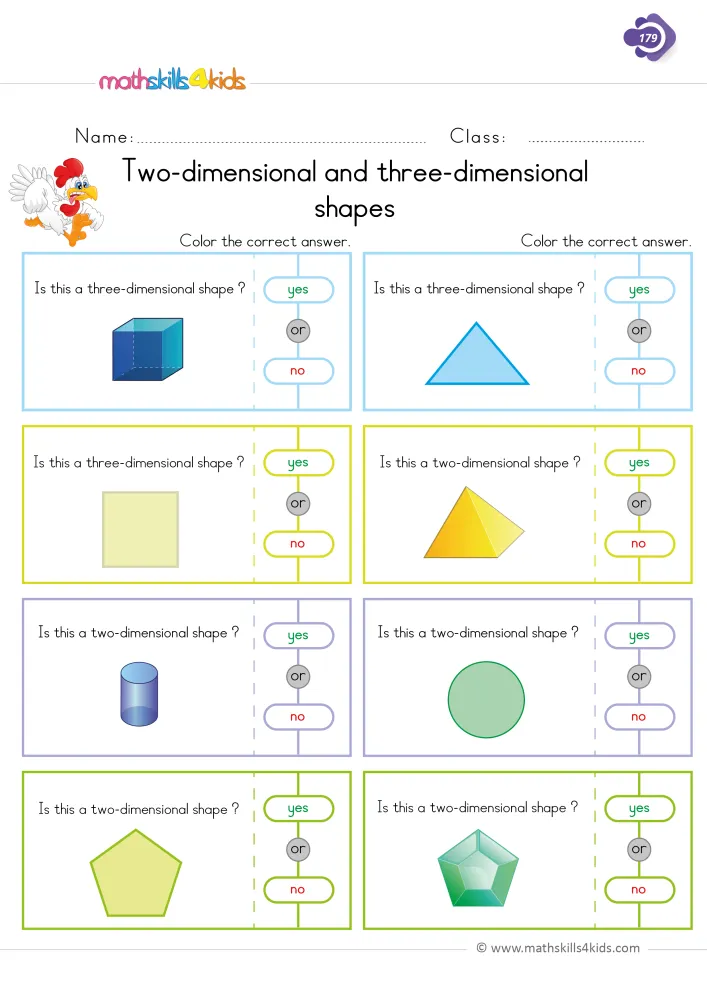
Put a block and a paper square side by side and ask a six-year-old which one you can hold like a box. The block wins at once. On paper, though, both are drawings, so the difference has to come from shading and edges. This 1st grade 2D or 3D shapes yes or no worksheet works on reading those clues. Eight boxes each show one shape: a blue cube, a triangle, a pale square, a yellow pyramid, a cylinder, a circle, a pentagon and a green gem. Each box asks a question, either "Is this a three-dimensional shape?" or "Is this a two-dimensional shape?" The child colors yes or no. A second page gives the answer key.
Why the question switches
Two-dimensional shapes are flat: they have length and width only. Three-dimensional shapes are solid: they also have depth, so you can hold them, stack them or roll them. Knowing the words two and three dimensions lets a child sort the world into flat shapes and solid shapes.
This page adds a twist. The first three boxes ask about three dimensions, then the rest ask about two. So a child who learned "cube means yes" has to think again when the cylinder comes with a two-dimensional question.
The drawings also teach a reading skill. Shading, a visible side and hidden edges are the clues that a picture shows a solid. Spotting them matters.
At the table: read twice, then decide
Ask your child to read each question aloud and tap the key word: two or three. Then let them decide whether the shape is flat or solid, and only then choose yes or no.
The likely slip comes at the yellow pyramid. It looks like a triangle, and the question asks about two dimensions. A child who sees "triangle" may color yes. Instead of correcting, ask, "Can you see more than one side?"
The green gem can puzzle too, because its outline is a pentagon. Point to the facets and let your child find the clue. If they mix up the question, read it together once more and ask, "Is it flat or solid?"
After the page: flat or solid around the house
Gather a few kitchen objects: a can, a box of tea, a ball, a coaster and a paper napkin. Your child can hold each one and sort the flat ones from the solid ones. Then trace around the can on paper and compare the circle with the can itself.
I Spy works well on a walk or in a store. Try "I spy something shaped like a cylinder" or "I spy something flat and round," and let your child take a turn.
Finally, check the page together with the answer key. Praise the careful reading: "You checked two or three before you colored." Answering yes or no then rests on a reason.
About this 1st grade 2D or 3D shapes yes or no worksheet and its answer key
Download the worksheet: 1st Grade 2D or 3D Shapes Yes or No Worksheet: Read Each Question Twice
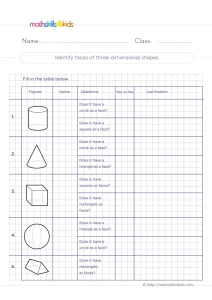 Worksheet3rd Grade Flat and Curved Faces Worksheet: Circles, Squares, Triangles
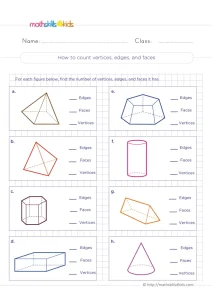 Worksheet3rd Grade Count Edges of 3D Shapes Worksheet: Faces and Vertices Too
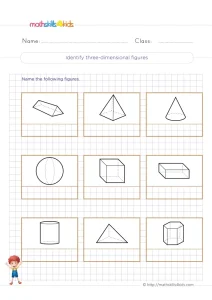 Worksheet3rd Grade Naming Solid Figures Worksheet: Prisms, Pyramids and More
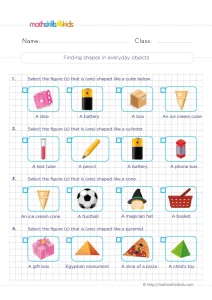 Worksheet3rd Grade Finding Shapes in Everyday Objects Worksheet: 16 Pictures
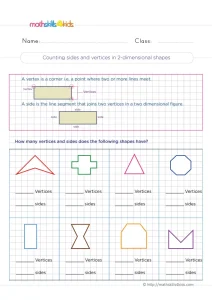 Worksheet3rd Grade Counting Sides and Vertices Worksheet: 8 Flat Shapes
A few related activities
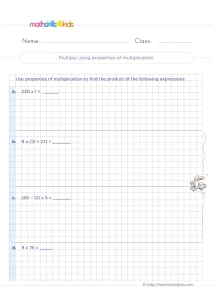 Work out four products, from 230 x 1 to 9 x 75, with the identity, distributive and commutative…See the activity3rd Grade Area with Length and Width Worksheet
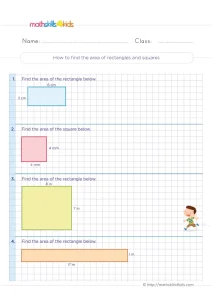 Three rectangles and one square, each with its side lengths. Your child multiplies length by width to find…See the activity3rd Grade Area of Rectangles in Real Life Worksheet: 3 Word Problems
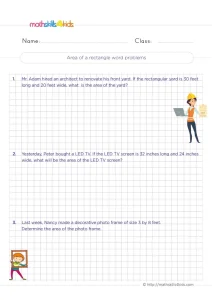 Three word problems about a yard, a TV screen and a photo frame. Children multiply length by width…See the activity
