1st Grade Addition with Cubes Worksheet: Add Two Rows, Write the Total
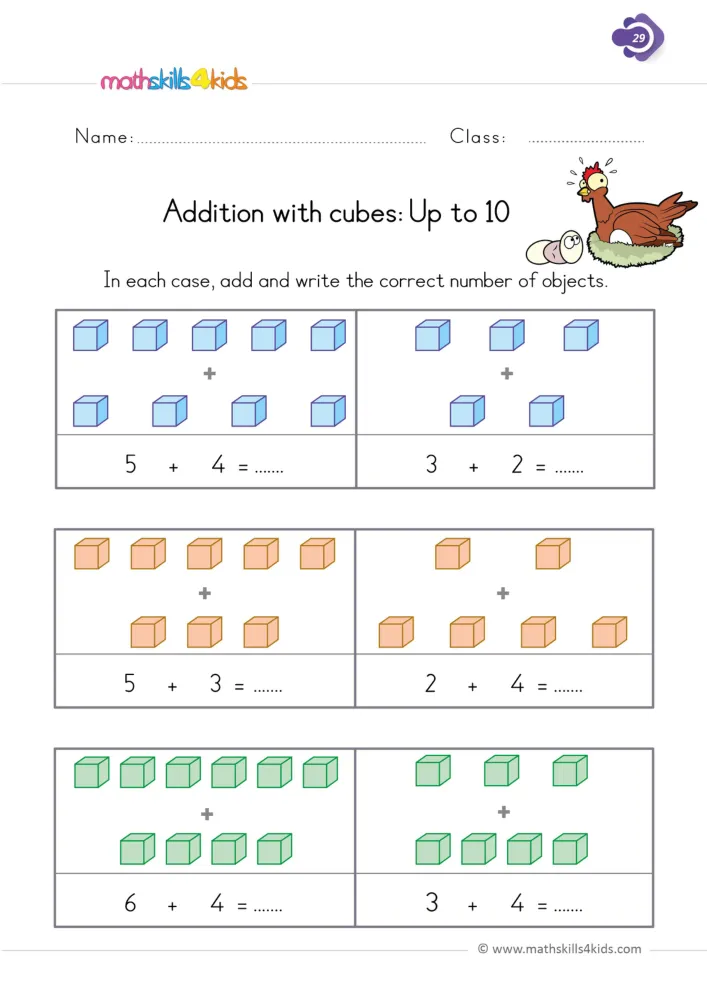
Put two rows of cubes in front of a six-year-old and ask for the total. Many children start again from one and count every cube. Others look at the top row, say "five," and keep going from there. This 1st grade addition with cubes worksheet sits right between those two habits. Six boxes hold blue, orange and green cubes, with one row above a plus sign and one row below it. Under each box, an addition sentence waits for its total, and the sums to 10 stay small enough to check by touch. The cubes never leave the page, so your child can always go back and count. A second page gives the answer key.
Why two rows beat one long count
At this age, addition starts as putting two groups together. The cubes make that visible: one row, a plus sign, another row, then one total for both.
The next step is counting on. Instead of counting all nine cubes in the first blue box, your child says "five" for the top row and then counts the bottom one. That shift is a real milestone in 1st grade.
The page also links pictures to symbols. Each addition sentence matches the cubes above it, so the numbers start standing for things. Look at the orange box with 2 + 4, for example. The bottom row holds more cubes, so starting from the bigger number saves time. Quietly, that is the idea that order does not change a sum. Small, but important.
At the table: the spaced-out cubes
Start with the first blue box. Point to the top row, then to the plus sign, and let your child count both rows aloud.
The likely slip comes where the cubes sit far apart, like the top row of the orange 2 + 4 box. While the finger jumps across the gap, a child may count one cube twice. So instead of correcting, ask for a slower count: "Touch each cube once and say its number."
Then wait. In the green 6 + 4 box, your child can also hold up six fingers and tap four more on the table. Finally, if a total still feels shaky, offer a question rather than an answer: "Which row has more cubes?"
Cubes, blocks and a jar of mice
Building blocks work just like the cubes on the page. Line up two short rows on the floor, then ask how many there are in all. Later, at snack time, put a few crackers on two plates and add them before anyone eats.
Also, the picture book Mouse Count by Ellen Stoll Walsh follows a snake who drops mice into a jar, one at a time, up to ten. While you read it, keep a running total with your fingers. Count on together.
Once you finish the page, check it with the answer key side by side. Then name the effort, not the score: "You touched every cube. That is careful adding."
About this 1st grade addition with cubes worksheet and its answer key
Download the worksheet: 1st Grade Addition with Cubes Worksheet: Add Two Rows, Write the Total
 Worksheet3rd Grade Addition and Subtraction Problems: 3 Stories
 Worksheet3rd Grade Addition Properties Worksheet: Commutative, Associative, Identity
 Worksheet3rd Grade Count Coins and Bills Worksheet: 8 Money Totals
 Worksheet3rd Grade Adding and Subtracting Like Fractions Worksheet: Eight Sums
 Worksheet3rd Grade Writing Fractions as Unit Fraction Sums Worksheet: Tick One
A few related activities
 Three money word problems with pennies, nickels, dimes, quarters and $1 and $5 bills. Children find each total…See the activity3rd Grade AM and PM Time Worksheet: 5 Daily Events
 Five everyday events, from breakfast to dinner. Your child reads each time and ticks a.m. or p.m. using…See the activity3rd Grade Divide by 2 Worksheet: Long Division with Even Numbers
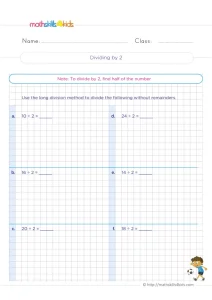 Six even numbers from 10 to 24 to divide by 2 with the long division method. Each answer…See the activity
