2nd Grade Balancing Subtraction Equations Worksheet: Make Both Sides Equal
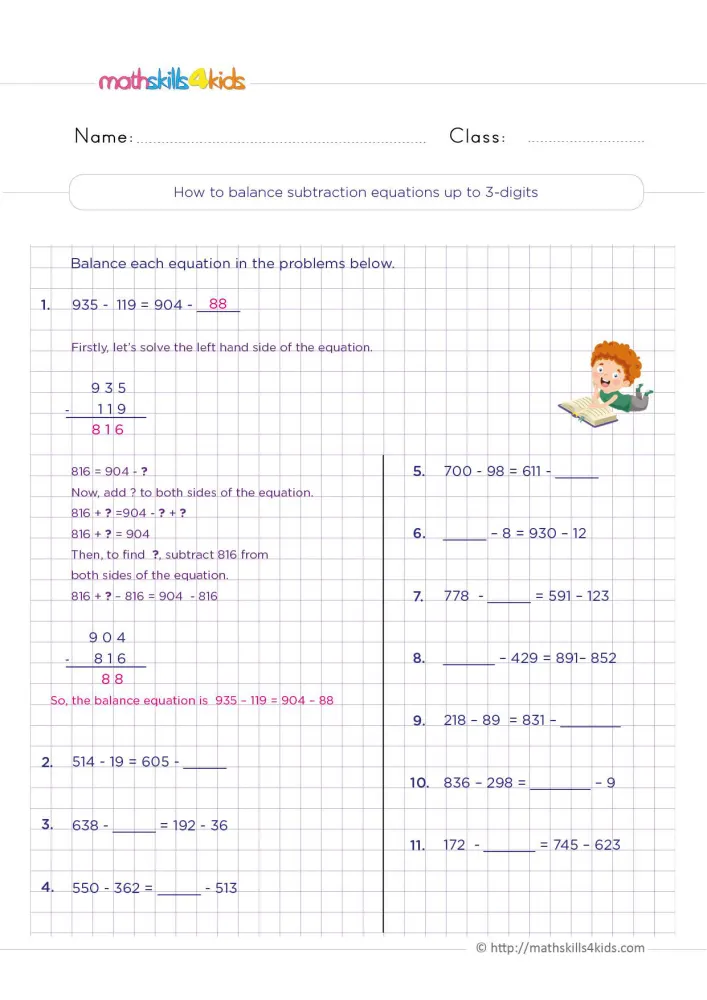
Many seven-year-olds read the equal sign as "now write the answer". Show them 514 − 19 = 605 − □ and they happily write 495 in the blank, even though the right side no longer matches. This 2nd grade balancing subtraction equations worksheet is built to change that habit. A worked example at the top solves 935 − 119 = 904 − 88 step by step, with the column subtraction in full. Below it, ten equations put a subtraction on each side and hide one number, sometimes at the start, sometimes in the middle. A boy lying with an open book watches from the side. Your child finds the value of one side, then makes the other side match. A second page gives the answer key.
Why the equal sign means "the same as"
The equal sign does not announce a result. It says that both sides have the same value, like two pans of a balance holding the same weight. Children who learn this early find later math, from missing numbers to algebra, much easier.
This page makes the idea concrete. In item 1, the left side is 935 − 119, which makes 816. So the right side, 904 minus something, must also make 816, and the answer is 88.
After that, every item works the same way. One side can be finished, and it tells your child what the other side must equal. Short subtractions, like 930 − 12 in item 6, keep the arithmetic light so the attention stays on the balanced equation itself.
At the table: item 2 and the tempting blank
Item 2 is the classic trap. Your child works out 514 − 19 = 495 and writes 495 in the blank. Instead of saying it is wrong, ask, "Is 605 minus 495 the same as 495?"
Then let them find the gap. If the right side must also make 495, how far is it from 495 up to 605? Counting up by tens and ones is fine.
Item 6 hides the first number: □ − 8 = 930 − 12. Ask, "What did you start with if taking 8 leaves the same as the other side?"
Also, for items 10 and 11, have your child point to each side and say its value out loud before writing. That small pause catches most slips.
After the page: balance things at home
A balance idea is easy to feel. Line up two rows of coins or blocks on the table, take a few away from each row, and ask whether the rows still match. Then let your child fix the uneven row by adding or removing pieces.
A card game helps too. Play Go Fish with cards that show small subtractions, like 10 − 3 and 9 − 2, where a pair means two cards with the same value. Your child has to work out each card before asking for a match.
When you check the answer key, praise the checking: "You tested both sides before you wrote." That is exactly the habit this page builds.
About this 2nd grade balancing subtraction equations worksheet and its key
Download the worksheet: 2nd Grade Balancing Subtraction Equations Worksheet: Make Both Sides Equal
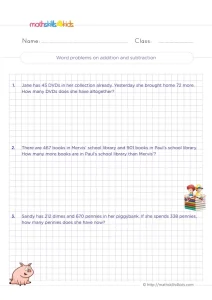 Worksheet3rd Grade Addition and Subtraction Problems: 3 Stories
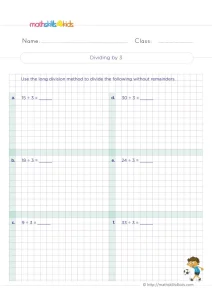 Worksheet3rd Grade Divide by 3 Worksheet: Long Division Without Remainders
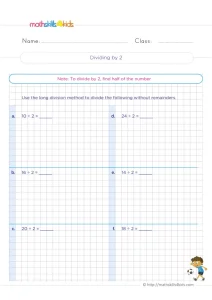 Worksheet3rd Grade Divide by 2 Worksheet: Long Division with Even Numbers
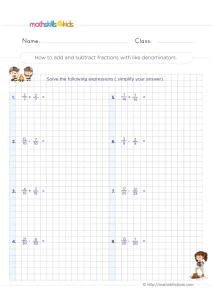 Worksheet3rd Grade Adding and Subtracting Like Fractions Worksheet: Eight Sums
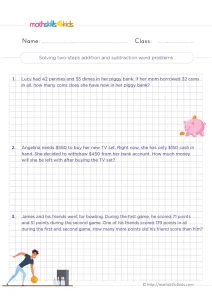 Worksheet3rd Grade Two-Step Add and Subtract Word Problems Worksheet: 3 Stories
A few related activities
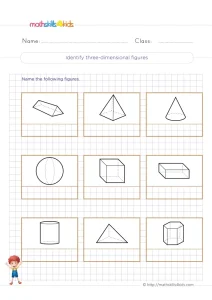 Nine drawn solids to name, from a cube and a cone to a hexagonal prism and a triangular…See the activity3rd Grade Count Edges of 3D Shapes Worksheet: Faces and Vertices Too
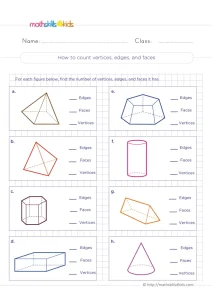 Eight drawn solids, from a square pyramid to a hexagonal prism and a cone. Count the edges, faces…See the activity3rd Grade Multiplication Worksheet: Find Products Using Properties
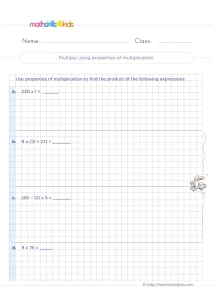 Work out four products, from 230 x 1 to 9 x 75, with the identity, distributive and commutative…See the activity
