2nd Grade Perimeter of Polygons Worksheet: Add Up Every Side
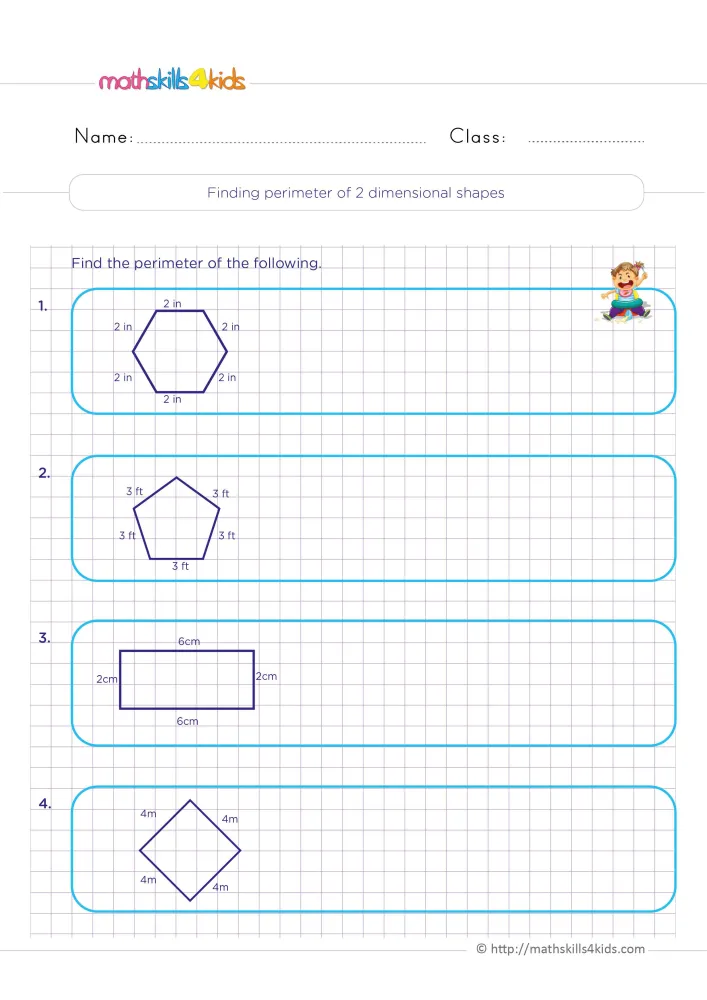
Walk around the edge of a rug with a seven-year-old, counting steps, and you have already measured a perimeter. The word is new; the idea is not. This 2nd grade perimeter of polygons worksheet turns that walk into addition. Four shapes sit in rounded frames, each side labeled with its length: a hexagon with 2 in sides, a pentagon with 3 ft sides, a rectangle of 6 cm by 2 cm and a diamond with 4 m sides. Your child adds every side and writes the total with its unit. Equal sides repeat, so a quick double check is always possible once the total is written. A second page gives the answer key.
Why perimeter is just careful adding
Perimeter is the distance all the way around a shape. For a second grader, it is simply adding lengths, and adding lengths is right on target at this age. The challenge is not the math. It is keeping track of every side.
The page helps with that. Each side carries its own label, so your child can tick each one as they add it. The perimeter of the hexagon, for example, needs six twos, while the rectangle needs only four numbers.
The page also mixes units of length: inches, feet, centimeters and meters. So the answer is never a bare number. A total of 16 means little; 16 cm tells you something real.
At the table: the hexagon and the rectangle
Start with the hexagon. A child often adds the sides they look at first and stops at four or five. Instead of correcting, say, "Touch each side as you add it." A small pencil dot on each side works well.
The rectangle brings a different trap. Some children add only 6 and 2, because those are the two numbers they see first. Ask, "How many sides does a rectangle have?" Then let them find all four labels around it.
Finally, check the units together. If your child writes "16", ask, "Sixteen what?" Pointing to the cm label on the drawing settles it. Repeated sides also invite a shortcut, so let your child spot it.
Measuring around the house
Perimeter is easy to find at home. Use a ruler or a tape measure on a book cover, a placemat or a picture frame. Write each side on a sticky note, then add them together. Also, walk around a table and count your steps, then compare with a bigger table.
The picture book "Inch by Inch" by Leo Lionni follows a small inchworm who measures birds to save himself. While you read it, measure a toy or a shoe in inches, one side at a time.
When your child works out the sum of the side lengths, praise the tracking: "You touched every side before you added." That steady care is what makes measurement work.
About this 2nd grade perimeter of polygons worksheet and its answer key
Download the worksheet: 2nd Grade Perimeter of Polygons Worksheet: Add Up Every Side
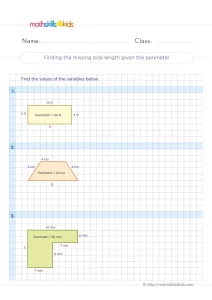 Worksheet3rd Grade Missing Side Length Perimeter Worksheet: Find a, b, t
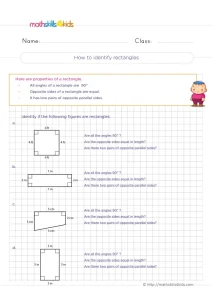 Worksheet3rd Grade Rectangle Properties Worksheet: Is It a Rectangle?
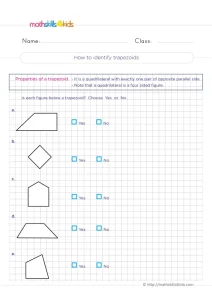 Worksheet3rd Grade Identifying Trapezoids Worksheet: 5 Shapes to Check
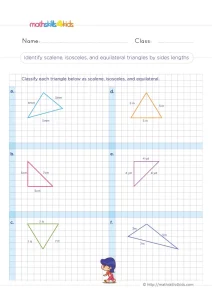 Worksheet3rd Grade Classifying Triangles by Side Lengths Worksheet: 6 Triangles
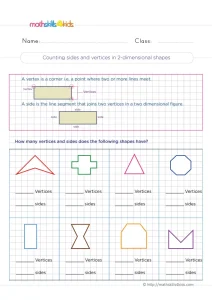 Worksheet3rd Grade Counting Sides and Vertices Worksheet: 8 Flat Shapes
A few related activities
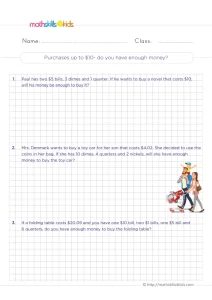 Three shopping stories with bills and coins. Children count the money, compare it with the price and decide…See the activity3rd Grade Count Coins and Bills Worksheet: 8 Money Totals
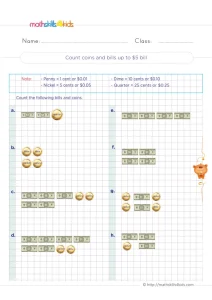 Eight sets of $1 and $5 bills with pennies, nickels, dimes and quarters. Children find each total in…See the activity3rd Grade Two-Step Multiply and Divide Problems: 3 Stories
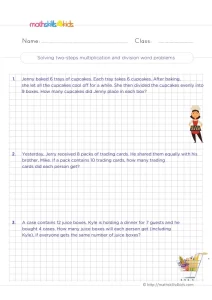 Three stories about cupcakes, trading cards and juice boxes. Your child multiplies to find a total, then divides…See the activity
