3rd Grade Writing Numbers from Expanded Form Worksheet: Up to Six Digits
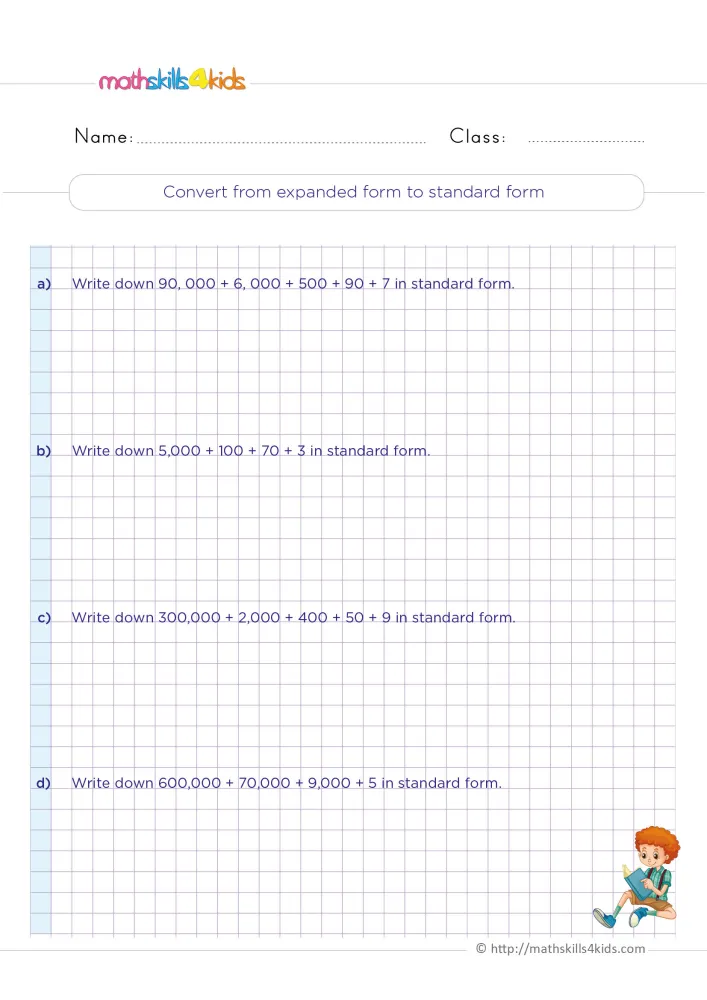
600,000 + 70,000 + 9,000 + 5 looks long, yet it is just one number. This 3rd grade writing numbers from expanded form worksheet asks children to put the pieces back together. There are four sums written in expanded form: one with four digits, one with five and two with six. For each one, your child writes the number in standard form, the usual way with digits and commas. A second page gives the answer key, with a place value chart for the first two.
Each part fills one place
In expanded form, every part names one place. 90,000 is 9 ten thousands, 6,000 is 6 thousands, and so on down to the ones.
Putting the parts in a place value chart gives the number: 96,597. A place with no part gets a zero.
The six-digit numbers are a stretch for third grade, but the rule is the same. Writing them helps children see that place value keeps going, one place at a time.
At the table: watch for the missing places
Start with b, 5,000 + 100 + 70 + 3. Let your child draw a chart with four columns, Th, H, T and O, and put one digit in each. That gives 5,173.
The traps are the missing places. In c there is no ten thousands, so 300,000 + 2,000 + 400 + 50 + 9 becomes 302,459. In d there are no hundreds and no tens, so two zeros come before the 5: 679,005.
Ask, "How many digits should this number have?" before your child writes it.
Finally, check all four with the answer key.
Big numbers in real life
Large numbers show up in house prices, car mileage and the number of people in a city. Read one together, then say it in expanded form: "three hundred thousand, plus two thousand..."
You can also play it the other way. Call out parts, such as 40,000 + 300 + 6, and let your child write the number.
When the page is done, name the effort: "You remembered the zeros, even with six digits."
About this 3rd grade writing numbers from expanded form worksheet
Download the worksheet: 3rd Grade Writing Numbers from Expanded Form Worksheet: Up to Six Digits
 Worksheet3rd Grade Subtraction Patterns Worksheet: Over Increasing Place Values
 Worksheet3rd Grade Thousands and Hundreds Digits Worksheet: Name Each Place
 Worksheet3rd Grade Place Value Blocks Matching Worksheet: Cubes, Flats, Rods and Ones
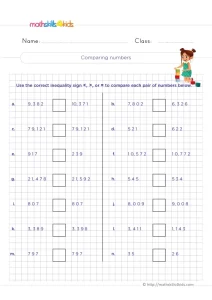 Worksheet3rd Grade Comparing Large Numbers Worksheet: Less Than, Greater Than, Equal
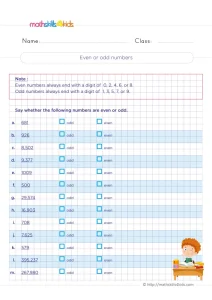 Worksheet3rd Grade Even or Odd Numbers Worksheet: Check the Last Digit
A few related activities
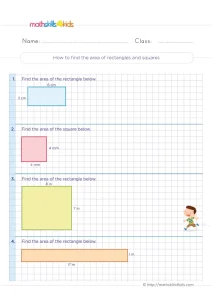 Three rectangles and one square, each with its side lengths. Your child multiplies length by width to find…See the activity3rd Grade Naming Solid Figures Worksheet: Prisms, Pyramids and More
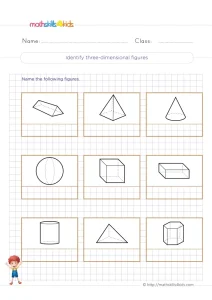 Nine drawn solids to name, from a cube and a cone to a hexagonal prism and a triangular…See the activity3rd Grade Count Edges of 3D Shapes Worksheet: Faces and Vertices Too
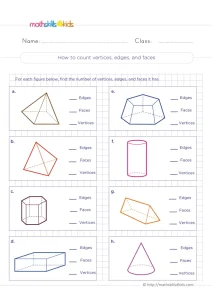 Eight drawn solids, from a square pyramid to a hexagonal prism and a cone. Count the edges, faces…See the activity
