Spot the Shape That Does Not Belong: Five Rows of Stars, Circles and Hearts
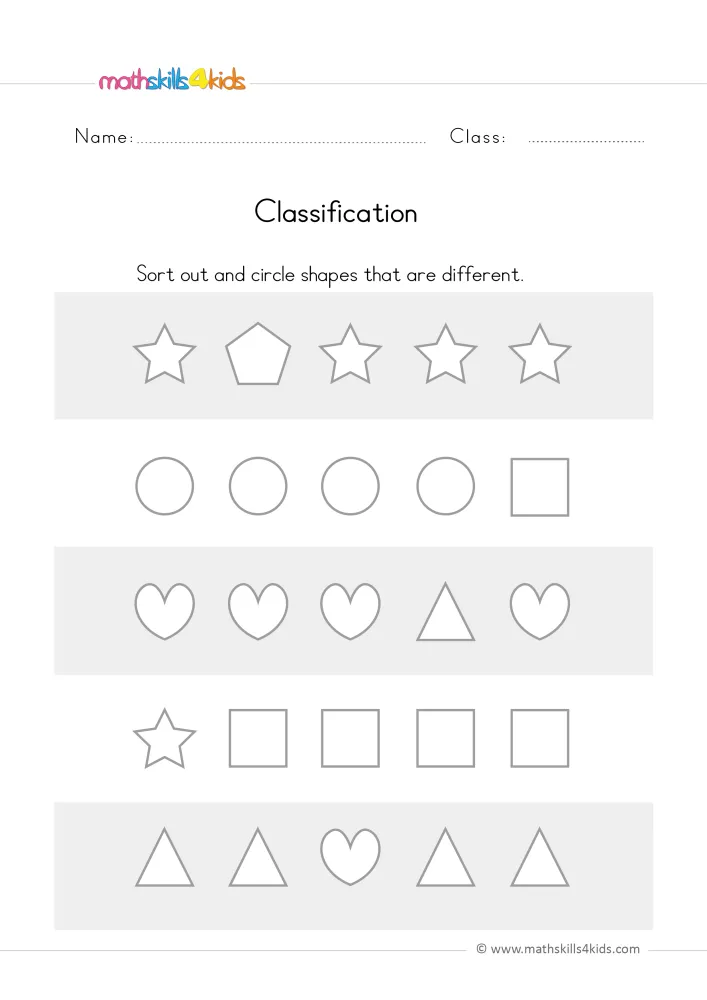
Put four spoons and one fork on the table, and most four-year-olds will point at the fork before you finish asking. Spotting what does not belong comes early. Saying why it does not belong takes much longer, and that is where this Pre-K circle the different shape worksheet helps. Five rows of gray outlines each hold four matching shapes and one stranger. So there is no color to lean on: the outline alone carries the answer, and your child has to look at it.
Four alike, one apart: the first sorting rule
Sorting starts with a simple question: what do these things share? Teachers call this classifying shapes, and it comes before any shape name is fully secure. Your child first notices that four outlines "go together," then tries to say what makes the fifth one different.
This page keeps that question clean. Every shape is drawn in the same thin gray line, so size and color never compete with form. However, the top row is not as easy as it looks. A pentagon sits among four stars, and both have five corners. As a result, your child must look at the edges, not just count points.
The other rows use clear contrasts between basic shapes: a square after four circles, a triangle among hearts, a star before squares, a heart among triangles. Easy wins.
What to say when the pencil hovers
Start with the circles in the second row, because the square at the end jumps out. Then ask, "Which one would not roll?" Next, let your child trace the square with a finger before circling it.
One mistake shows up often on this page. The instruction says "shapes" in the plural, so some children ring all four hearts and leave the triangle alone. Don't erase anything. Instead, ask, "Tell me about the one you didn't circle." Usually the child finds their own way back to the triangle.
For the stars and the pentagon, try "Touch the tips of this star. Now touch this one." The pentagon has corners, but no pointy tips. Naming each outline aloud also turns the page into shape recognition practice.
Strangers at snack time
The same game works with whatever is on the table. For example, line up four round crackers and one square one, then ask your child to tap the stranger. Next, swap roles: your child hides an odd one out in a row of toy blocks for you to find.
Outside, play I Spy with one twist: "I spy one round window among square ones." Short sorting games like these fit in a waiting room or at the bus stop, while shapes are all around you.
When the page is finished, praise the looking, not the circles: "You checked every heart before you chose. That was careful work."
About this Pre-K circle the different shape worksheet with five rows
Download the worksheet: Spot the Shape That Does Not Belong: Five Rows of Stars, Circles and Hearts
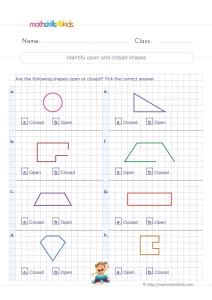 Worksheet3rd Grade Open and Closed Shapes Worksheet: 8 Shapes to Check
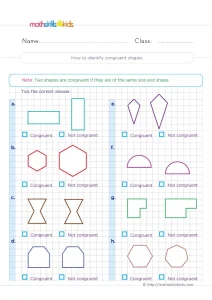 Worksheet2nd Grade Congruent Shapes Worksheet: Same Size and Same Shape?
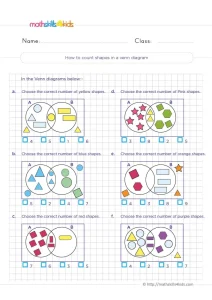 Worksheet2nd Grade Venn Diagram Color Counting Worksheet: Find Every Shape of One Color
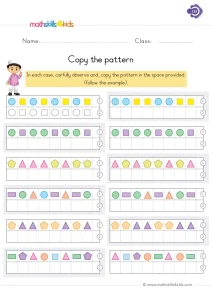 Worksheet1st Grade Copy the Shape Pattern Worksheet: Draw Each Row Again
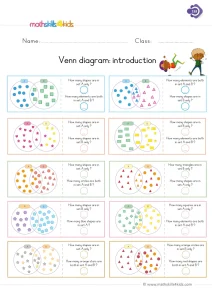 Worksheet1st Grade Two-Circle Venn Diagram Worksheet: Count the Shapes in Each Set
A few related activities
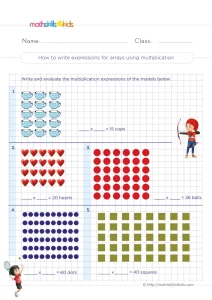 Five arrays of cups, hearts, balls, dots and squares. Your child writes the multiplication expression for each one…See the activity3rd Grade 1 Times Table Worksheet: 18 Column Facts and the Identity Rule
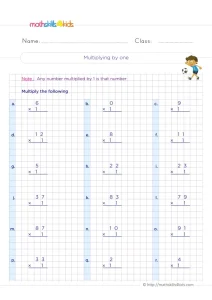 Eighteen column facts times 1, from 0 × 1 to 91 × 1. One rule solves them all:…See the activityGrade 2 Math — Time to the half hourGrade 2 math review game (ages 7–8): time to the half hour. Instructions are read aloud, and every…See the activity
