Kindergarten Location in a Grid Worksheet: Top Left, Center, Middle Right
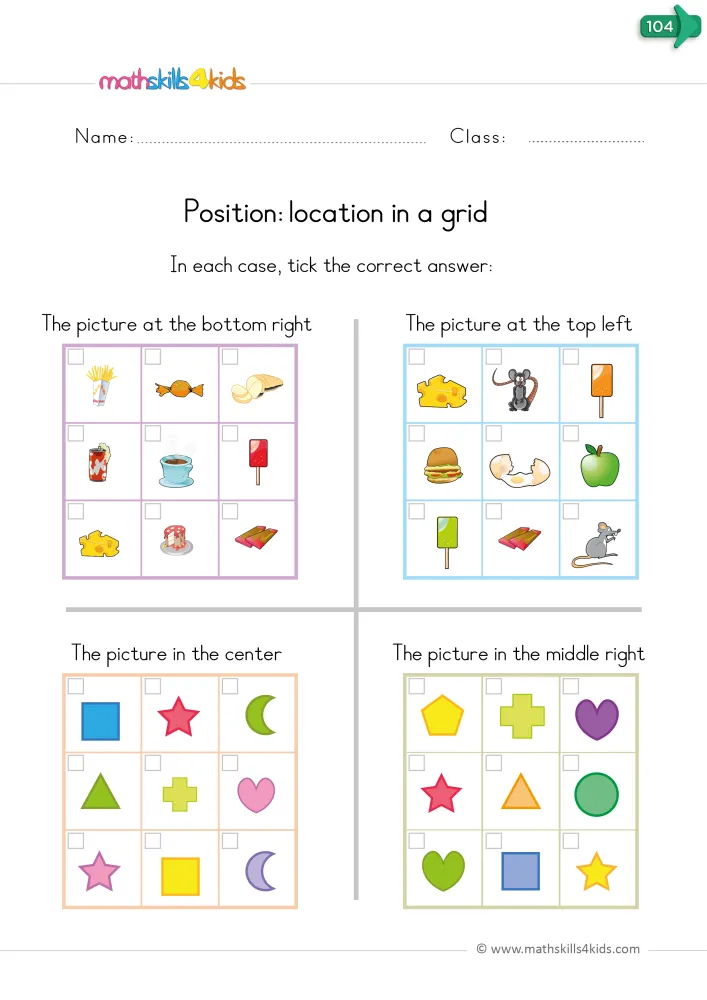
Lay nine crackers on a plate in three rows, ask for "the one at the top left," and watch your child's eyes. Many five-year-olds find the top row quickly, then hesitate over which end is left. This kindergarten location in a grid worksheet trains exactly that double step. It has four grids of nine boxes each, and two of them hold snacks such as fries, cheese, a burger and ice pops,, with two mice hiding in one. The other two hold colored shapes: stars, hearts, moons and a cross. Each grid asks for one place, from the bottom right to the middle right. The PDF comes as two pages, the worksheet and its answer key.
Why two words make one place
"Top" alone points to a whole row of three. "Left" alone points to a whole column. However, together do they name one box, and that is the big idea of a grid.
So the page asks the child to hold two clues at once. First find the row, then slide along it. Over time, this habit becomes the root of rows and columns, which later supports maps, calendars and tables.
The four questions also bring in directional words that sound alike. "Center" is the one box in the middle of everything. "Middle right" is the middle row, at the right end. Getting these apart is careful thinking. Two clues, one box.
At the table: the middle right box
Begin with the snack grid and the bottom right question. Ask your child to put a finger on the bottom row first, and when it is there, say, "Now slide to the right end."
Next, the center grid is usually easy, since the cross sits alone in the middle. The last grid, however, is the real test, and a child may tick the top right heart, or the triangle in the very middle. Instead of correcting, ask, "Which row is the middle one? Show me with your hand."
Left and right can wobble too. If your child picks the wrong end, let them hold up the hand they draw with. That way, the eyes get an anchor. This is left and right discrimination in action, and it takes many tries.
Memory cards, muffin tins and a final check
A game of Memory is a grid in disguise. Lay nine cards face down in three rows of three. Before each turn, your child names the card's place: "I'll flip the top left one."
Also, in the kitchen a muffin tin works the same way. Hide a raisin in one cup and give clues like "middle row, left end." Afterwards, swap roles so your child gives the clues and you do the looking.
These games build visual scanning, row by row. When the page is finished, compare the four ticks with the answer key together. Then praise the method: "You found the row first, then the end. That is how grids work."
About this kindergarten location in a grid worksheet and its four grids
Download the worksheet: Kindergarten Location in a Grid Worksheet: Top Left, Center, Middle Right
 Worksheet3rd Grade Area of Shaded Parts Worksheet: Subtract the Gaps
 Worksheet3rd Grade Draw Shapes with a Given Area Worksheet: Six Grids
 Worksheet3rd Grade Figures with the Same Area Worksheet: Count the Squares
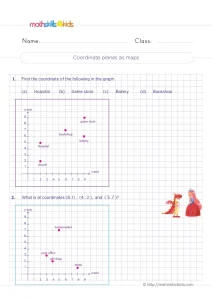 Worksheet3rd Grade Reading Coordinates on a Map Worksheet: Find the Places
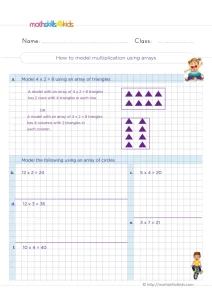 Worksheet3rd Grade Drawing Multiplication Arrays Worksheet: Rows of Circles
A few related activities
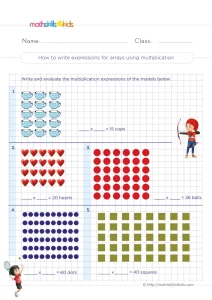 Five arrays of cups, hearts, balls, dots and squares. Your child writes the multiplication expression for each one…See the activity3rd Grade Multiplication Properties Worksheet: Zero, Identity, Commutative
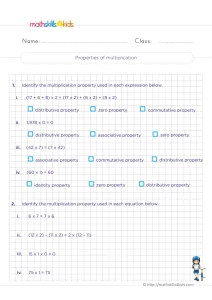 Tick the right property for four equations, from 1,978 x 0 = 0 to (60 x 1) =…See the activity3rd Grade 8 Times Table Worksheet: 12 Column Facts and a Doubling Trick
 Twelve column facts times 8, from 1 × 8 to 12 × 8, in a mixed order. Double…See the activity
