Kindergarten 2D and 3D Shapes Worksheet: Is It Flat or Solid?
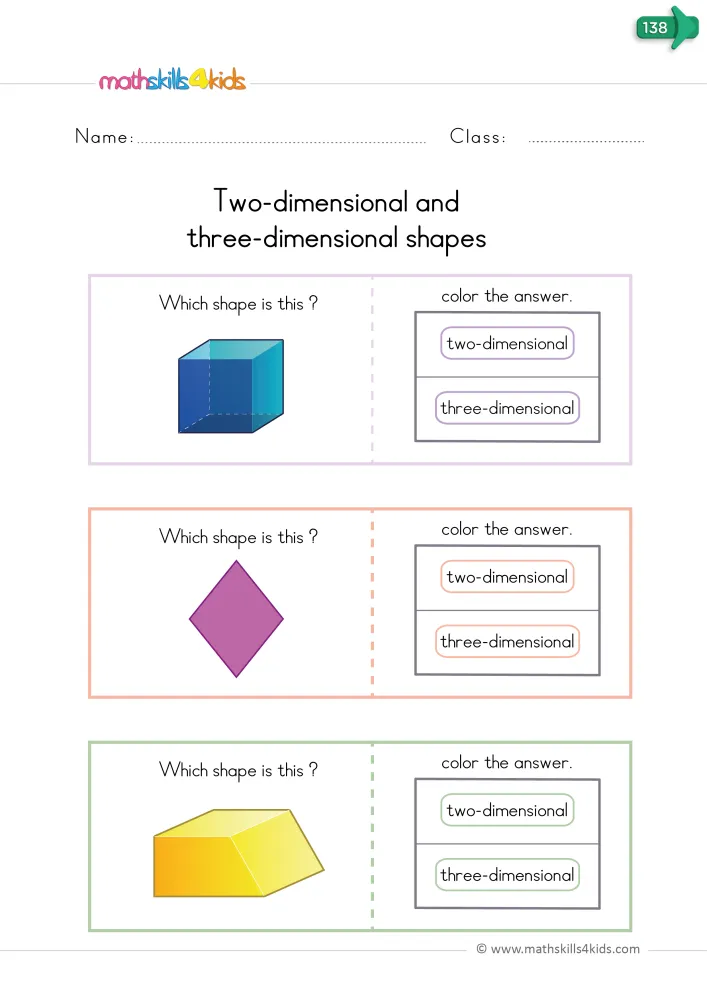
Hand a child a block and a paper square, and they will happily tell you which one they can stack, even if they have never heard the word "dimension." This kindergarten 2D and 3D shapes worksheet puts names on that difference. It shows three shapes: a blue cube, a purple diamond and a yellow block with a slanted side. Beside each one sit two tags, two-dimensional and three-dimensional, and the child colors the right one. The cube and the block are drawn with shading and hidden edges, which is how a flat page shows something solid. The PDF holds two pages, the worksheet and its answer key.
Why "can I hold it?" is the right question
A two-dimensional shape is flat: it has length and width, like a drawing or a sticker. A three-dimensional shape is solid: it also has depth, so you can hold it and turn it. That is the core of two-dimensional and three-dimensional thinking, and the long words matter less than the idea.
The page asks children to read pictures, which is a real step. The cube shows three faces and dashed lines for the edges hidden at the back. Likewise, the yellow block shows its top and two sides. Spotting those clues means the child is reading depth on a flat sheet.
However, the diamond has none of those clues, so it is one flat face. Flat, or can you hold it?
At the table: the purple diamond
First, start with the cube and ask, "If this were on the table, could you pick it up?" Point to the dashed lines and explain that they show the back edges, which we cannot see.
The purple diamond is the shape that surprises children. Because "diamond" sounds like a jewel, some color three-dimensional. Instead of correcting, ask, "Can you see a side or a back on this one?" Then compare it with the cube's shading.
For the yellow block, let your child trace each visible face with a finger and count them. As a result, seeing more than one face becomes a strong hint.
Coloring the tag keeps the answer clear, while saying the word out loud while coloring helps geometry vocabulary stick.
Hopscotch, blocks and a flat-or-solid hunt
The house is full of solid shapes: dice, boxes, cans and balls. Put a few on the table next to flat shapes traced from them on paper, and ask your child to match each object to its drawing.
A game of Hopscotch shows the two worlds side by side. The chalk squares on the ground are flat, while the stone your child throws is solid. Ask, "Which one can you pick up?" before each turn.
Afterwards, a quick hunt works well: your child finds one thing that is flat, such as a sticker, and one that is solid. Then check the page with the answer key and praise the thinking: "You looked for the hidden sides. That was clever."
About this kindergarten 2D and 3D shapes worksheet with three shapes
Download the worksheet: Kindergarten 2D and 3D Shapes Worksheet: Is It Flat or Solid?
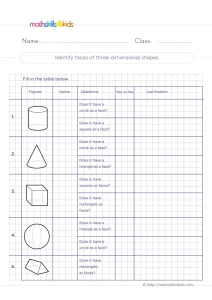 Worksheet3rd Grade Flat and Curved Faces Worksheet: Circles, Squares, Triangles
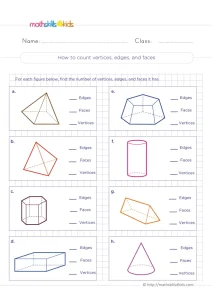 Worksheet3rd Grade Count Edges of 3D Shapes Worksheet: Faces and Vertices Too
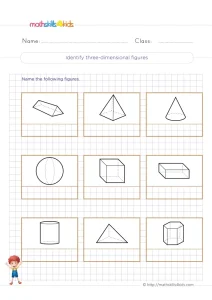 Worksheet3rd Grade Naming Solid Figures Worksheet: Prisms, Pyramids and More
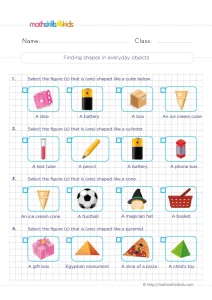 Worksheet3rd Grade Finding Shapes in Everyday Objects Worksheet: 16 Pictures
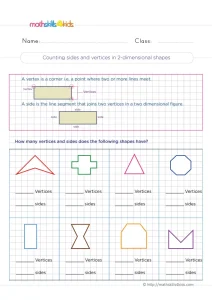 Worksheet3rd Grade Counting Sides and Vertices Worksheet: 8 Flat Shapes
A few related activities
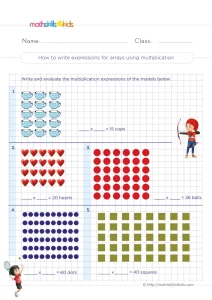 Five arrays of cups, hearts, balls, dots and squares. Your child writes the multiplication expression for each one…See the activity3rd Grade 1 Times Table Worksheet: 18 Column Facts and the Identity Rule
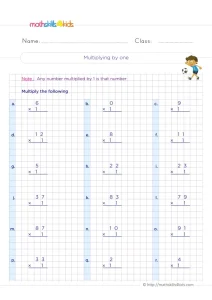 Eighteen column facts times 1, from 0 × 1 to 91 × 1. One rule solves them all:…See the activity3rd Grade Reading a Data Table Worksheet: 2 Tables
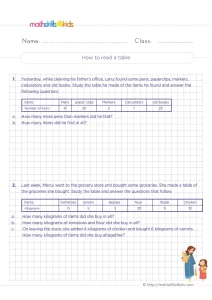 Two small tables, one of office items and one of groceries in kilograms. Your child finds the numbers,…See the activity
