1st Grade Find the Odd Number Worksheet: Spot It, Then Continue
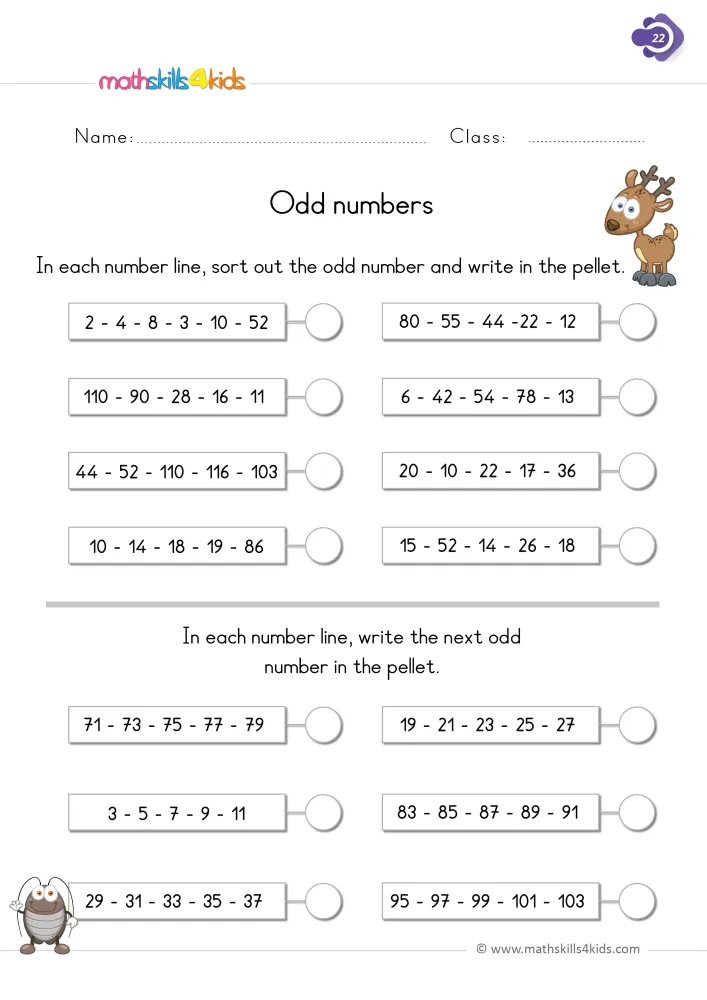
Read out 2, 4, 8, 3, 10 to a six-year-old, and the 3 often slips past unnoticed, because every number sounds equally ordinary. Spotting it takes a rule. This 1st grade find the odd number worksheet works in two parts. At the top, eight rows mix even numbers with exactly one odd number, and your child writes that odd number in the circle at the end. Below, six rows count up in odd numbers, such as 71, 73, 75, 77, 79, and your child writes what comes next. The numbers reach past 100, while the rule stays the same. A second page gives the answer key.
Why two parts, one rule
Odd numbers end in 1, 3, 5, 7 or 9. That single fact about the ones digit works for 3, for 17 and for 103 alike, so children no longer need to make pairs with counters.
The top half asks your child to use the rule as a filter. In the row 44, 52, 110, 116, 103, the big numbers are a distraction; only the last digit matters.
The bottom half shows another side of the same idea. Odd numbers come every two steps, so each number sequence grows by two. Finding the next odd number means jumping over one even number. Then the pattern holds even across 100, as in 99, 101, 103. That is a real step forward.
At the table: 101 and beyond
For the top rows, ask your child to touch the last digit of each number and whisper "even" or "odd". The row that starts with 10, 14, 18 is a good first try.
In the bottom part, the row 95, 97, 99, 101, 103 is the likely sticking point. Some children write 104, because counting by ones feels natural after a big number. If that happens, ask, "How far apart are 101 and 103?" Let them count the gap.
Another slip is writing 30 after 29, 31, 33, 35, 37. Point to the last two numbers and say, "What does each jump add?" Finally, read one finished row aloud together, so your child hears the rhythm.
Odd steps and a counting rhyme
The staircase is a good place to start. On the stairs, step only on the odd steps: 1, 3, 5, and so on. Also, while you set the table, lay out forks in pairs and ask whether an odd number of guests would leave one fork alone.
The old rhyme "One, Two, Buckle My Shoe" helps here. Each line begins with an odd number: one, three, five, seven, nine. While you say it together, tap the table on the first number of each line.
Once the page is complete, check it with the answer key. Then name the work: "You found the one odd number every time. You also kept the jumps of two." Patient effort.
About this 1st grade find the odd number worksheet and its answer key
Download the worksheet: 1st Grade Find the Odd Number Worksheet: Spot It, Then Continue
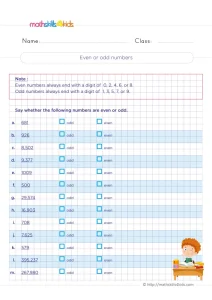 Worksheet3rd Grade Even or Odd Numbers Worksheet: Check the Last Digit
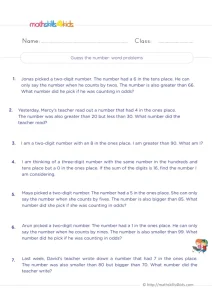 Worksheet2nd Grade Two-Digit Number Riddles Worksheet: Use the Clues, Find the Number
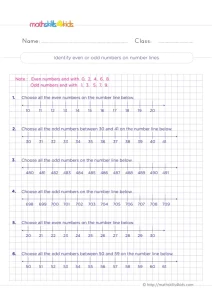 Worksheet2nd Grade Even and Odd Number Line Worksheet: Circle by the Last Digit
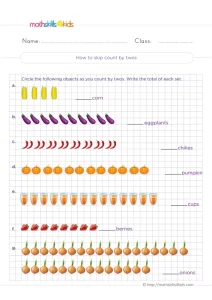 Worksheet2nd Grade Skip Count by 2 Worksheet: Circle Pairs, Write the Total
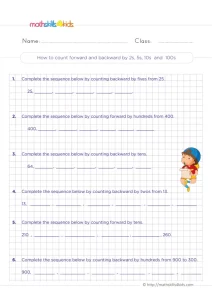 Worksheet2nd Grade Count Forward and Back Worksheet: By 2s, 5s, 10s and 100s
A few related activities
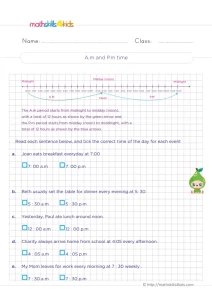 Five everyday events, from breakfast to dinner. Your child reads each time and ticks a.m. or p.m. using…See the activity3rd Grade Divide by 2 Worksheet: Long Division with Even Numbers
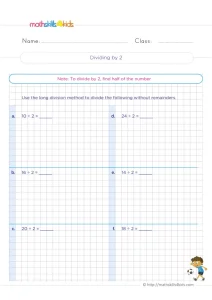 Six even numbers from 10 to 24 to divide by 2 with the long division method. Each answer…See the activity3rd Grade How Much Money in All Worksheet: 3 Word Problems
 Three money word problems with pennies, nickels, dimes, quarters and $1 and $5 bills. Children find each total…See the activity
