1st Grade Shapes Traced from Solids Worksheet: Can You Trace It?
Set a can on a sheet of paper, trace around its base, and lift it away. A six-year-old will usually stare at the circle left behind as if it were a magic trick. This 1st grade shapes traced from solids worksheet builds on that trick. Eight boxes each show one solid: a cylinder, a cone, a cube, three pyramids and two long boxes. A question asks whether one face of the solid could trace a circle, a square, a rectangle or a triangle. So the child pictures the solid standing on paper, imagines the outline, and colors yes or no. A second page gives the answer key.
Why a solid hides flat shapes
Every flat face of a solid is a 2D shape. A cylinder has two circles, a cube has six squares, and a pyramid has triangles around a base. Seeing the faces of a solid links two worlds that children often keep apart: flat shapes on paper and solids in the hand.
This page asks the child to switch between those worlds in their head. In the cone box, for example, the round base turns into a circle once traced. In the pink pyramid box, a slanted face turns into a triangle.
This kind of mental picture is a real step in spatial reasoning. It also prepares later work on nets and surfaces. Imagining comes before measuring.
At the table: find the face, then decide
For each box, ask your child to point to the face that could rest on the paper. Then let them name the shape that face would draw.
The likely slip comes at the cube. Because it looks like a box, a child may say rectangle in their head and color no for square. Instead of correcting, ask, "Are all its edges the same length?"
The two purple pyramids open a good debate. Their base is a square, and a square is a special kind of rectangle, so a thoughtful child may argue for yes in both boxes. Welcome the reasoning, then read the answer key together and talk it over. Ask, "Which face did you trace in your head?"
After the page: trace around real objects
Gather a few solids from the kitchen: a can, a tea box, a toy block, a funnel or a party hat. Let your child trace around one face of each on paper, then guess which object made which outline. Next, swap roles and let them test you.
Memory makes a good follow-up game. Draw each outline on one card and the object on another, place them face down, and play to find the matching pairs.
When you check the page, praise the thinking you heard: "You pictured the face before you chose." Every yes or no then comes from a real image in their head, not a guess. Try one more tracing tomorrow.
About this 1st grade shapes traced from solids worksheet and its answer key
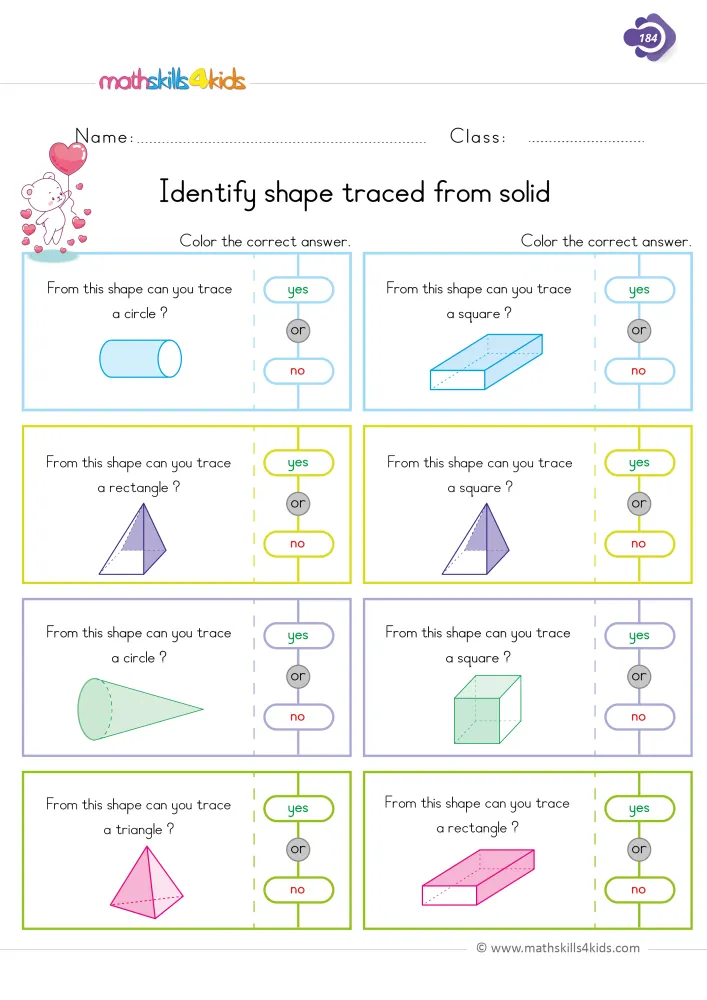
Download the worksheet: 1st Grade Shapes Traced from Solids Worksheet: Can You Trace It?
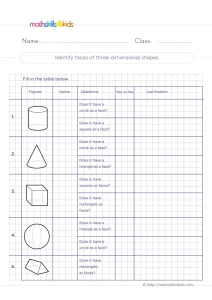 Worksheet3rd Grade Flat and Curved Faces Worksheet: Circles, Squares, Triangles
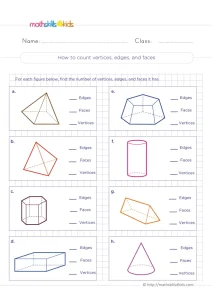 Worksheet3rd Grade Count Edges of 3D Shapes Worksheet: Faces and Vertices Too
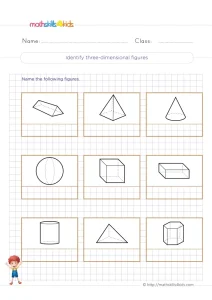 Worksheet3rd Grade Naming Solid Figures Worksheet: Prisms, Pyramids and More
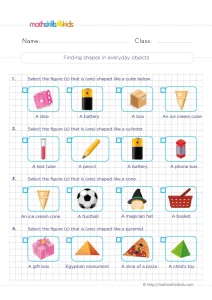 Worksheet3rd Grade Finding Shapes in Everyday Objects Worksheet: 16 Pictures
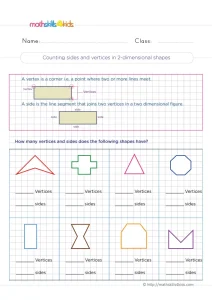 Worksheet3rd Grade Counting Sides and Vertices Worksheet: 8 Flat Shapes
A few related activities
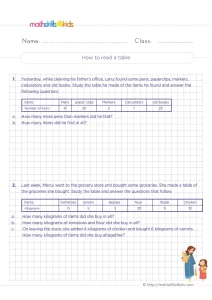 Two small tables, one of office items and one of groceries in kilograms. Your child finds the numbers,…See the activity3rd Grade 1 Times Table Worksheet: 18 Column Facts and the Identity Rule
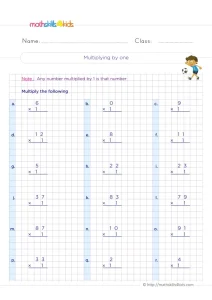 Eighteen column facts times 1, from 0 × 1 to 91 × 1. One rule solves them all:…See the activity3rd Grade Expressions for Arrays Worksheet: Write Each Product
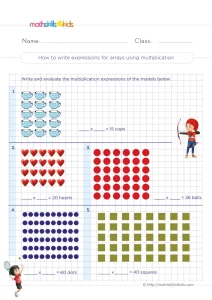 Five arrays of cups, hearts, balls, dots and squares. Your child writes the multiplication expression for each one…See the activity
