2nd Grade Addition and Subtraction Vocabulary Worksheet: Addend, Sum, Difference
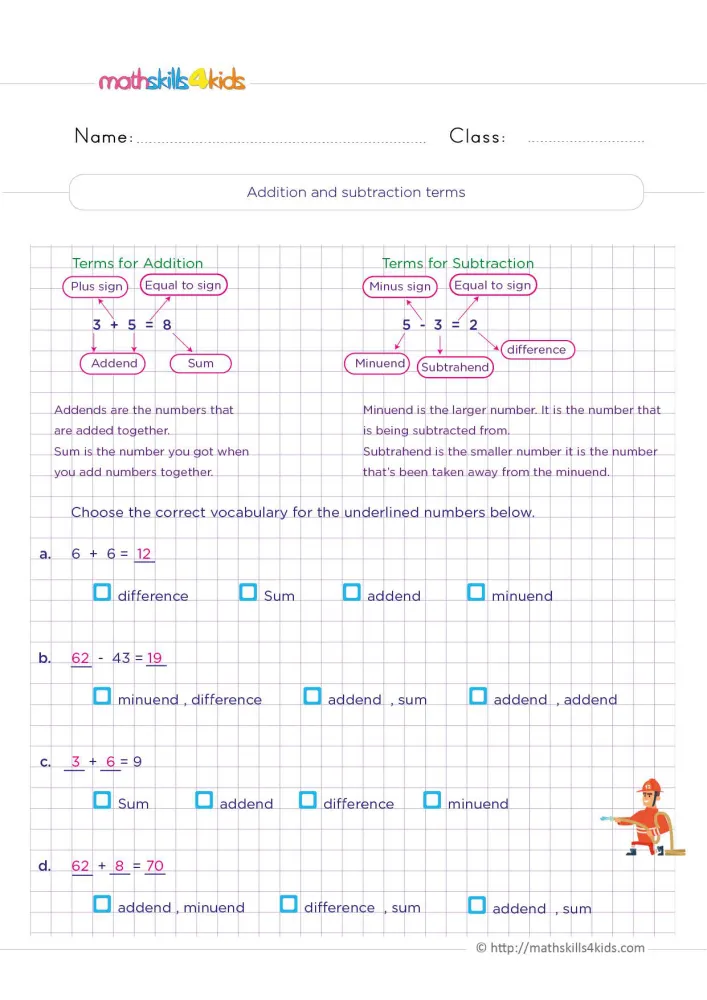
A seven-year-old can solve 62 − 43 and still freeze when the teacher asks, "What is the difference?" The math is fine; the word is the problem. This 2nd grade addition and subtraction vocabulary worksheet gives those words a clear home. At the top, two small diagrams label every part of 3 + 5 = 8 and 5 − 3 = 2: the plus sign, the minus sign, the equal sign, the addend, the sum, the minuend, the subtrahend and the difference. Short definitions sit underneath. Below, four equations have numbers underlined, and your child ticks the box with the matching word. A cartoon firefighter with a hose adds a bit of action. A second page gives the answer key.
Why the names of the numbers matter
Teachers and word problems use these terms all the time: "Find the sum," "What is the difference?" As a result, when a child knows the words, instructions stop being a puzzle and the thinking can start right away.
The page builds math vocabulary in a tidy way. Each diagram uses arrows to point from a word to its number, so the term is always tied to a place in the equation. For example, the sum is always on the far side of the equal sign in an addition.
However, second graders do not need every word on day one. Addend, sum and difference are the core ones; minuend and subtrahend are a bonus. Knowing that the sum and difference are both results is the real goal.
At the table: two words at once
Items a and c ask about one kind of number at a time. Then read each equation aloud and ask, "Is this number a part, or the answer?"
However, item b is the tricky one. Two numbers are underlined in 62 − 43 = 19, so the right box names two words. A child may tick "addend, sum" because those words feel familiar. Instead of correcting, ask, "Is there a plus sign here?"
Finally, in item d, 62 + 8 = 70, let your child touch each underlined number and name it before choosing a box.
Also, use the diagrams as a dictionary. Point to them. Children often find the answer there on their own.
After the page: use the words out loud
New words stick when they are spoken. At snack time, put 3 crackers next to 5 and ask, "What is the sum?" Then eat 2 and ask for the difference. Use the real terms, not "the answer".
Also, a quick round of Simon Says works well, since it turns listening into a game. Write a few numbers on paper, then call, "Simon says touch the addend," or, "Simon says point to the difference." Your child has to listen for the word and find the number.
When you check the answer key together, praise the precise language: "You used the word difference correctly." Naming things well is a real math skill.
About this 2nd grade addition and subtraction vocabulary worksheet and key
Download the worksheet: 2nd Grade Addition and Subtraction Vocabulary Worksheet: Addend, Sum, Difference
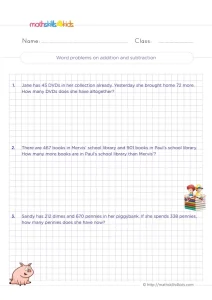 Worksheet3rd Grade Addition and Subtraction Problems: 3 Stories
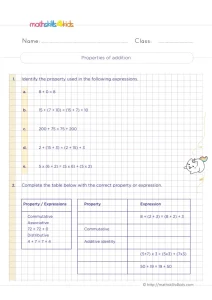 Worksheet3rd Grade Addition Properties Worksheet: Commutative, Associative, Identity
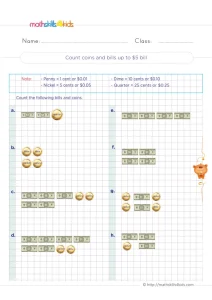 Worksheet3rd Grade Count Coins and Bills Worksheet: 8 Money Totals
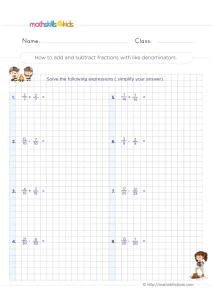 Worksheet3rd Grade Adding and Subtracting Like Fractions Worksheet: Eight Sums
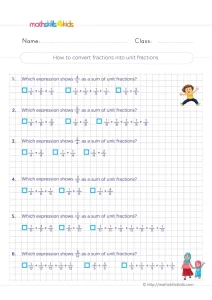 Worksheet3rd Grade Writing Fractions as Unit Fraction Sums Worksheet: Tick One
A few related activities
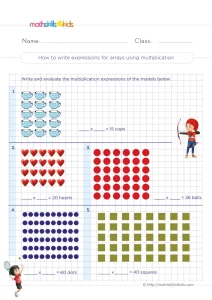 Five arrays of cups, hearts, balls, dots and squares. Your child writes the multiplication expression for each one…See the activity3rd Grade Reading a Data Table Worksheet: 2 Tables
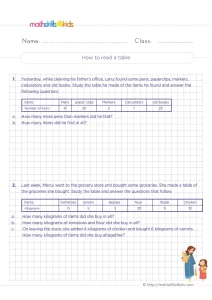 Two small tables, one of office items and one of groceries in kilograms. Your child finds the numbers,…See the activity3rd Grade 1 Times Table Worksheet: 18 Column Facts and the Identity Rule
 Eighteen column facts times 1, from 0 × 1 to 91 × 1. One rule solves them all:…See the activity
