2nd Grade Adding and Subtracting to 1000 Worksheet: 15 Column Problems
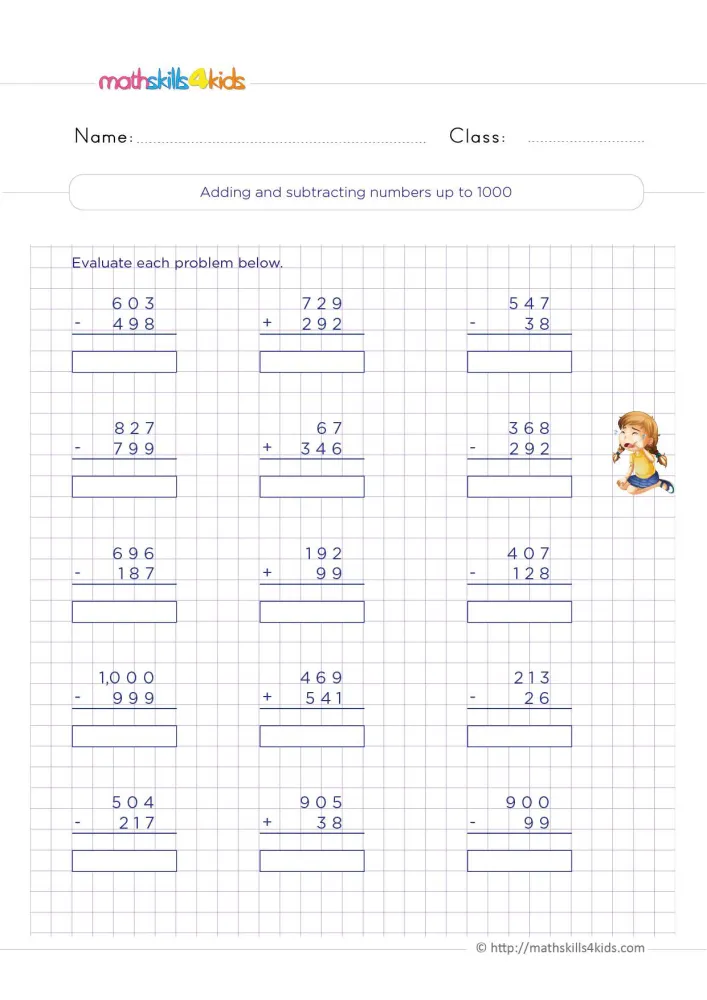
Hand a seven-year-old 603 - 498 and you may see the pencil hover over the zero for a long time. There is nothing to take from, and the hundreds seem far away. This 2nd grade adding and subtracting to 1000 worksheet puts that puzzle right at the top. The page holds fifteen problems set out in columns, each with a box for the answer. The middle column adds, and the two outer columns subtract. Numbers range from 26 up to 1,000, and several problems, like 900 - 99, push your child to regroup more than once. A second page gives the answer key.
Why the zeros make this page
Writing numbers in columns lines up hundreds, tens and ones, so each digit meets its partner. That is the whole idea behind column addition and subtraction: work one place at a time, from the ones to the hundreds.
The hard moments come when a column cannot manage on its own. In 729 + 292, the ones make 11, so ten ones become a new ten. In subtraction with regrouping, one ten turns back into ten ones.
This page leans on zeros: 603 - 498, 504 - 217, 900 - 99, and 1,000 - 999. Regrouping across zeros means borrowing from the hundreds, then passing a ten down to the ones. It takes two moves instead of one.
Mastering this with three-digit numbers sets up every larger calculation later. Patience pays here.
At the table: start with 603 - 498
Point to the ones column of 603 - 498. A common slip is to flip the digits and subtract 3 from 8. If your child writes 5 in the ones place, ask, "Which number is on top?"
Next comes the zero in the tens. Ask, "Where can we get a ten?" Let your child discover that the hundreds have to help first.
The middle column brings a different surprise. Two of the sums, 729 + 292 and 469 + 541, pass 1,000, so the answer needs four digits. Some children squeeze them into three.
Also, show a quick check for subtraction. For example, after 368 - 292, add the answer back to 292 and see whether you land on 368. Checking this way makes mistakes easy to spot.
Prices, pages and a swim race
Big numbers live in ordinary places. For example, on a long drive, look at road signs and ask how far apart two towns are. When reading a chapter book, find how many pages remain until the end.
Prices work too, so write two price tags, such as $5.04 and $2.17, and ask your child to line the digits up in columns before finding the difference.
For a story, Shark Swimathon by Stuart J. Murphy follows a shark swim team counting laps toward a goal, subtracting two-digit numbers with regrouping along the way. While you read, keep track of the laps together on paper.
Finally, check the page with the answer key and praise the method: "You regrouped through every zero." That takes real focus.
About this 2nd grade adding and subtracting to 1000 worksheet and key
Download the worksheet: 2nd Grade Adding and Subtracting to 1000 Worksheet: 15 Column Problems
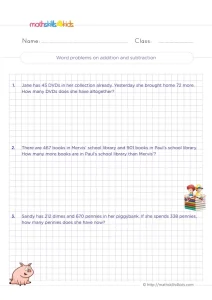 Worksheet3rd Grade Addition and Subtraction Problems: 3 Stories
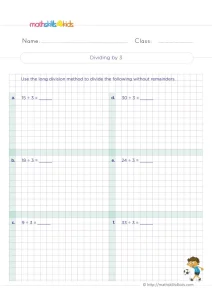 Worksheet3rd Grade Divide by 3 Worksheet: Long Division Without Remainders
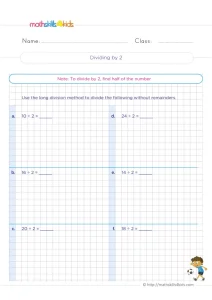 Worksheet3rd Grade Divide by 2 Worksheet: Long Division with Even Numbers
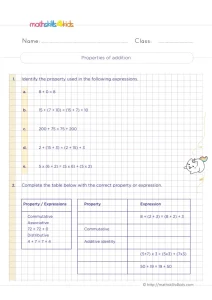 Worksheet3rd Grade Addition Properties Worksheet: Commutative, Associative, Identity
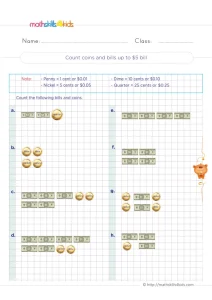 Worksheet3rd Grade Count Coins and Bills Worksheet: 8 Money Totals
A few related activities
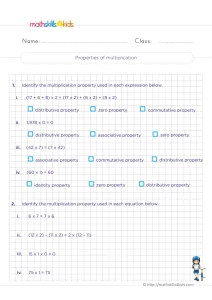 Tick the right property for four equations, from 1,978 x 0 = 0 to (60 x 1) =…See the activity3rd Grade 8 Times Table Worksheet: 12 Column Facts and a Doubling Trick
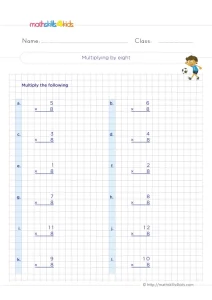 Twelve column facts times 8, from 1 × 8 to 12 × 8, in a mixed order. Double…See the activity3rd Grade Change and Total Cost Worksheet: Money Word Problems
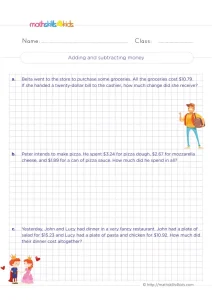 Three money word problems about groceries, a pizza and a dinner out. Children find the change from a…See the activity
