2nd Grade Match Analog and Digital Clocks Worksheet: Draw a Line to the Same Time
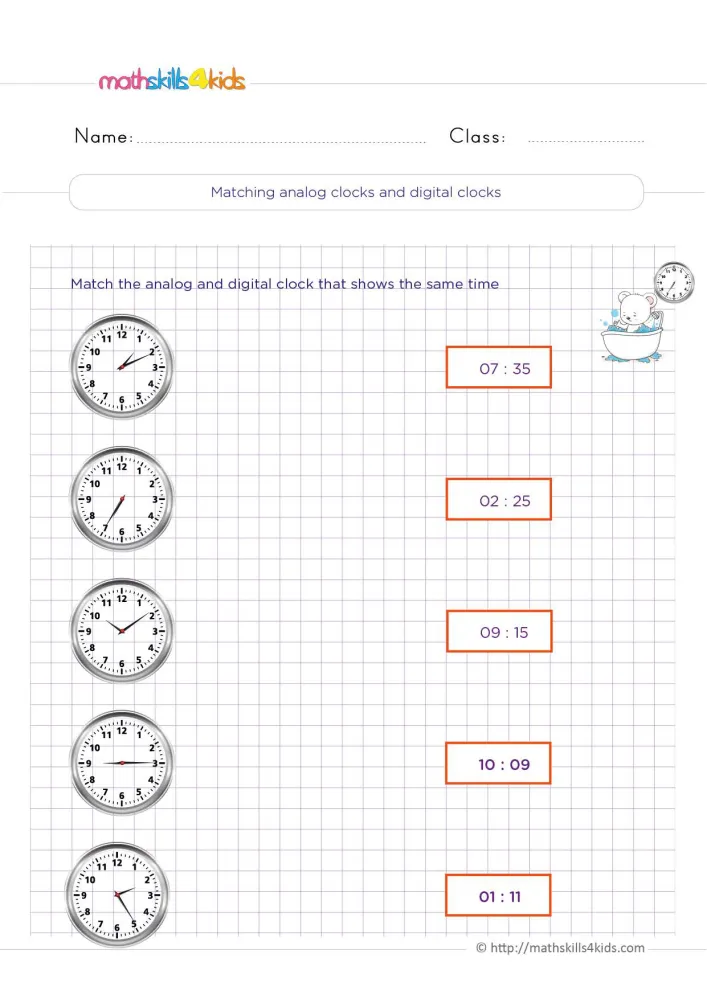
Ask a seven-year-old the time and they will glance at the microwave, not the wall clock, because digits feel easier than hands. This 2nd grade match analog and digital clocks worksheet joins the two. Five round clocks line the left side of a purple grid, each with a short hand and a long hand. On the right, five orange boxes show digital times: 07:35, 02:25, 09:15, 10:09 and 01:11. Your child reads each clock, finds the box with the same time, and draws a line between them. A little mouse in a bathtub keeps watch in the corner. A second page gives the answer key.
Why two kinds of clocks tell one time
A digital time gives the answer ready-made: hours before the colon, minutes after it. A clock face asks the child to build that answer from two hands, so reading it takes real understanding.
The hour hand is short and moves slowly between numbers, while the minute hand is long, and each number it points to stands for five minutes. That is why skip counting by fives matters here.
The page also mixes easy times like 9:15 with exact ones like 10:09 and 1:11. Those last two ask your child to count the small marks between the numbers, one minute at a time. Careful eyes win.
At the table: the clocks at 2:25 and 10:09
Start with the fourth clock, where both hands sit almost flat across the face. Ask, "Which hand is short? Where does it point?" Then let your child find the matching box.
The last clock, showing 2:25, is a common trap. The hour hand sits past the 2, and some children read it as 5:10 by swapping the hands. Instead of correcting, ask, "Which hand is longer? So which one tells the minutes?"
For 10:09, the long hand stops just short of the 2. So your child must count the small marks from the 12, while a pencil keeps the place. Also, a pencil tip touching each mark while counting keeps the count honest.
Clocks all around the house
Most homes have both kinds of clock. At breakfast, ask your child to read the clock face on the wall, then check the oven display. If the two agree, then they read it right, and if not, you can look at both together.
When playing Hide and Seek, let the seeker count by fives to sixty, just like the minute hand going around once.
You can also draw a big clock face on paper and use two strips of card as hands. Call out a digital time and let your child set the hands.
Once you finish the page, check it with the answer key together and praise the looking: "You checked which hand was longer every time. That is careful reading."
About this 2nd grade match analog and digital clocks worksheet and key
Download the worksheet: 2nd Grade Match Analog and Digital Clocks Worksheet: Draw a Line to the Same Time
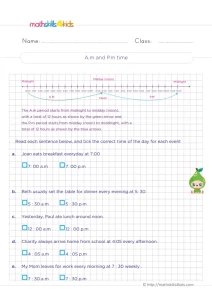 Worksheet3rd Grade AM and PM Time Worksheet: 5 Daily Events
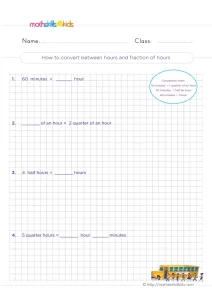 Worksheet3rd Grade Fractions of an Hour Worksheet: Half Hours and Quarters
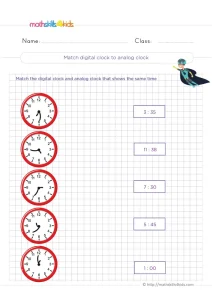 Worksheet3rd Grade Matching Digital and Analog Clocks Worksheet: Draw a Line
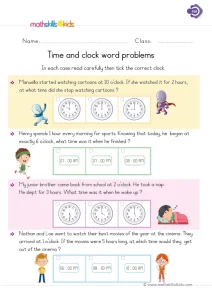 Worksheet1st Grade Elapsed Time Worksheet With Clocks: Add Whole Hours, Tick the End Time
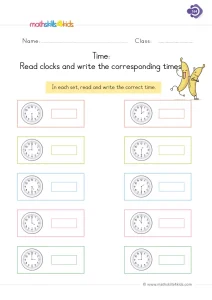 Worksheet1st Grade Read Analog Clocks Worksheet: Write the Time to the Half Hour
A few related activities
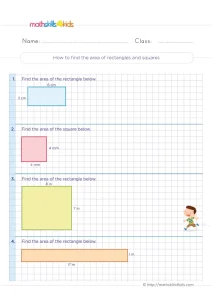 Three rectangles and one square, each with its side lengths. Your child multiplies length by width to find…See the activity3rd Grade Naming Solid Figures Worksheet: Prisms, Pyramids and More
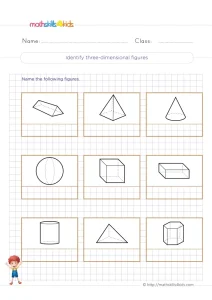 Nine drawn solids to name, from a cube and a cone to a hexagonal prism and a triangular…See the activity3rd Grade Count Edges of 3D Shapes Worksheet: Faces and Vertices Too
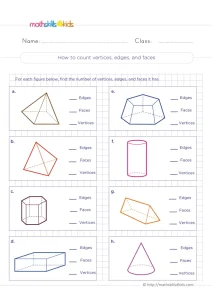 Eight drawn solids, from a square pyramid to a hexagonal prism and a cone. Count the edges, faces…See the activity
