2nd Grade Money Totals up to 5 Dollars Worksheet: Count Bills and Coins
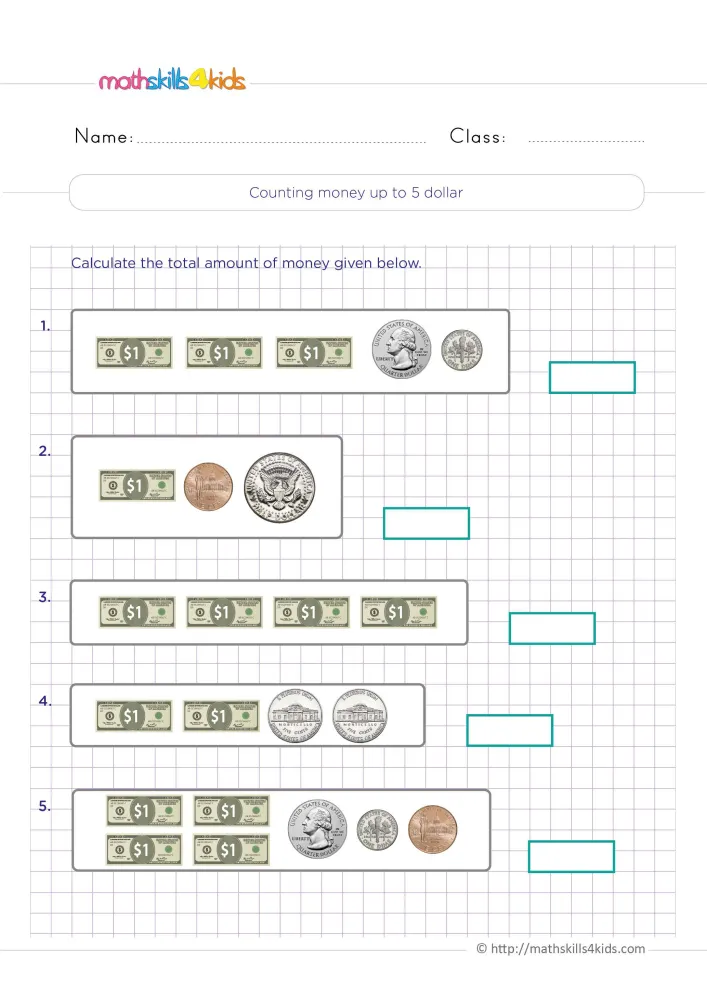
A seven-year-old who knows that a quarter is 25 cents may still freeze when a dollar bill joins the pile: is it 100, or 1? This 2nd grade money totals up to 5 dollars worksheet works on that bridge. The page shows five boxes on a purple grid, each with a few dollar bills and some coins. Box 3 holds four bills and nothing else, while box 5 mixes four bills with a quarter, a dime and a penny. One box even has a big half dollar. Your child finds each total and writes it in the empty frame. A second page gives the answer key, with box 1 worked out step by step.
Why dollars and cents need two parts
Money written as $3.35 tells two stories at once. The number before the decimal point counts whole dollars, and the two digits after it count cents. Children need to keep these apart, much like tens and ones, so the best habit is to count the bills first, then the coins.
For example, three bills make $3; then a quarter and a dime add 35 cents. The answer key shows exactly that path for box 1.
The page also brings back the dollar sign, written in front of the number. That small symbol matters: $4 and 4¢ are very different amounts. Write it every time.
At the table: box 2 and box 4
Start with box 3. Ask, "How many bills? So how many dollars?" and most children get it at once.
Box 2 holds the half dollar, a coin many children have never seen, so ask, "What do you think half of a dollar is worth?" Then let them reason from 100 cents.
Box 4 is the classic trap. Two bills and two nickels, and a child may write $2.1 or $2.01. Point to the coins and ask, "How many cents do the nickels make?" Then show that ten cents needs two digits after the point. Also, saying the total out loud, "two dollars and ten cents," helps the writing come out right.
Paying with bills and coins
Real money is the best practice. Next time you shop, hand your child two or three bills and a few coins and ask for the money total before you pay. At home, a jar of coins and some play bills make a small shop.
The card game Go Fish adapts well: make pairs of cards where one shows coins and the other shows the same amount written with a dollar sign, then ask, "Do you have $1.25?"
Once you finish the page, check it with the answer key together and praise the order of the work: "You counted the bills first, then the coins. That kept it tidy."
About this 2nd grade money totals up to 5 dollars worksheet and its key
Download the worksheet: 2nd Grade Money Totals up to 5 Dollars Worksheet: Count Bills and Coins
 Worksheet3rd Grade Addition and Subtraction Problems: 3 Stories
 Worksheet3rd Grade Addition Properties Worksheet: Commutative, Associative, Identity
 Worksheet3rd Grade Change and Total Cost Worksheet: Money Word Problems
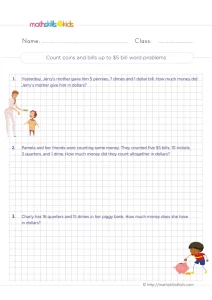 Worksheet3rd Grade How Much Money in All Worksheet: 3 Word Problems
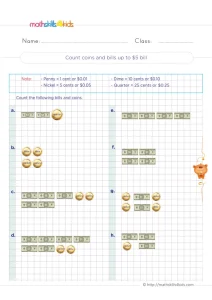 Worksheet3rd Grade Count Coins and Bills Worksheet: 8 Money Totals
A few related activities
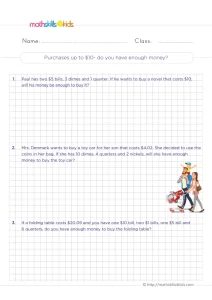 Three shopping stories with bills and coins. Children count the money, compare it with the price and decide…See the activity3rd Grade Multiplication Properties Worksheet: Zero, Identity, Commutative
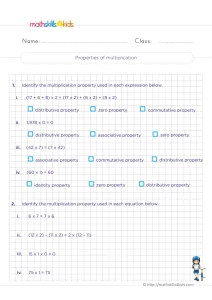 Tick the right property for four equations, from 1,978 x 0 = 0 to (60 x 1) =…See the activity3rd Grade 8 Times Table Worksheet: 12 Column Facts and a Doubling Trick
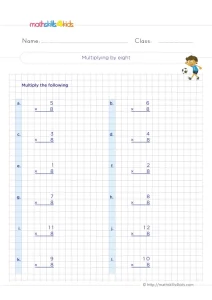 Twelve column facts times 8, from 1 × 8 to 12 × 8, in a mixed order. Double…See the activity
