2nd Grade Multiplying on a Number Line Worksheet: Count the Jumps
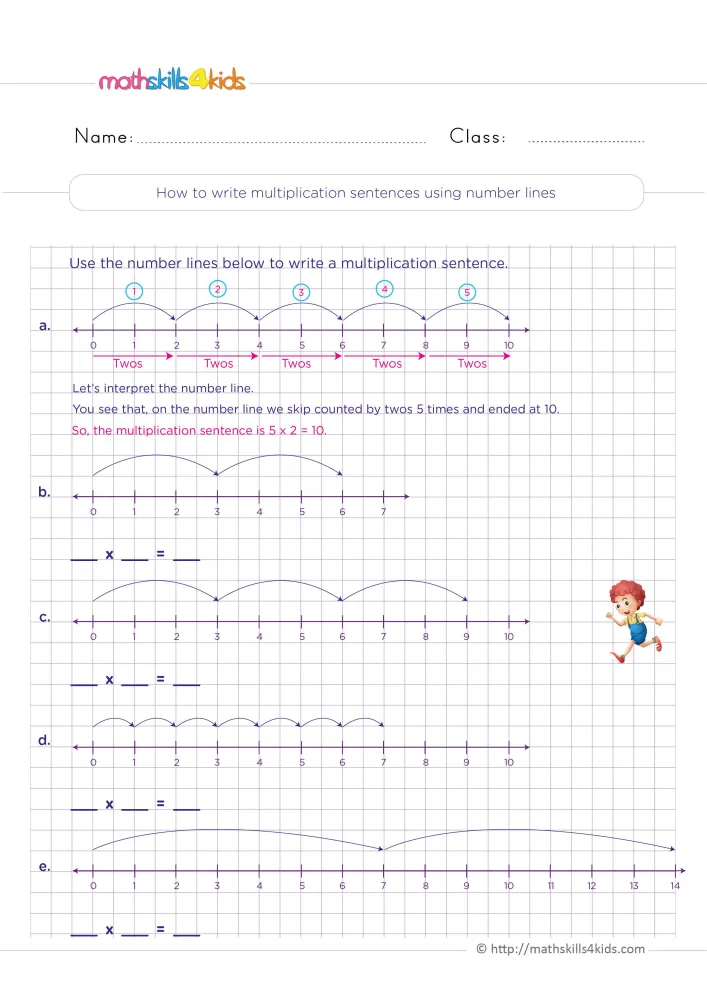
Watch a seven-year-old cross a room in giant steps, counting "two, four, six" as they land, and you are watching multiplication on the move. This 2nd grade multiplying on a number line worksheet puts those steps on paper. Five number lines run across the page, each with arcs that jump the same distance every time. The first one is a worked example: five jumps of two, labeled "Twos", land on 10, so the sentence is 5 × 2 = 10. Then your child takes over with four lines of their own, counts the jumps and their size, and writes each multiplication sentence. A second page gives the answer key.
Why a jump is a group
On a number line, each equal jump plays the same role as a group of objects. The number of jumps is the number of groups, and the length of each jump is how many are in each group. Where the last jump lands is the total.
This page builds directly on skip counting. The worked example is counting by twos: 2, 4, 6, 8, 10. Once your child sees that five jumps of two reach 10, the sentence 5 × 2 = 10 reads like a description, not a rule to memorize.
The lines also vary the jump size. Some arcs cover one space, others three, and the last line uses two long jumps of seven. So your child learns to read both numbers every time.
At the table: jumps, not marks
Before writing anything, ask your child to trace each arc with a finger. "How many jumps?" comes first, then "How far is each jump?"
Line d is where most children slip. It has many tiny jumps of one, and the tick marks are close together. A child may count the marks, including zero, instead of the jumps. Instead of correcting, ask, "Where does the first jump start? Where does it land?" Then count again, one arc at a time.
Line e has the opposite challenge: only two arcs, but each one is long. Ask, "Where did the first jump land?" and let your child read the number below it. That landing spot is the jump size. Tap it.
Sidewalk lines and Hopscotch
A number line on the floor makes this page physical. Use painter's tape or chalk to mark 0 to 20, then ask your child to jump in threes and call out each landing spot. Also, try it with stairs: two steps at a time, five times, and see where you end up.
Hopscotch is a natural partner. Before a turn, ask how many hops it takes to reach the last square if every hop covers two squares. These hops on a number line become a game rather than a worksheet.
When the page is done, check it against the answer key together and praise the tracing: "You followed every arc to its end. That is careful counting."
About this 2nd grade multiplying on a number line worksheet and its key
Download the worksheet: 2nd Grade Multiplying on a Number Line Worksheet: Count the Jumps
 Worksheet3rd Grade Area with Length and Width Worksheet
 Worksheet3rd Grade Two-Step Multiply and Divide Problems: 3 Stories
 Worksheet3rd Grade Expressions for Arrays Worksheet: Write Each Product
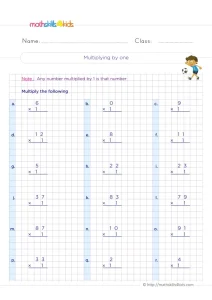 Worksheet3rd Grade 1 Times Table Worksheet: 18 Column Facts and the Identity Rule
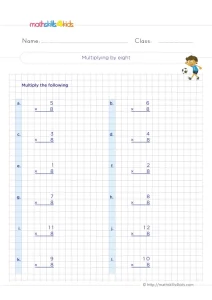 Worksheet3rd Grade 8 Times Table Worksheet: 12 Column Facts and a Doubling Trick
A few related activities
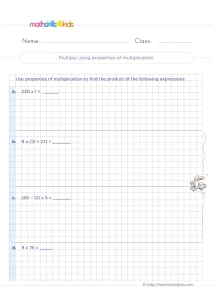 Work out four products, from 230 x 1 to 9 x 75, with the identity, distributive and commutative…See the activity3rd Grade Multiplication Properties Worksheet: Zero, Identity, Commutative
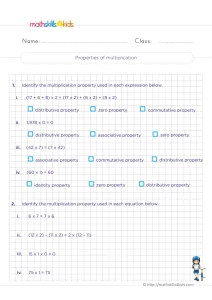 Tick the right property for four equations, from 1,978 x 0 = 0 to (60 x 1) =…See the activity3rd Grade Count Edges of 3D Shapes Worksheet: Faces and Vertices Too
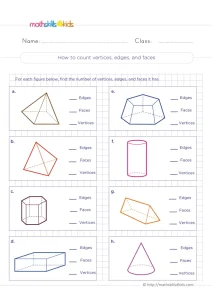 Eight drawn solids, from a square pyramid to a hexagonal prism and a cone. Count the edges, faces…See the activity
