3rd Grade Subtraction Patterns Worksheet: Over Increasing Place Values
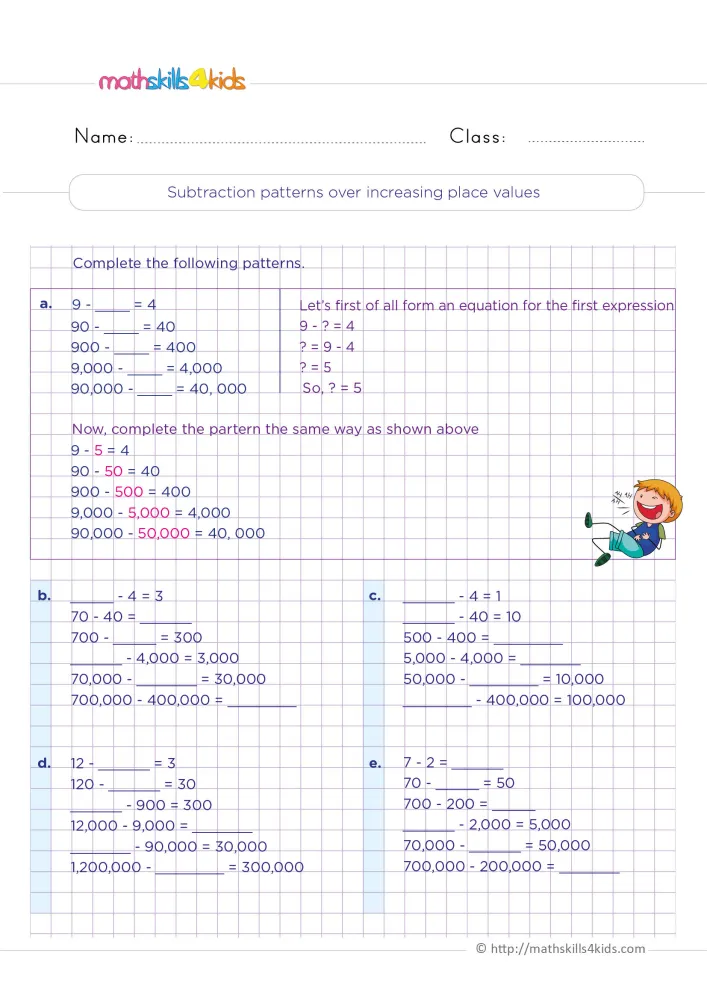
If 7 − 4 = 3, what is 7,000 − 4,000? This 3rd grade subtraction patterns worksheet builds big subtractions from small basic facts. A worked example starts with 9 − 5 = 4 and grows it to 90,000 − 50,000. Then four patterns of six lines each ask your child to fill the blanks. Sometimes the missing number is the answer, sometimes the first or second number. A second page gives the answer key.
Same fact, bigger places
Each line keeps the same basic fact and adds a zero to every number. 12 − 9 = 3 becomes 120 − 90 = 30, then 1,200 − 900 = 300.
The digits do not change, only their place. That is place value at work.
The last lines reach 1,200,000, far beyond third grade. Let your child count the zeros rather than read the number aloud.
At the table: find the fact first
Before filling a pattern, ask, "Which small fact is hiding here?" In e, it is 7 − 2 = 5.
Then look at where the blank is. In 500 − 400 = ___, it is the answer. In ___ − 4,000 = 3,000, it is the first number, so your child adds: 3,000 + 4,000.
Count the zeros on both sides of the = sign. They must match.
Check all four patterns with the key.
Quick mental math
Use money: 70 cents minus 40 cents, then 7 dollars minus 4 dollars, then 70 dollars minus 40. Your child will see the same 3 each time.
Notice the pattern out loud together: "You used one fact to solve six problems."
About this 3rd grade subtraction patterns worksheet and its answers
Download the worksheet: 3rd Grade Subtraction Patterns Worksheet: Over Increasing Place Values
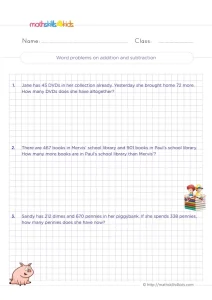 Worksheet3rd Grade Addition and Subtraction Problems: 3 Stories
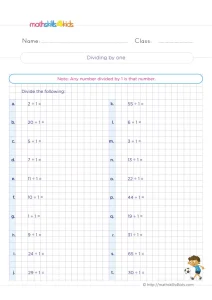 Worksheet3rd Grade Divide by 1 Worksheet: 20 Facts and the Rule of One
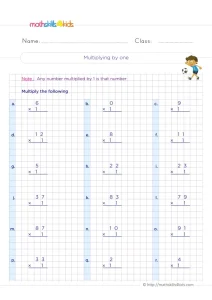 Worksheet3rd Grade 1 Times Table Worksheet: 18 Column Facts and the Identity Rule
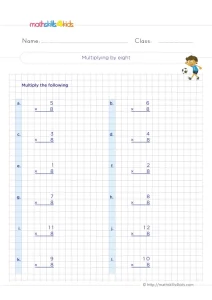 Worksheet3rd Grade 8 Times Table Worksheet: 12 Column Facts and a Doubling Trick
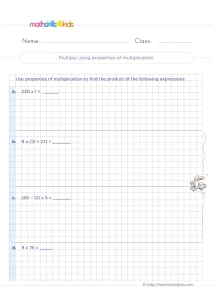 Worksheet3rd Grade Multiplication Worksheet: Find Products Using Properties
A few related activities
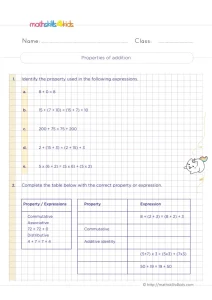 Five number sentences to name, from 8 + 0 = 8 to 5 x (6 + 2). Then…See the activity3rd Grade Multiplication Properties Worksheet: Zero, Identity, Commutative
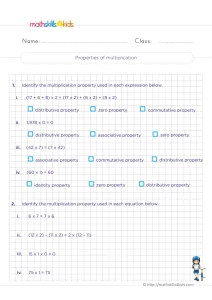 Tick the right property for four equations, from 1,978 x 0 = 0 to (60 x 1) =…See the activity3rd Grade AM and PM Time Worksheet: 5 Daily Events
 Five everyday events, from breakfast to dinner. Your child reads each time and ticks a.m. or p.m. using…See the activity
