3rd Grade Times 10 Worksheet: 12 Column Facts and the Place Value Shift
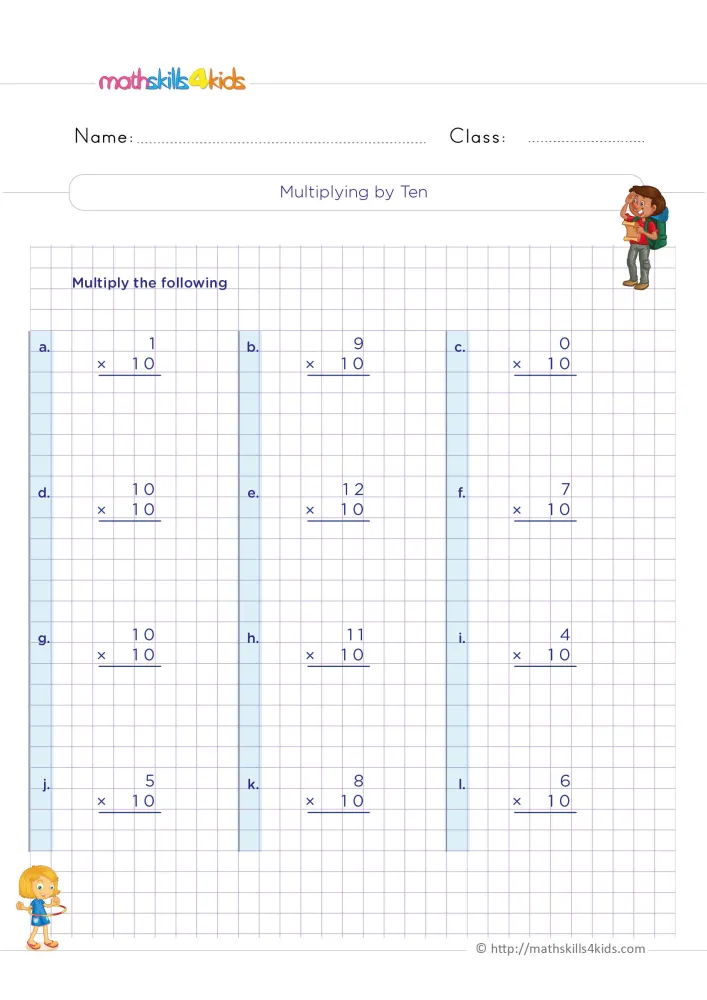
Multiplying by 10 is the first big pattern children meet in the times tables. It also opens the door to place value. This 3rd grade times 10 worksheet lists 12 facts written in columns, labeled a to l, with numbers from 0 to 12. A child with a big backpack stands by the title, and a girl waves from the bottom corner. Every answer is a whole number of tens, which makes the page quick to check. A second page gives the answer key.
Why a zero appears
Ten groups of 7 make 7 tens, and 7 tens is 70. The 7 moves from the ones place to the tens place, and a zero holds the ones place.
That is why "just add a zero" works here. Yet your child should also say the reason. Saying "7 tens" out loud ties the fact to tens and ones. It will help later with 10 × 40 or 10 × 300.
At the table: the tricky ones
Item c, 0 × 10, trips up quick workers. Ten groups of nothing make 0, not 10 and not 00. Item a, 1 × 10, gives 10.
The fact 10 × 10 comes up twice, in items d and g, so the second one is a free point. Items e and h, 12 × 10 and 11 × 10, pass 100 and count as a stretch for third grade. The answer key writes each column multiplication in two rows before the total; at this age, the place value shift is enough.
After the page: dimes and dollars
Use dimes. Eight dimes are worth 80 cents, so 8 × 10 = 80. Let your child count out the coins for a few facts on the page.
Then try it the other way: say a total like 60 cents, and your child finds how many dimes make it. Multiplying by 10 becomes a habit, not a rule to memorize.
About this 3rd grade times 10 worksheet and its two-page answer key
Download the worksheet: 3rd Grade Times 10 Worksheet: 12 Column Facts and the Place Value Shift
 Worksheet3rd Grade Area with Length and Width Worksheet
 Worksheet3rd Grade Two-Step Multiply and Divide Problems: 3 Stories
 Worksheet3rd Grade Expressions for Arrays Worksheet: Write Each Product
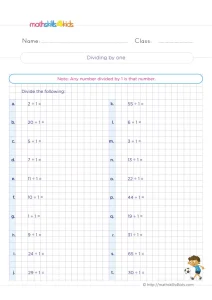 Worksheet3rd Grade Divide by 1 Worksheet: 20 Facts and the Rule of One
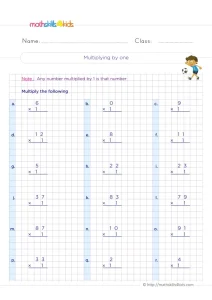 Worksheet3rd Grade 1 Times Table Worksheet: 18 Column Facts and the Identity Rule
A few related activities
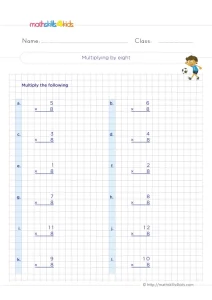 Twelve column facts times 8, from 1 × 8 to 12 × 8, in a mixed order. Double…See the activity3rd Grade Multiplication Properties Worksheet: Zero, Identity, Commutative
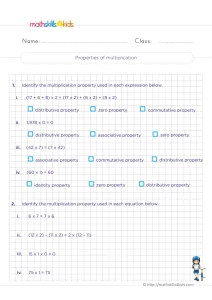 Tick the right property for four equations, from 1,978 x 0 = 0 to (60 x 1) =…See the activity3rd Grade Multiplication Worksheet: Find Products Using Properties
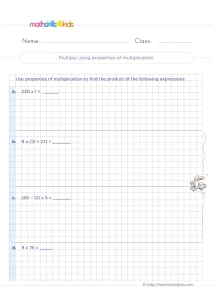 Work out four products, from 230 x 1 to 9 x 75, with the identity, distributive and commutative…See the activity
