The Dreyfus Affair: a Republic Under Challenge
In 1894, an innocent officer was convicted of treason. For twelve years, his fate divided France. How does a miscarriage of justice turn into a crisis for the whole Republic?
This lesson takes about 15 minutes. You can take a break after each part.
Before you start
Learning objectives
- I can tell the main stages of the Dreyfus Affair, from 1894 to 1906.
- I can explain why the injustice done to Dreyfus lasted so long.
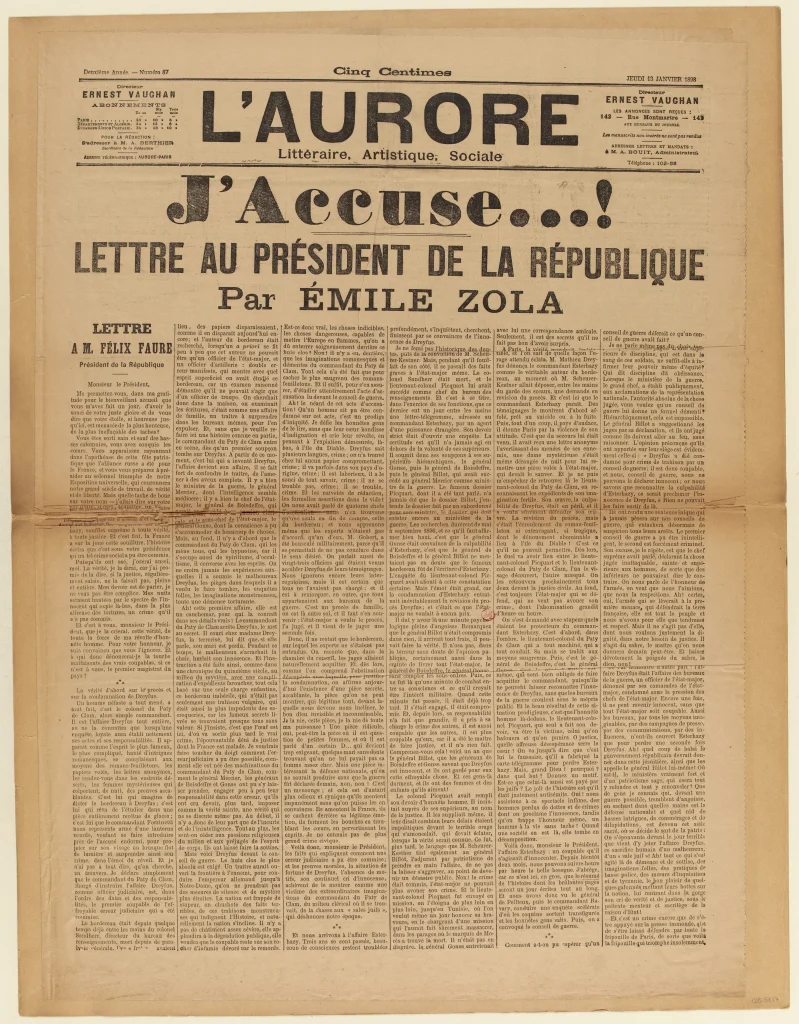
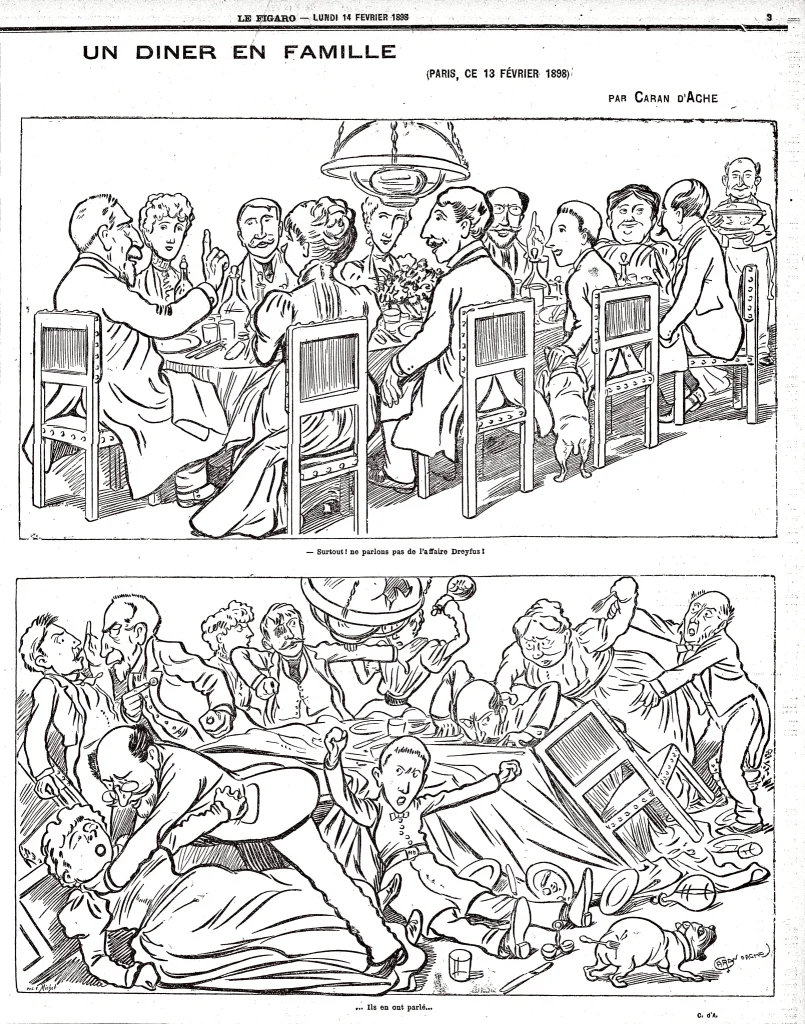
- I can read a newspaper front page and a press cartoon from 1898.
- I can say who challenged the Republic between 1870 and 1905, and how it held firm.
An officer wrongly accused (1894)
Convicted of treason
In 1894, the army found out that an officer was handing military secrets to Germany. Captain Alfred Dreyfus, a Jewish officer, was accused. He was innocent.
A court-martial, a military court, convicted him. Dreyfus was publicly stripped of his rank, then deported to French Guiana, to Devil’s Island.
Why the injustice lasted
Several reasons were mixed together. Forged documents accused Dreyfus. The army refused to admit its mistake, even when faced with proof.
Antisemitism, hatred of Jews, was widespread in part of the press and public opinion: it also explains the accusation and the violence of the debate.
Loading the questions…
France torn apart: “J'accuse…!” (1898)
Zola accuses
On January 13, 1898, the writer Émile Zola published “J’accuse…!” (I accuse!) on the front page of the newspaper L’Aurore. In this letter to the President of the Republic, he accused the army’s leaders of having an innocent man convicted.
Zola was convicted of libel and had to flee to England. But the Affair had become a great public debate.
Dreyfusards and anti-Dreyfusards
The Dreyfusards demanded a retrial in the name of justice and truth. In 1898, some of them founded the Human Rights League.
The anti-Dreyfusards refused to retry Dreyfus, in the name of the army’s honor.
Loading the questions…
From Rennes to exoneration (1899-1906)
Pardoned, not yet cleared
In 1899, Dreyfus was retried in Rennes. He was convicted again, with “extenuating circumstances.” President Loubet pardoned him: he was free, but a pardon does not say he was innocent.
In 1906, the Court of Cassation exonerated him: the justice system recognized his innocence, and he returned to the army.
What the Affair put at stake
The Affair, from 1894 to 1906, called the principles of the Republic into question: justice, the equality of all before the law, and the rights of each individual.
When the justice system admitted its mistake, the Republic came out stronger.
Loading the questions…
A Republic still challenged (1870-1905)
The Republic’s opponents
From 1870 to 1905, the Republic was still debated and challenged. The monarchists wanted to give power back to a king. Part of the Catholic Church rejected a Republic that removed religion from schools and from the State. The nationalists called for a strong government.
1877 and 1905: the Republic holds firm
In 1877, President Mac Mahon dissolved the Chamber of Deputies. But the voters sent back a republican majority, and he had to give in.
In 1905, after long debates, the law separating the Churches and the State was passed: the State no longer paid for any religion and guaranteed freedom of conscience.
Loading the questions…
Review game
Final assessment
To master the lesson, you need at least 60% correct answers.
Loading the assessment…
Summary
- In 1894, Captain Dreyfus, an innocent man, was convicted of treason. Forged documents, an army that refused to admit its mistake, and antisemitism explain the injustice.
- In 1898, with “J’accuse…!”, Zola relaunched the Affair. France split between the Dreyfusards, who defended justice, and the anti-Dreyfusards, who put the army first.
- Retried in 1899 and then pardoned, Dreyfus was only exonerated in 1906. By recognizing his innocence, the Republic put the rights of each individual before reason of state.
- Monarchists, part of the Catholics and nationalists challenged the Republic. It held firm: in 1877 against Mac Mahon, and in 1905 with the law separating the Churches and the State.
A few related activities
 GameHistory, French curriculum 4e — Society, culture and politics in 19th-century FranceHistory review game, French curriculum 4e: society, culture and politics in 19th-century France. Every answer is checked and…See the activity
