Women in 19th-Century France
In 19th-century France, women worked, raised their children, learned to read… but they could not vote, and the law placed them under their husband’s authority. What place did they have in society, and how did some of them fight for equality?
This lesson takes about 15 minutes. You can take a break after each part.
Before you start
Learning objectives
- I can say which rights the law refused women in 19th-century France.
- I can show that women worked and got more education, and name rights won between 1900 and 1909.
- I can explain how feminists demanded equality and the right to vote before 1914.
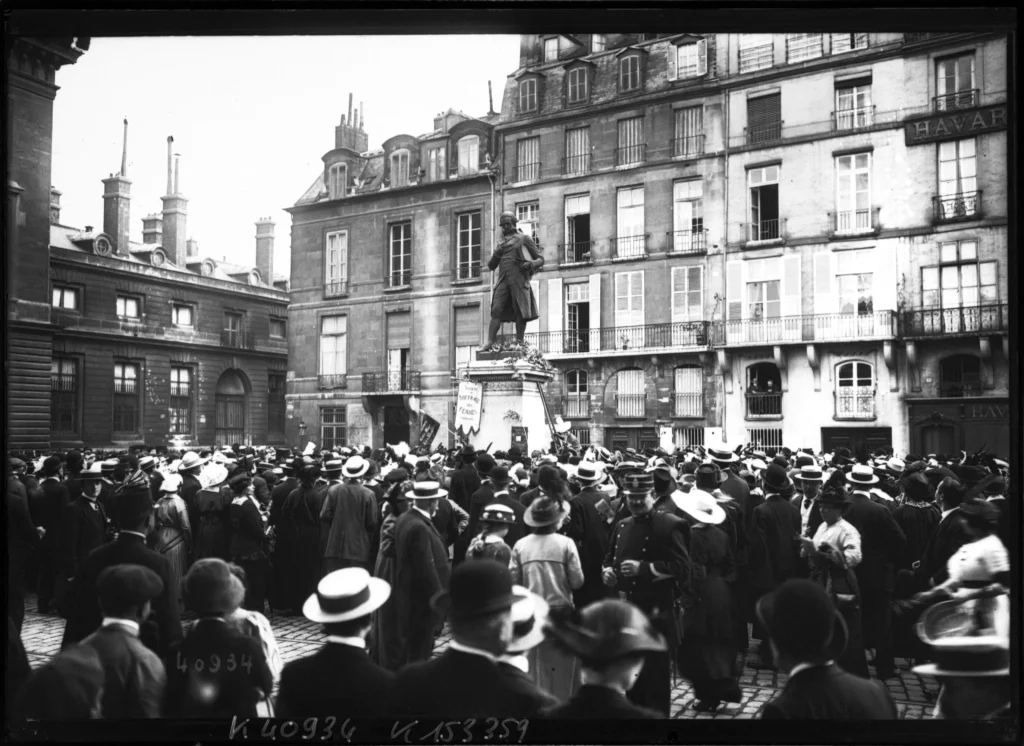
- I can read a photograph from 1914 and compare France with other European countries.
Women without the same rights as men
A married woman under her husband’s authority
The Civil Code of 1804 says that a wife owes “obedience to her husband”. A married woman cannot manage her property or go to court without his consent: she is treated like a minor.
In 1848, universal suffrage gave the right to vote to all men. Women remained excluded.
Women at work
In 1866, women made up about one third of the working population. Many were factory workers, for example in textile mills, or servants.
This figure is probably too low: many wives of farmers, craftsmen, or shopkeepers worked alongside their husbands without being counted as workers.
Rights won step by step
In 1861, Julie-Victoire Daubié became the first woman to pass the baccalauréat. A law of 1880 created girls’ high schools, which did not teach the same subjects as boys’ schools.
Other laws followed: women could become lawyers (1900), a married woman could keep her own wages (1907), and unpaid maternity leave protected their jobs (1909).
Loading the questions…
Women demand equality (1848-1914)
Feminists
Some women, and a few men, fought for women to have the same rights as men: they were feminists. They did not fight against men, but for equality.
Hubertine Auclert demanded the right to vote for women. In 1881, she founded a newspaper, La Citoyenne (The Citizen).
Making themselves heard
Activists wrote in newspapers, created associations, signed petitions, and demonstrated. In July 1914, in Paris, a crowd gathered at the statue of Condorcet, a philosopher who had asked for political rights for women as early as 1790.
Equality still far away
Before 1914, women won a few rights, one by one, but not the right to vote. Other European countries granted it before France: Finland in 1906, Norway in 1913.
In France, women only got the right to vote in 1944, and they voted for the first time in 1945.
Loading the questions…
Review game
Final assessment
To master the lesson, you need at least 60% correct answers.
Loading the assessment…
Summary
- In 19th-century France, the law does not give women the same rights as men: the Civil Code of 1804 places a wife under her husband’s authority, and the universal suffrage of 1848 is for men only.
- Yet women work and get more education. They win a few rights step by step: becoming a lawyer (1900), keeping their own wages (1907), maternity leave (1909).
- Feminists, such as Hubertine Auclert, demand equality and the right to vote: they write, form groups, sign petitions, and demonstrate.
- Before 1914, these advances remain limited: French women cannot vote, while Finland (1906) and Norway (1913) have granted it. They vote for the first time only in 1945.
A few related activities
 GameHistory, French curriculum 4e — Society, culture and politics in 19th-century FranceHistory review game, French curriculum 4e: society, culture and politics in 19th-century France. Every answer is checked and…See the activity
