1st Grade Add Three Numbers Worksheet: Doubles First, Then Make Ten
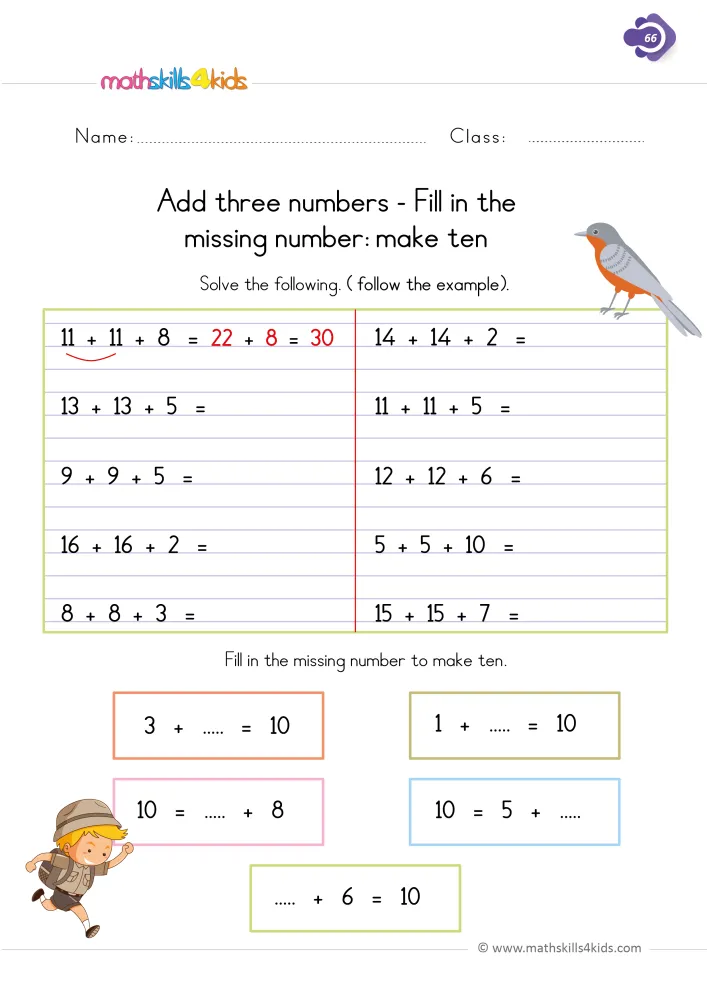
Give a six-year-old three numbers to add, and the usual plan is to go left to right, one long count. Yet 8 + 8 + 3 gets much easier once you spot the 8 + 8. This 1st grade add three numbers worksheet teaches that shortcut. In the top part, ten sums each start with a double, and the worked example shows the move: 11 + 11 + 8 becomes 22 + 8, then 30. Some totals go past 20, up to the thirties, so the doubles really earn their keep. In the bottom part, five boxes ask for the missing number to make ten, as in 3 + ... = 10. A second page gives the answer key.
Why the order of adding is a choice
With three numbers, your child may add them in any order and still get the same total. That freedom is the whole point here. Adding the doubles first turns a hard sum into an easy one, because doubles are facts many children already know.
The worked example draws a small arc under 11 + 11. That arc is a habit worth copying: spot the pair, join it, then add the third number.
The second part moves to make ten. Knowing the pairs that make ten, such as 3 and 7, is one of the strongest tools in 1st grade arithmetic. Later, your child will use it to add 8 + 5 by breaking the 5 apart. So these five boxes matter more than their size suggests.
At the table: when the equal sign comes first
Start with the example. Ask your child to trace the arc under 11 + 11 with a finger and say what it joins.
In the top part, the slip is often a long count from the first number. If your child starts counting 9 + 9 + 5 one by one, point to the pair and ask, "Do you already know this double?"
The likely slip in the bottom part comes in the pink box, 10 = ... + 8. With the equal sign on the left, a child may add 10 and 8 and write their total. Instead of correcting, ask, "What goes with 8 to make 10?"
Ten fingers settle it. Hold up eight, then let your child count the fingers still down. Also, read the box aloud as "ten is the same as" to show what the sign means.
Ten in the bed, three on the plate
Three-number sums show up at snack time. Put four crackers on a plate, four more beside them, then two more, and ask your child to find the double before counting. On the stairs, count two steps, then two more, then one, and say the total.
For make ten, the song "Ten in the Bed" helps. While you sing, hold up ten fingers and fold one down each time someone rolls out. Then ask how many rolled out and how many are left. Together they always make ten.
Once you finish the page, name the effort rather than the score: "You looked for the double before you added."
About this 1st grade add three numbers worksheet and its answer key
Download the worksheet: 1st Grade Add Three Numbers Worksheet: Doubles First, Then Make Ten
 Worksheet3rd Grade Addition and Subtraction Problems: 3 Stories
 Worksheet3rd Grade Addition Properties Worksheet: Commutative, Associative, Identity
 Worksheet3rd Grade Count Coins and Bills Worksheet: 8 Money Totals
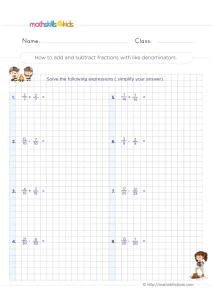 Worksheet3rd Grade Adding and Subtracting Like Fractions Worksheet: Eight Sums
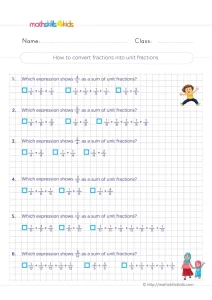 Worksheet3rd Grade Writing Fractions as Unit Fraction Sums Worksheet: Tick One
A few related activities
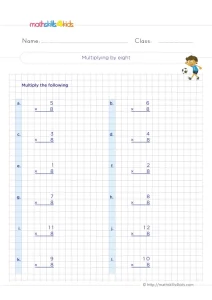 Twelve column facts times 8, from 1 × 8 to 12 × 8, in a mixed order. Double…See the activity3rd Grade Count Edges of 3D Shapes Worksheet: Faces and Vertices Too
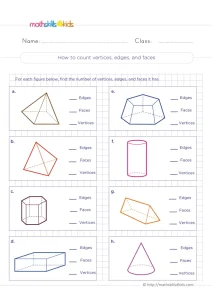 Eight drawn solids, from a square pyramid to a hexagonal prism and a cone. Count the edges, faces…See the activity3rd Grade Multiplication Worksheet: Find Products Using Properties
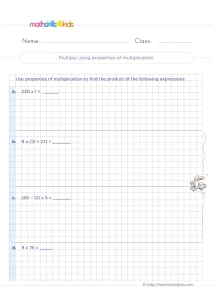 Work out four products, from 230 x 1 to 9 x 75, with the identity, distributive and commutative…See the activity
