1st Grade Adding 1 Worksheet: Fifteen Vertical Sums of One More
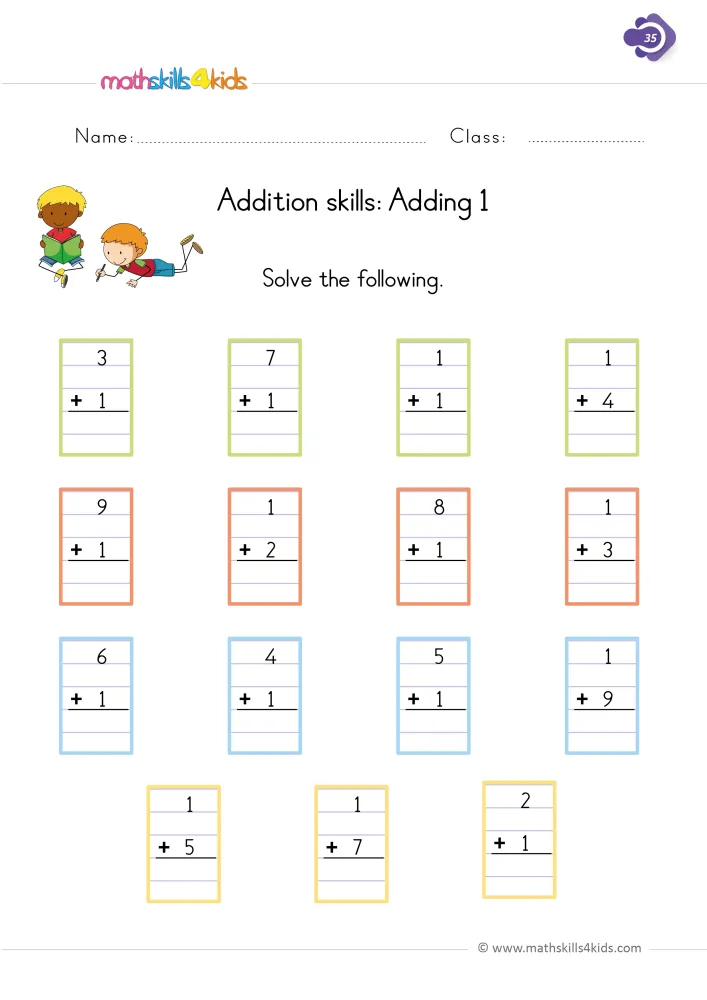
Ask a six-year-old what comes after 7, and the answer is quick. Ask for 7 + 1, and the same child may start counting on their fingers from one. This 1st grade adding 1 worksheet helps your child see that the two questions are really the same. Fifteen vertical sums sit in colored boxes, each with a line to write the answer under it. In most of them, 1 sits at the bottom, like 3 + 1 or 9 + 1. In others, 1 moves to the top, as in 1 + 4 or 1 + 9, and every total stays within the sums to 10. A second page gives the answer key.
Why plus one is just the next number
Adding 1 is often the first addition fact a child can do without counting. The answer is simply the next number in the counting sequence: 4 + 1 is the number after 4. Once your child notices that, a whole row of facts becomes easy, so attention is free for harder sums later.
The page also mixes the order. Look at the orange row: 9 + 1, then 1 + 2. Some children believe the bigger number must come first. Seeing 1 on top, then 1 below, shows that the order does not change the total. Same total, both ways.
Finally, the layout matters too. Each sum stacks one number above the other, with a line underneath for the answer. That is the format of vertical addition, which your child will use with bigger numbers.
At the table: when 1 sits on top
Start with 3 + 1 in the top left box. Ask what number comes right after 3, then let your child write it on the line.
The likely slip comes in a box like 1 + 4, at the end of the green row. A child in a rhythm of "next number" may look at the top 1 and write 2. Instead of correcting, point to the bottom number and ask a question back: "Which number is bigger here?"
Then let your child start from that bigger number and add one. In the blue row, 1 + 9 works the same way. Tap the 9, say it aloud, then hold up one finger. Slow down there.
Also, once a row is finished, ask your child to read it back as a story of "one more."
One more plate, one more step
Plus-one facts hide everywhere at home. While you set the table, add a plate for a guest and ask how many there are now. On the stairs, stop on a step, say its number, then climb one more and say the new one.
Also, the nursery rhyme "This Old Man" climbs from one to ten, one verse at a time. Before each new verse, ask which number comes next. Every answer is a plus-one fact.
Once you finish the page, check it with the answer key together. Then praise the method rather than the score: "You looked for the bigger number before adding."
About this 1st grade adding 1 worksheet, its 15 sums and answer key
Download the worksheet: 1st Grade Adding 1 Worksheet: Fifteen Vertical Sums of One More
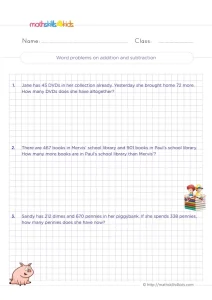 Worksheet3rd Grade Addition and Subtraction Problems: 3 Stories
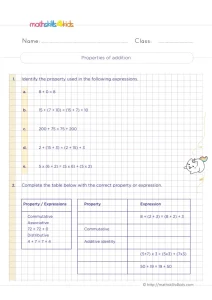 Worksheet3rd Grade Addition Properties Worksheet: Commutative, Associative, Identity
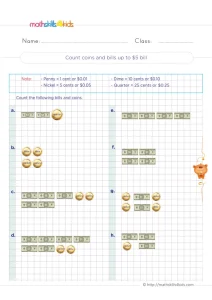 Worksheet3rd Grade Count Coins and Bills Worksheet: 8 Money Totals
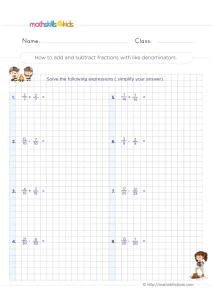 Worksheet3rd Grade Adding and Subtracting Like Fractions Worksheet: Eight Sums
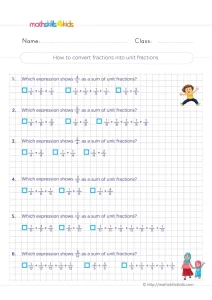 Worksheet3rd Grade Writing Fractions as Unit Fraction Sums Worksheet: Tick One
A few related activities
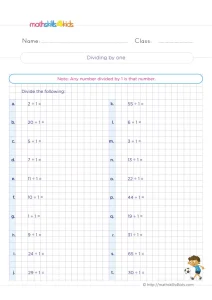 Twenty division facts by 1, from 1 ÷ 1 to 65 ÷ 1. One rule solves them all:…See the activity3rd Grade Metric Units of Length Worksheet
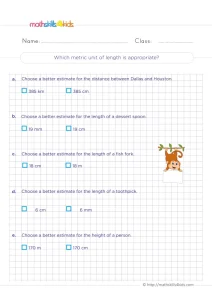 Five lengths and distances, from a toothpick to a road trip. Your child ticks the better metric estimate…See the activity3rd Grade How Much Money in All Worksheet: 3 Word Problems
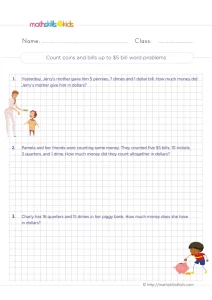 Three money word problems with pennies, nickels, dimes, quarters and $1 and $5 bills. Children find each total…See the activity
