1st Grade Adding Doubles with Pictures Worksheet: Two Equal Rows
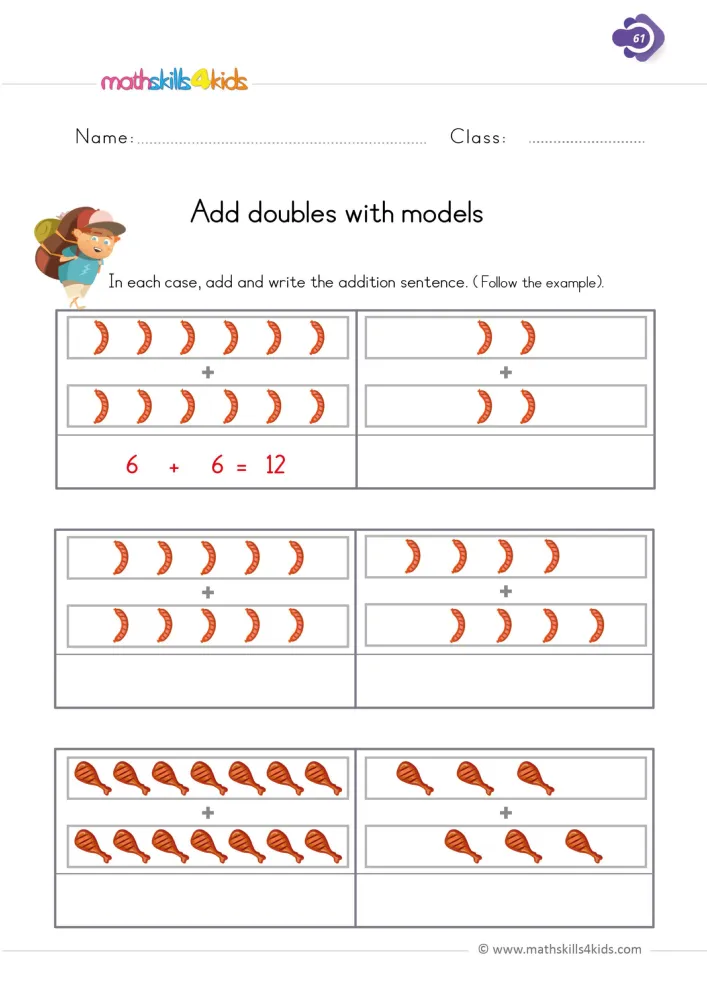
Put two equal rows of snacks in front of a six-year-old, and many will count every piece, from one to the very end. Fewer notice that both rows match. This 1st grade adding doubles with pictures worksheet is about noticing. Six boxes each hold two equal rows of pictures: sausages or chicken drumsticks. The first box shows the worked example, 6 + 6 = 12. For the other five, your child counts one row, sees that the second row is the same, then writes the full addition sentence on the empty line. The doubles run from 2 + 2 up to 7 + 7. A second page gives the answer key.
Why doubles are worth knowing by heart
Doubles facts are among the first sums children remember without counting. They are easy to picture, because both parts are the same. Later they become anchors for nearby sums: if 5 + 5 is 10, then 5 + 6 is one more.
This page makes the doubles visible. Each box shows one row above a plus sign and a matching row below it. So your child only needs to count once, then trust that the second row holds the same number. That trust is a real step in thinking.
Finally, the page asks for the whole addition sentence, not just the total. Writing both numbers, the plus sign, the equal sign and the answer links the picture to the symbols. One line, three ideas.
At the table: the row that slides to the right
Start with the worked example. Ask your child to touch each sausage in the top row, then point to the bottom row and ask whether it holds the same number.
The likely slip comes in the box with four sausages on top. The bottom row sits further to the right, so it can look longer, and a child may count it as more. Instead of correcting, ask, "Is that row longer, or just moved?"
Then let your child touch the pictures in pairs, one from the top and one from the bottom. Every picture finds a partner. The same check works for the box with three drumsticks.
Also, some children write only the total. Point to the example and ask what else it shows.
Egg boxes, shoes and a game of Memory
Doubles live in pairs around the house. An egg box shows 6 + 6 in two rows, so open one together and ask for the total. While you put away shoes, ask how many shoes three pairs make. Hold up three fingers on each hand, too.
Also, the card game Memory is built on pairs. Make a small set of cards with dots, two cards for each number. Every time your child finds a match, ask for the double before the next turn.
Once you finish the page, check it with the answer key together. Then name the effort, not the score: "You counted one row and trusted the other."
About this 1st grade adding doubles with pictures worksheet and key
Download the worksheet: 1st Grade Adding Doubles with Pictures Worksheet: Two Equal Rows
 Worksheet3rd Grade Addition and Subtraction Problems: 3 Stories
 Worksheet3rd Grade Addition Properties Worksheet: Commutative, Associative, Identity
 Worksheet3rd Grade Count Coins and Bills Worksheet: 8 Money Totals
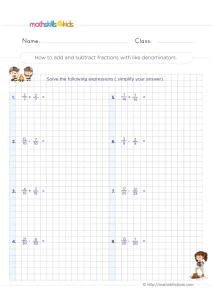 Worksheet3rd Grade Adding and Subtracting Like Fractions Worksheet: Eight Sums
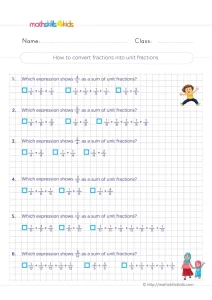 Worksheet3rd Grade Writing Fractions as Unit Fraction Sums Worksheet: Tick One
A few related activities
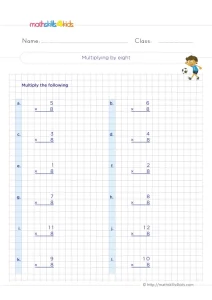 Twelve column facts times 8, from 1 × 8 to 12 × 8, in a mixed order. Double…See the activity3rd Grade Divide by 2 Worksheet: Long Division with Even Numbers
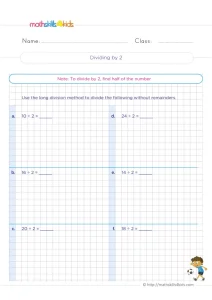 Six even numbers from 10 to 24 to divide by 2 with the long division method. Each answer…See the activity3rd Grade AM and PM Time Worksheet: 5 Daily Events
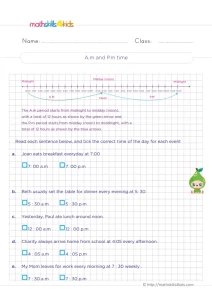 Five everyday events, from breakfast to dinner. Your child reads each time and ticks a.m. or p.m. using…See the activity
