1st Grade Make a Number Addition Worksheet: Mark the Sum That Fits
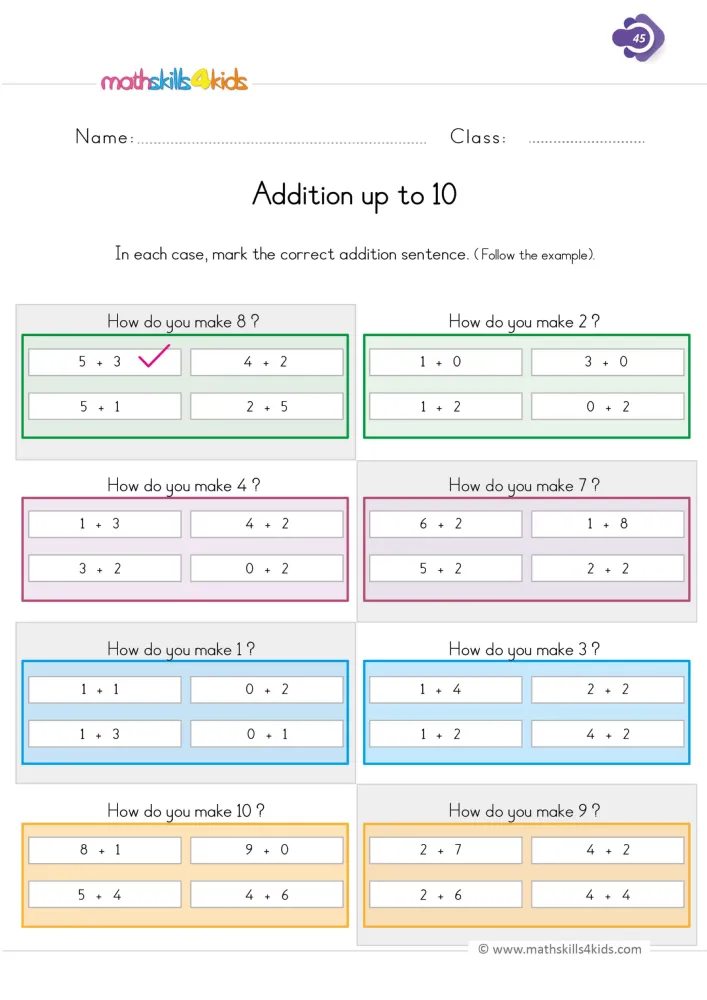
Ask a six-year-old how to make 8, and the first answer is often "seven and one," followed by a long pause. Seeing that a number can be built in several ways takes time. This 1st grade make a number addition worksheet works on exactly that idea. Eight colored boxes each ask a question, such as "How do you make 4?" Under each question, four sums wait, and only one of them gives the target. Your child works out each sum, then marks the one that fits. The targets run from 1 to 10, and the first box shows a worked example with its tick. A second page gives the answer key.
Why one number has many names
Every number can be split into two parts: 8 is 5 and 3, but also 4 and 4, or 6 and 2. Teachers call this part-part-whole thinking. It sits under almost every addition and subtraction strategy your child will learn, so knowing that 7 can be 5 + 2 makes 7 − 2 easier later.
This page builds that flexibility. Each box offers four addition sentence choices for the same target. To find the right one, your child has to work out every sum, rather than guess from the numbers they see.
Zero also shows up often, as in 9 + 0 or 1 + 0. It reminds your child that zero can be one of the two parts as well. A small idea with big reach.
At the table: the box that asks for 1
Start with the worked example. Ask your child to say why 5 + 3 has a tick, then move on to the box for 2.
The likely slip comes in the box for 1. Two choices show the numeral 1, and a child may tick 1 + 1 because it looks right. Instead of correcting, ask, "What does 1 + 1 make?"
Let your child say it, then compare it with the target. The box for 10 holds a second trap, because several choices land just below it. Ask one short question there and let fingers settle it: "Is that ten, or one less?"
Finally, once a box is done, cover the tick and ask your child to explain the choice aloud. Explaining is half the learning.
Buttons in two hands, dots on a page
Hide six buttons in your two hands, open one hand, and let your child guess what the other one holds. Then mix them again and split them a new way. At snack time, share eight grapes between two plates, and ask how many different ways you could do it.
Also, the picture book Ten Black Dots by Donald Crews builds pictures from one dot, then two, then three, up to ten. While you read, point to the dots in a picture and ask how they could be split into two groups.
Once you finish the page, check it with the answer key together. Then name the effort, not the score: "You checked every sum before you chose."
About this 1st grade make a number addition worksheet and its answer key
Download the worksheet: 1st Grade Make a Number Addition Worksheet: Mark the Sum That Fits
 Worksheet3rd Grade Addition and Subtraction Problems: 3 Stories
 Worksheet3rd Grade Addition Properties Worksheet: Commutative, Associative, Identity
 Worksheet3rd Grade Count Coins and Bills Worksheet: 8 Money Totals
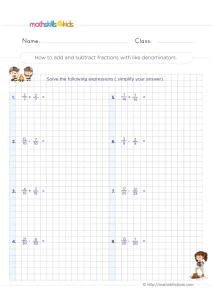 Worksheet3rd Grade Adding and Subtracting Like Fractions Worksheet: Eight Sums
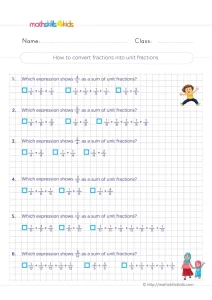 Worksheet3rd Grade Writing Fractions as Unit Fraction Sums Worksheet: Tick One
A few related activities
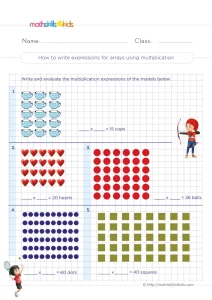 Five arrays of cups, hearts, balls, dots and squares. Your child writes the multiplication expression for each one…See the activity3rd Grade Reading a Data Table Worksheet: 2 Tables
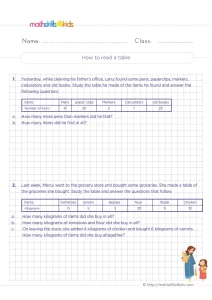 Two small tables, one of office items and one of groceries in kilograms. Your child finds the numbers,…See the activity3rd Grade 1 Times Table Worksheet: 18 Column Facts and the Identity Rule
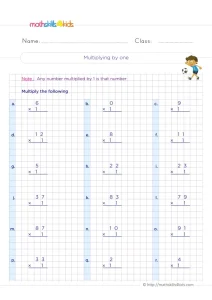 Eighteen column facts times 1, from 0 × 1 to 91 × 1. One rule solves them all:…See the activity
