1st Grade Matching Addition Facts to 20 Worksheet: Draw a Line to Each Total
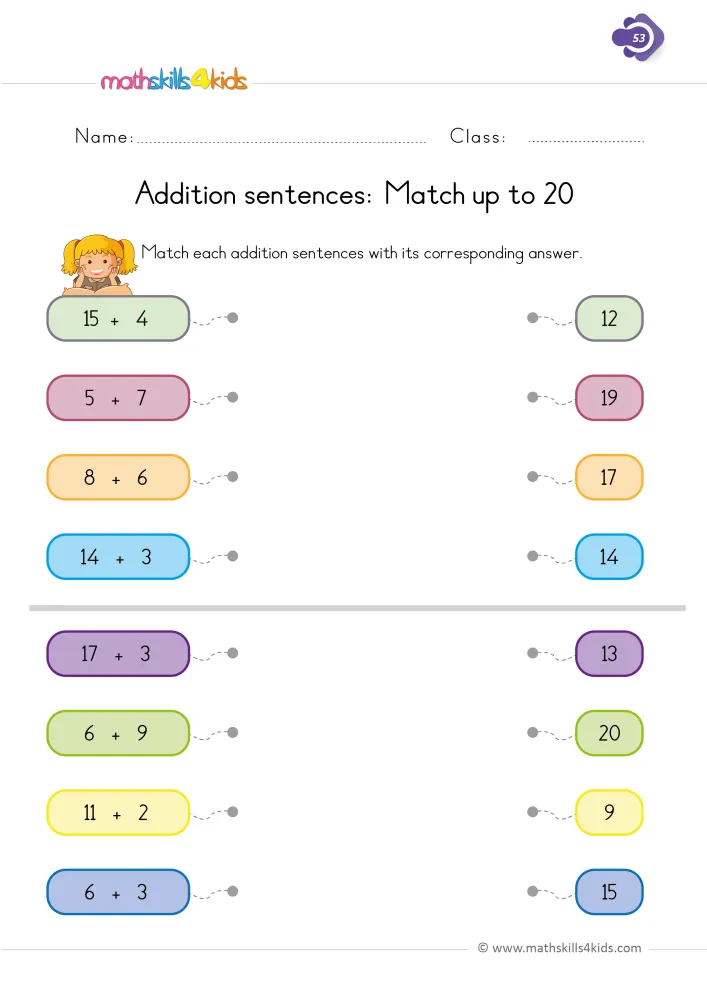
Give a six-year-old a page of colored cards and a pencil, and the first instinct is often to join the cards that look alike. This 1st grade matching addition facts to 20 worksheet asks for something else: join each sum to its true total. Eight sum cards sit on the left side, in two groups of four, and eight answer cards sit on the right. Some sums add a small number to a teen number, like 15 + 4 or 11 + 2. Others cross ten, like 8 + 6 or 6 + 9. Your child works out each fact, then draws a line to match each sum to its total, all within the sums to 20. A second page gives the answer key.
Why two kinds of sums share one page
The sums on this page are not all the same kind. Some, like 14 + 3, keep the ten and change only the ones. Others, like 5 + 7, start with two small numbers and cross ten to reach a teen. Mixing them asks your child to choose a strategy for each card, which is how addition facts start to feel flexible.
For crossing ten, a useful trick is to fill up to ten first. For example, 8 + 6 can become 8 + 2, then 4 more. Your child does not need the name of the trick yet. Seeing it helps.
Matching also has a quiet benefit. Once most lines are drawn, the last totals left over give a check on the work.
At the table: colors that do not match
Start with 14 + 3 in the first group. Ask your child to solve it out loud before drawing anything.
The likely slip comes from the colors. Each sum card shares its color with the answer card in the same row, so a child may join the green card to the green card and move on. Instead of correcting, point to one line and ask, "Does that sum really make that number?"
So the colors become a trap worth naming together. Once your child sees it, they will slow down.
In the second group, 6 + 9 needs more care. If the answer feels shaky, ask your child to start from the 9 and hold up six fingers. Then let them draw the line with a ruler, finger first.
Fish, socks and quick facts
Quick facts grow with short, frequent practice. While you fold laundry, hold up two piles of socks, say how many are in each, and ask for the total. At the shop, count the apples in two bags and add them before you reach the checkout.
Also, Fish Eyes by Lois Ehlert has a narrator fish who adds itself to every group it counts. While you read, ask your child to add one more each time, just as the fish does.
Once you finish the page, compare the lines with the answer key together. Then name the effort, not the score: "You checked each sum instead of trusting the colors."
About this 1st grade matching addition facts to 20 worksheet and its key
Download the worksheet: 1st Grade Matching Addition Facts to 20 Worksheet: Draw a Line to Each Total
 Worksheet3rd Grade Addition and Subtraction Problems: 3 Stories
 Worksheet3rd Grade Addition Properties Worksheet: Commutative, Associative, Identity
 Worksheet3rd Grade Count Coins and Bills Worksheet: 8 Money Totals
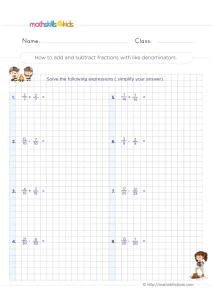 Worksheet3rd Grade Adding and Subtracting Like Fractions Worksheet: Eight Sums
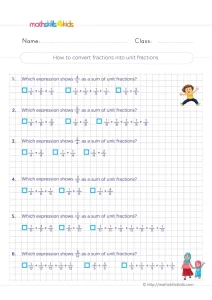 Worksheet3rd Grade Writing Fractions as Unit Fraction Sums Worksheet: Tick One
A few related activities
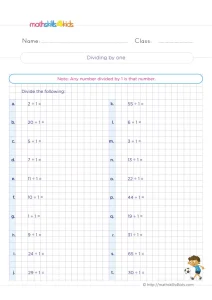 Twenty division facts by 1, from 1 ÷ 1 to 65 ÷ 1. One rule solves them all:…See the activity3rd Grade Metric Units of Length Worksheet
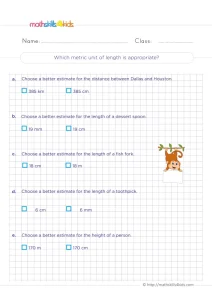 Five lengths and distances, from a toothpick to a road trip. Your child ticks the better metric estimate…See the activity3rd Grade How Much Money in All Worksheet: 3 Word Problems
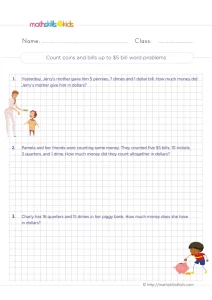 Three money word problems with pennies, nickels, dimes, quarters and $1 and $5 bills. Children find each total…See the activity
