1st Grade Roman Numerals to 20 Worksheet: I, V and X
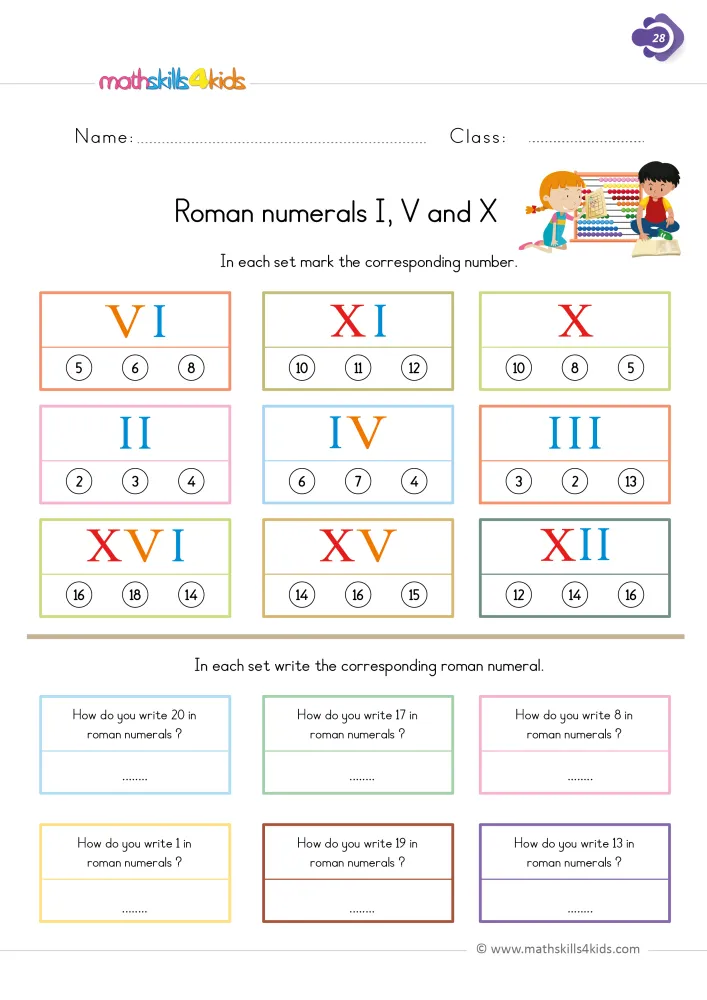
Point to an old clock face, and a six-year-old will often read IV as "one, five" or "six", because the letters seem to add up from left to right. Order matters here. This 1st grade Roman numerals to 20 worksheet uses only three symbols: I, V and X. In the top part, nine cards each show a numeral, such as VI, XI or XVI, and your child marks the matching number among three choices. In the bottom part, six boxes ask how to write numbers like 8, 13 or 19. Two items, the IV card and the number 19, use the subtraction rule, so they deserve a slow look. A second page gives the answer key.
Why three letters are enough
Our usual numbers rely on place value: the 1 in 15 means ten. Roman numerals work differently. Each letter has a fixed value, I for one, V for five and X for ten, and the values are added. So XVI is ten, five and one: sixteen.
There is one twist. When a smaller letter comes before a bigger one, it is taken away. IV means one before five, so four. That rule returns in 9, and again in 19 among the Roman numerals 11 to 20.
For children who learn Roman numerals for the first time, this page shows the logic in small steps. Reading comes first with the cards, then writing. Converting Roman numerals both ways is what makes the symbols stick, because your child has to build each number, not just recognize it.
At the table: IV, XV and 19
Start with an easy card, II or III. Ask your child to touch each I and count aloud. Next, try VI:"Five, and one more?"
The IV card is where most mistakes happen. Many children mark 6, because they add the letters. Instead of correcting, cover the I with a finger and ask, "What is V alone? Is the I before or after?"
In the writing part, 19 is the hardest. Some children write XVIIII, which is long but shows real thinking. Ask, "Can you write nine the way IV writes four?" Let them try on scrap paper first.
The card with X alone looks simple, yet it is worth a second look. Ask your child to say aloud what X means.
Clocks, chapters and a memory game
Roman numerals still appear around us. Look for them on clock faces, in the chapter numbers of a book, or after a name like a king's. Also, count the toys in a box and write the total in Roman numerals on a sticky note.
For a card game, make a set for Memory: write numbers from 1 to 20 on some cards and the matching Roman numerals on others. Turn two cards at a time and keep the pairs that match.
When your child finishes, go through the answers together and talk over any card where you see it differently. Then name the effort: "You checked whether the I came before or after." Real reading.
About this 1st grade Roman numerals to 20 worksheet and its answer key
Download the worksheet: 1st Grade Roman Numerals to 20 Worksheet: I, V and X
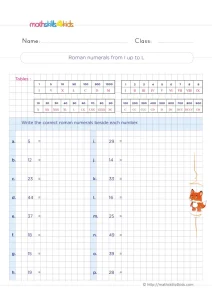
A few related activities
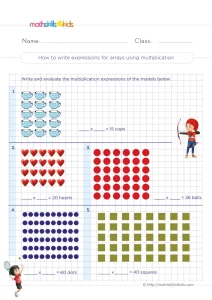 Five arrays of cups, hearts, balls, dots and squares. Your child writes the multiplication expression for each one…See the activity3rd Grade Reading a Data Table Worksheet: 2 Tables
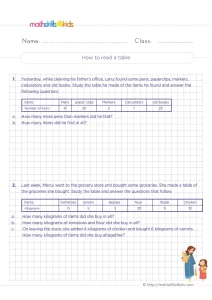 Two small tables, one of office items and one of groceries in kilograms. Your child finds the numbers,…See the activity3rd Grade 1 Times Table Worksheet: 18 Column Facts and the Identity Rule
 Eighteen column facts times 1, from 0 × 1 to 91 × 1. One rule solves them all:…See the activity
