1st Grade Writing Doubles Facts Worksheet: Split Each Number in Two
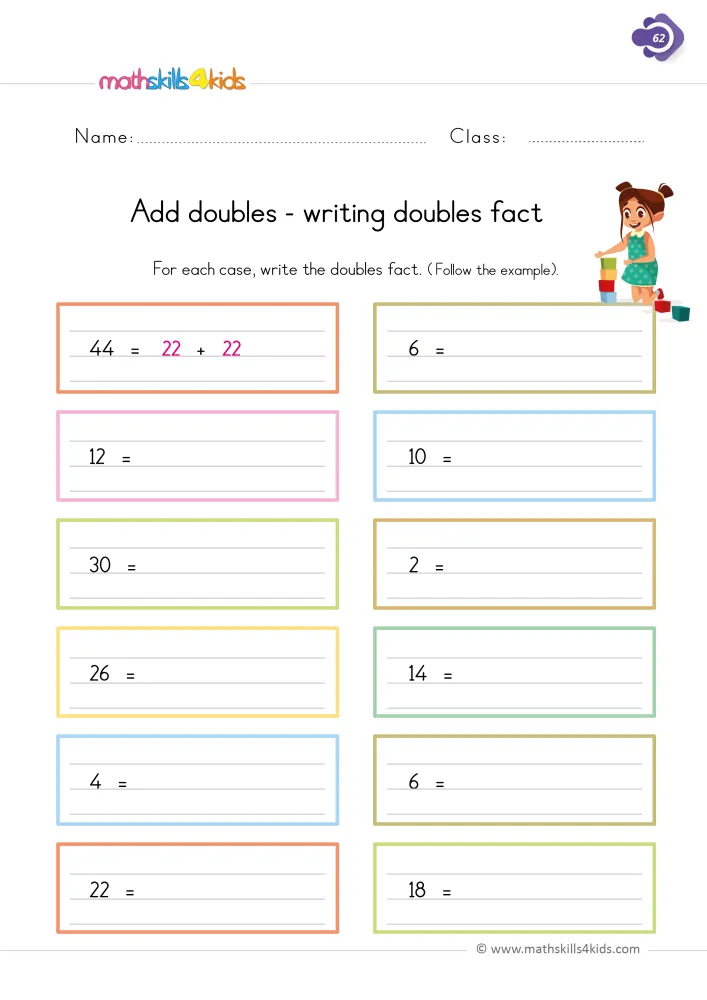
Ask a six-year-old what 4 + 4 makes, and the answer often comes fast. Ask which double makes 8, and the same child may need a long think. This 1st grade writing doubles facts worksheet works on that second, harder question. Twelve colored boxes each start with an even number and an equal sign, such as 12 = or 18 =. Your child finds the two equal parts and writes them after the sign. The first box shows a worked example, 44 = 22 + 22. Most numbers stay at 20 or under, while a few, like 26 and 30, stretch further and invite your child to split tens and ones. A second page gives the answer key.
Why going backward matters
Most practice runs one way: two numbers in, a total out. This page reverses it. Your child starts from the total and looks for its two equal parts, which is the first step toward halving. Knowing doubles facts in both directions makes them far more useful.
The layout also teaches something quiet. The equal sign sits after the single number, as in 10 =, so the sum comes on the right side. Many children believe the equal sign means "the answer comes next." Seeing it used this way shows that it really means "is the same as."
Finally, every number on the page is one of the even numbers. That is no accident. Only even numbers split into two equal parts with nothing left over.
At the table: doubling instead of splitting
Start with the worked example. Ask your child to read it aloud, then say what the two parts have in common.
The likely slip is doubling the number instead of splitting it. In the box for 12, a child in a doubles habit may write a number bigger than 12. Instead of correcting, ask, "Which two equal numbers make 12?"
Small objects help here. Count out twelve buttons, then share them into two piles, one for you and one for your child.
The larger numbers need a different move. For 26, ask your child to split the tens first, then the ones, and put the parts back together. Tap the 2, then the 6. Go slowly.
I spy a double
Doubles are easy to spot once you look for them. At lunch, cut a sandwich into two equal halves and ask how many pieces of cucumber should go on each half. When you pack toys away, share them fairly into two boxes and ask what number each box holds.
Also, the game I Spy works well with doubles. Take turns saying, "I spy something that comes in two equal groups," such as the wheels of a bike or the eyes on a face. While you play, ask for the total and its two parts.
Once you finish the page, name the effort rather than the score: "You split every number fairly."
About this 1st grade writing doubles facts worksheet and its answer key
Download the worksheet: 1st Grade Writing Doubles Facts Worksheet: Split Each Number in Two
 Worksheet3rd Grade Addition and Subtraction Problems: 3 Stories
 Worksheet3rd Grade Addition Properties Worksheet: Commutative, Associative, Identity
 Worksheet3rd Grade Count Coins and Bills Worksheet: 8 Money Totals
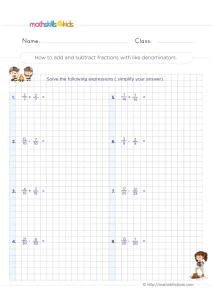 Worksheet3rd Grade Adding and Subtracting Like Fractions Worksheet: Eight Sums
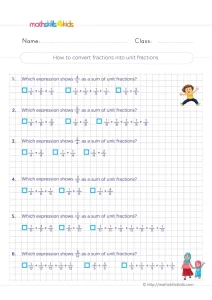 Worksheet3rd Grade Writing Fractions as Unit Fraction Sums Worksheet: Tick One
A few related activities
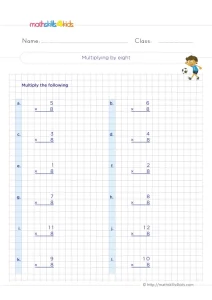 Twelve column facts times 8, from 1 × 8 to 12 × 8, in a mixed order. Double…See the activity3rd Grade Multiplication Properties Worksheet: Zero, Identity, Commutative
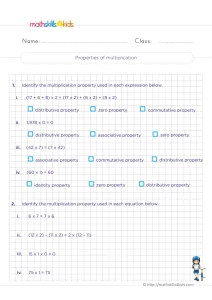 Tick the right property for four equations, from 1,978 x 0 = 0 to (60 x 1) =…See the activity3rd Grade Divide by 1 Worksheet: 20 Facts and the Rule of One
 Twenty division facts by 1, from 1 ÷ 1 to 65 ÷ 1. One rule solves them all:…See the activity
