2nd Grade Celsius and Fahrenheit Thermometer Worksheet: Read Where the Red Line Ends
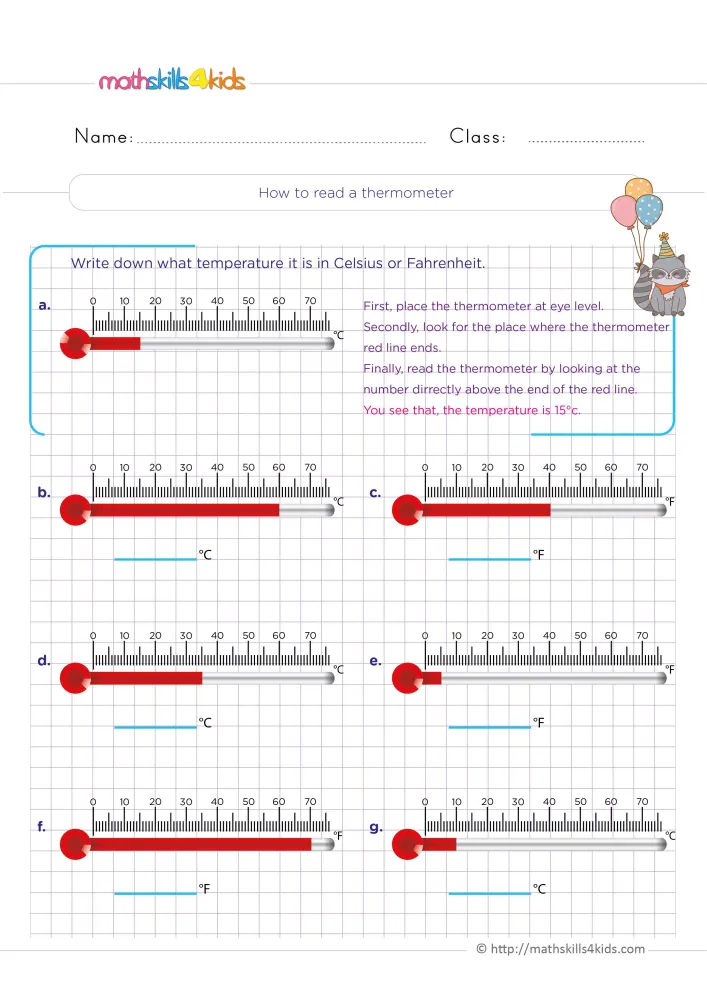
On a cold morning, a seven-year-old will happily read the car's outside temperature aloud, without knowing what the number means. This 2nd grade Celsius and Fahrenheit thermometer worksheet shows where that number comes from. Every thermometer lies on its side, with a bulb on the left and a scale from 0 to 70 along the top. A worked example explains three steps and shows 15°C. Then six thermometers follow, some in degrees Celsius and some in Fahrenheit. Your child finds where the red line stops and writes the temperature on the line below. A second page gives the answer key.
Why a thermometer is a number line
A thermometer is simply a number line with a red line that grows along it. Learning to read a thermometer is really learning to read a scale, the same skill your child uses on a ruler or a measuring cup.
On this page, the big numbers jump by 10, while the small marks between them count by ones. So a reading like 35 sits halfway between 30 and 40, on the tall middle mark.
The page also mixes two units. Some thermometers say °C, others °F, and the same number does not mean the same warmth. Your child only writes what the scale shows, but noticing the letter is a good habit. Small letter, big difference.
At the table: thermometers d and e
Start with the worked example. Ask, "Where does the red line stop? Which number is right above it?" Then read the three steps together, starting at eye level.
Thermometer d is where most children slip. The red line ends between two numbers, and a child may write 30 or 40. Instead of correcting, ask, "Is it closer to 30 or to 40? What is in the middle?"
Thermometer e has a very short red line, so it is easy to read as 0 or 10. Put a finger on the end of the red line and slide it straight up. Also, counting the small marks from 0 aloud helps your child land on the exact number.
Temperatures in daily life
Temperatures are everywhere. Check the weather together each morning and ask whether it feels warm or cold for that number. If you have an outdoor thermometer, let your child read it at the same time each day for a week.
Play a quick round of I Spy with numbers on scales: "I spy a number with a zero on the oven dial."
Also, a glass of cold water and a glass of warm water make a nice comparison with a kitchen thermometer, if you have one.
Once you finish the page, check it with the answer key together and praise the method: "You followed the red line all the way up. That is careful reading."
About this 2nd grade Celsius and Fahrenheit thermometer worksheet and key
Download the worksheet: 2nd Grade Celsius and Fahrenheit Thermometer Worksheet: Read Where the Red Line Ends
 Worksheet3rd Grade Cups, Pints and Gallons Worksheet
 Worksheet3rd Grade Customary Units of Weight Worksheet: Ounces, Pounds, Tons
 Worksheet2nd Grade Meters and Centimeters Word Problems Worksheet: Longer, Shorter, Taller
 Worksheet2nd Grade Customary Units Word Problems Worksheet: Feet, Inches, Yards, Miles
 Worksheet2nd Grade Choose a Measuring Tool Worksheet: Weight, Length or Time?
A few related activities
 Three rectangles and one square, each with its side lengths. Your child multiplies length by width to find…See the activity3rd Grade Naming Solid Figures Worksheet: Prisms, Pyramids and More
 Nine drawn solids to name, from a cube and a cone to a hexagonal prism and a triangular…See the activity3rd Grade Multiplication Worksheet: Find Products Using Properties
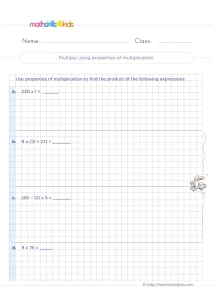 Work out four products, from 230 x 1 to 9 x 75, with the identity, distributive and commutative…See the activity
