2nd Grade Equal Sign Missing Numbers Worksheet: Make Both Sides Match
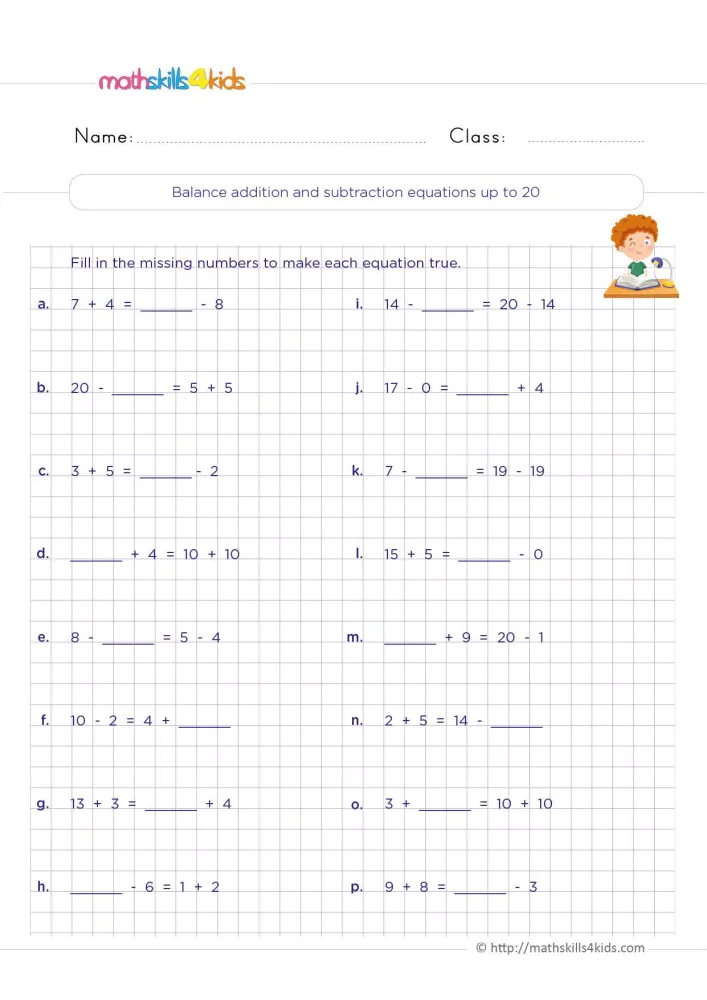
Show a seven-year-old 7 + 4 = ___ - 8 and many will write 11 in the blank without a pause. To them, the equal sign means the answer comes next. This 2nd grade equal sign missing numbers worksheet gently takes that idea apart. The page holds sixteen equations, a to p, in two columns. Each one has a single blank, and it can sit anywhere: at the start, in the middle, or at the end. Some sides add, some subtract, and all the numbers stay at 20 or below. Your child has to look at both sides before writing anything. A second page gives the answer key.
Why the equal sign is a balance, not an arrow
In early grades, children see the equal sign mostly at the end of a sum, so they read it as "write the answer here." That habit works until an equation has numbers on both sides.
The real meaning is simpler and stronger: the equal sign says the same as. Whatever sits on the left must have the same value as what sits on the right. Think of a seesaw that stays level.
This page forces that view. In equation d, the blank comes first, before + 4, while the right side reads 10 + 10. In k, the right side is 19 - 19, which is zero. So your child must work out one side completely, then build the other side to match.
That shift prepares the ground for algebra years later. It starts here.
At the table: equation a sets the trap
Begin with equation a, 7 + 4 = ___ - 8. If your child writes 11, do not cross it out. Instead, ask, "Is 11 take away 8 the same as 11?" Let them work out that the two sides do not match, then search for the missing number that fixes it.
A quick drawing helps. So draw a level seesaw, put 7 + 4 on one side and the blank on the other.
Then watch equation l, 15 + 5 = ___ - 0, because some children freeze at the zero. Point to it and ask what taking away nothing does.
Also, encourage a check out loud once each blank is filled. For example, your child reads both sides and says whether they match. Hearing the two values side by side catches most slips.
Two plates and a picture book
Balance is easy to feel with real objects. Put two plates on the table, place 6 grapes on one and 4 on the other, then ask what must happen so both plates hold the same amount. Let your child move or add grapes until the plates match.
Also, a kitchen scale or a park seesaw works well. While you play, use the words "the same as" instead of "equals."
For reading time, Equal Shmequal by Virginia Kroll follows a group of animals trying to make two teams fair for a tug-of-war. It turns the idea of both sides into a story.
Finally, go through the answer key together. Praise the checking: "You read both sides every time." That habit matters more than speed.
About this 2nd grade equal sign missing numbers worksheet and its key
Download the worksheet: 2nd Grade Equal Sign Missing Numbers Worksheet: Make Both Sides Match
 Worksheet3rd Grade Addition and Subtraction Problems: 3 Stories
 Worksheet3rd Grade Divide by 1 Worksheet: 20 Facts and the Rule of One
 Worksheet3rd Grade 1 Times Table Worksheet: 18 Column Facts and the Identity Rule
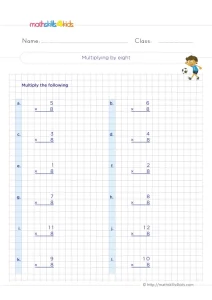 Worksheet3rd Grade 8 Times Table Worksheet: 12 Column Facts and a Doubling Trick
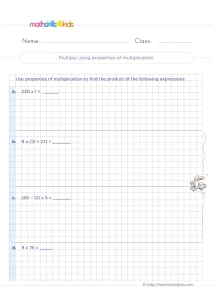 Worksheet3rd Grade Multiplication Worksheet: Find Products Using Properties
A few related activities
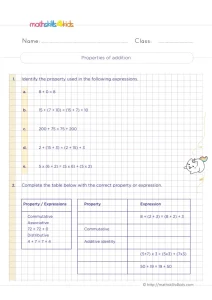 Five number sentences to name, from 8 + 0 = 8 to 5 x (6 + 2). Then…See the activity3rd Grade Multiplication Properties Worksheet: Zero, Identity, Commutative
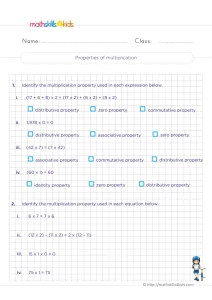 Tick the right property for four equations, from 1,978 x 0 = 0 to (60 x 1) =…See the activity3rd Grade Count Coins and Bills Worksheet: 8 Money Totals
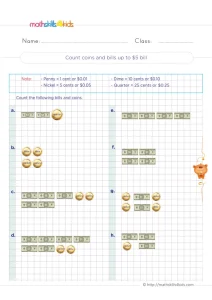 Eight sets of $1 and $5 bills with pennies, nickels, dimes and quarters. Children find each total in…See the activity
