2nd Grade Estimate the Difference Worksheet: 16 Subtractions to Round
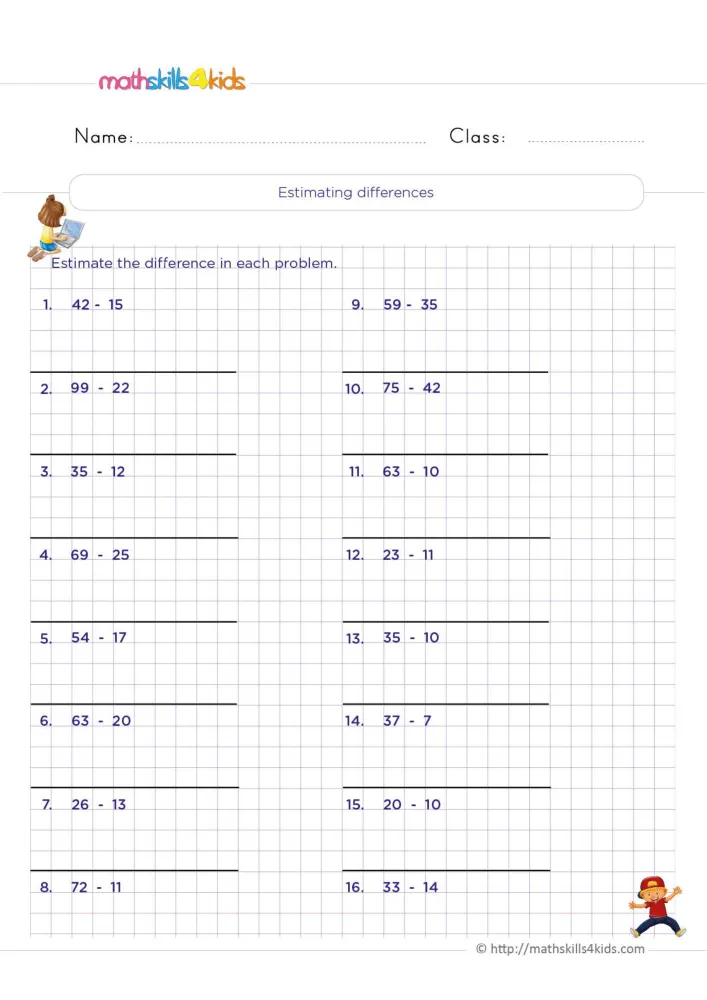
Ask a seven-year-old roughly how far apart 99 and 22 are, and the pencil usually comes out for an exact subtraction. Yet 100 take away 20 is something they can do in their head. This 2nd grade estimate the difference worksheet builds that habit. The page lists sixteen subtraction problems in two columns, from 42 - 15 to 33 - 14, with space under each one to work. Your child rounds both numbers to the nearest ten, subtracts the tens, and writes about how much. A few problems, like 37 - 7, include a one-digit number, which makes the rounding step easy to forget. A second page gives the answer key.
Why rounded differences are quick checks
Subtracting tens is easy: 70 - 30 takes a moment. So when both numbers round to the nearest ten, a tricky subtraction turns into a quick one. The result is an estimated difference, close to the real answer but much faster to find.
This matters later, when your child subtracts with regrouping. Knowing that 42 - 15 is about 20 makes an answer like 37 look suspicious right away.
The rule is the same as for sums. Look at the ones digit: 5 or more rounds up, 4 or less rounds down. The page offers good practice of the 5 case, with 15, 25, 35 and 75 all appearing.
It also has a few problems, like 63 - 20 and 20 - 10, where a number is already a ten. That is a small gift. Spot it.
At the table: 37 - 7 and the fives
Start with 63 - 10 or 35 - 10. Only one number needs rounding there, so your child can warm up.
Then look at 37 - 7. Many children round 37 to 40 and leave the 7 alone. Point to the 7 and ask, "Which ten is 7 closest to?"
The fives bring the next slip. In 42 - 15, some children round 15 down to 10. Ask, "What does the rule say about a 5 in the ones place?"
Also, watch for exact answers. A careful child may work out 42 - 15 in full and write 27. That is right arithmetic but not an estimate, so tap the word estimate in the instructions.
Finally, encourage mental math out loud. For example, your child says, "Forty minus twenty," before writing.
Ages, pages and a board game race
Differences come up in daily talk. Ask how much older a grandparent is than a parent, rounding both ages to the nearest ten first. Afterward, check the exact answer together.
Reading time works too. If a chapter book has 72 pages and your child is on page 41, ask roughly how many pages remain until the end.
Board games bring a natural race. During Chutes and Ladders, stop now and then to estimate how far apart two players are on the board, rounding both squares first. Then count the real gap with a finger.
Finally, check the page with the answer key and praise the method: "You rounded both numbers every time." That steady habit is what makes estimates reliable.
About this 2nd grade estimate the difference worksheet and its answer key
Download the worksheet: 2nd Grade Estimate the Difference Worksheet: 16 Subtractions to Round
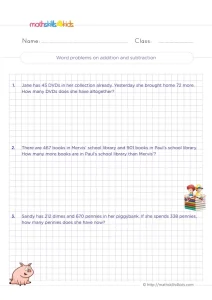 Worksheet3rd Grade Addition and Subtraction Problems: 3 Stories
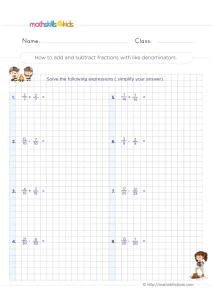 Worksheet3rd Grade Adding and Subtracting Like Fractions Worksheet: Eight Sums
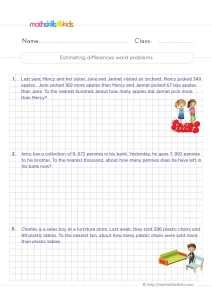 Worksheet3rd Grade Rounding to Estimate Differences Worksheet: 3 Stories
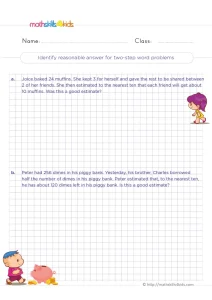 Worksheet3rd Grade Checking Reasonable Estimates Worksheet: Two-Step Problems
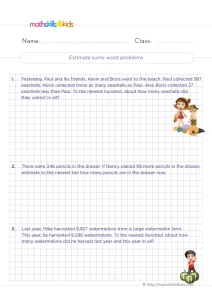 Worksheet3rd Grade Estimating Sums in Stories Worksheet: Round, Then Add
A few related activities
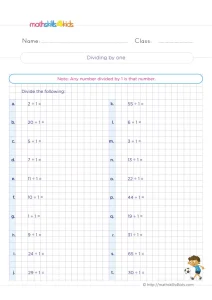 Twenty division facts by 1, from 1 ÷ 1 to 65 ÷ 1. One rule solves them all:…See the activity3rd Grade Divide by 3 Worksheet: Long Division Without Remainders
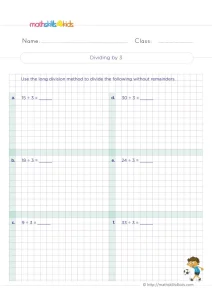 Six numbers from 9 to 33 to divide by 3 with the long division method. Each one is…See the activity3rd Grade Like Denominator Fraction Story Problems Worksheet
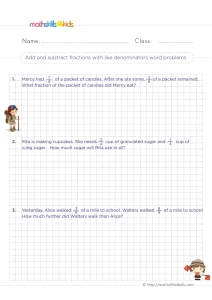 Three short stories about candies, cupcakes and a walk to school. Your child adds or subtracts fractions with…See the activity
