2nd Grade Faces of Solid Shapes Worksheet: Which Flat Faces Does It Have?
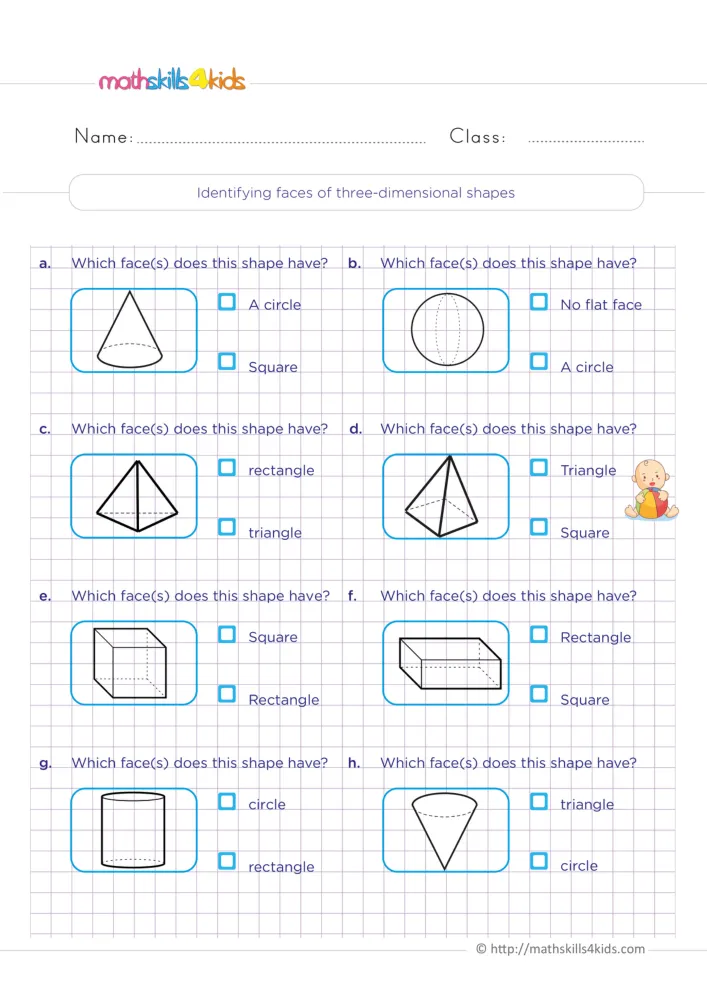
Press the bottom of a paper cup into play dough and a seven-year-old will be surprised to find a circle. The solid hides a flat shape. This 2nd grade faces of solid shapes worksheet builds on that idea. Eight solids sit in blue frames, labeled a to h: cones, two pyramids, a cube, a long box, a cylinder and more. Beside each one, the same question returns, "Which face(s) does this shape have?", with two answers to tick, such as a circle, a square, a triangle or a rectangle. However, sometimes both answers fit. A second page gives the answer key.
Why every solid hides flat shapes
A face is a flat surface of a solid. Once a child sees that a cube is built from squares and a pyramid from triangles, solids stop being mysterious lumps. They become flat shapes put together.
This page trains that link. For example, the square pyramid in figure d has a square at the bottom and triangles on the sides, so both answers fit. Also, every face of the long box in figure f is a rectangle. However, the cone only has one flat face, a circle at its base, because its side is curved. The sphere in figure b goes further: it has no flat face at all, so the answer to tick there is "No flat face".
So your child has to tell flat from curved before ticking. That small distinction is the heart of describing faces of solids. Curved parts do not count.
At the table: the upside-down cone
Start with figure a, the cone. Ask, "Where is the flat part?" Let your child touch the circle at the bottom of the drawing.
Figure h is the same kind of solid turned upside down, with its point at the bottom. Many children tick triangle, since the drawing looks like a triangle from the side. Instead of correcting, hand them a real cone, such as an ice cream cone or a paper party hat, and ask, "Can you find a flat triangle anywhere?" Rolling it on the table settles the question.
The cylinder in figure g brings a similar pause. Then ask how many flat circles it has, top and bottom. Finally, compare figures a and h together.
Stamping faces at home
Faces are easy to see when you stamp them. Dip the bottom of a can, a small box and a toy block in paint, then press them on paper. Then each print shows one face. Also, trace around a tissue box on every side and count the face shapes you find.
The photo book "Cubes, Cones, Cylinders, & Spheres" by Tana Hoban shows solids in city streets and homes, without words. While you turn the pages, ask your child to point to a flat face in each photo. A cone and cylinder often appear side by side.
When you check the page, praise the testing: "You rolled the cone to check its faces." Hands-on checking builds real understanding.
About this 2nd grade faces of solid shapes worksheet and its answer key
Download the worksheet: 2nd Grade Faces of Solid Shapes Worksheet: Which Flat Faces Does It Have?
 Worksheet3rd Grade Flat and Curved Faces Worksheet: Circles, Squares, Triangles
 Worksheet3rd Grade Count Edges of 3D Shapes Worksheet: Faces and Vertices Too
 Worksheet3rd Grade Naming Solid Figures Worksheet: Prisms, Pyramids and More
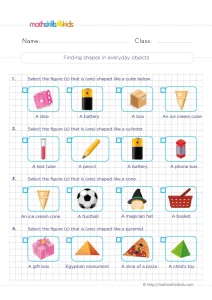 Worksheet3rd Grade Finding Shapes in Everyday Objects Worksheet: 16 Pictures
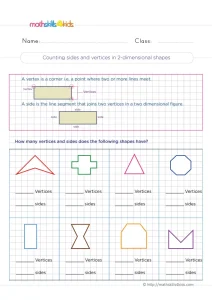 Worksheet3rd Grade Counting Sides and Vertices Worksheet: 8 Flat Shapes
A few related activities
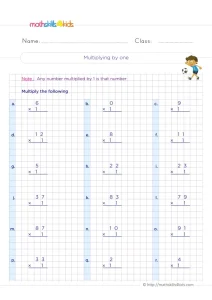 Eighteen column facts times 1, from 0 × 1 to 91 × 1. One rule solves them all:…See the activity3rd Grade Reading a Data Table Worksheet: 2 Tables
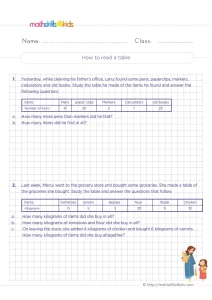 Two small tables, one of office items and one of groceries in kilograms. Your child finds the numbers,…See the activity3rd Grade Expressions for Arrays Worksheet: Write Each Product
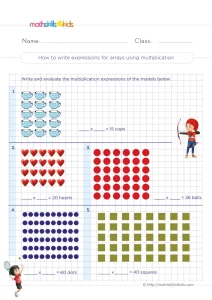 Five arrays of cups, hearts, balls, dots and squares. Your child writes the multiplication expression for each one…See the activity
